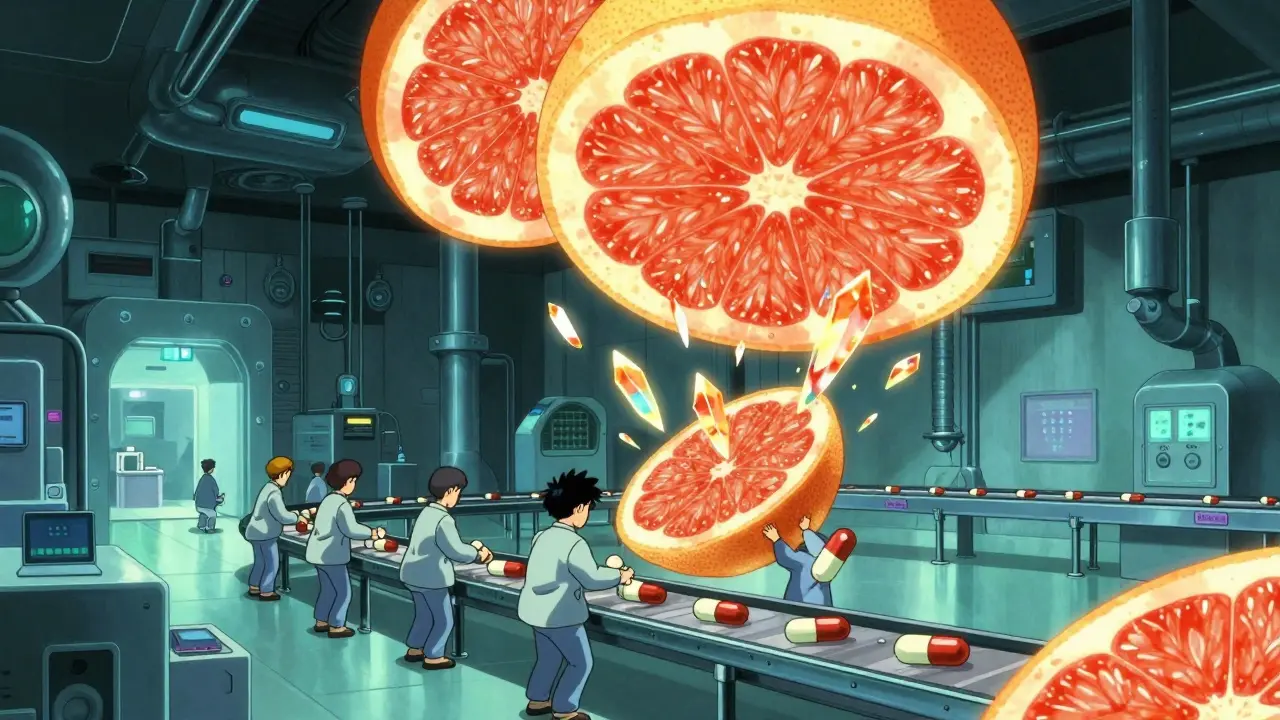
You've probably seen a warning label on a prescription bottle telling you to avoid grapefruit juice. It sounds like a strange rule-why would a piece of fruit interfere with a high-tech medicine? The answer lies in your liver and intestines, specifically with a group of enzymes called CYP450 is a superfamily of enzymes, primarily the Cytochrome P450 system, responsible for metabolizing about 75% of all clinically used drugs in the human body. When these enzymes are blocked, your medication doesn't break down as it should, leading to dangerously high levels of the drug in your bloodstream.
The Science of the "Grapefruit Effect"
Grapefruit contains natural compounds called furanocoumarins, such as bergamottin. These aren't just simple nutrients; they act as "suicide inhibitors." This means they don't just temporarily block an enzyme; they bind to it and permanently disable it. Specifically, they target CYP3A4, the most common enzyme used to process medications in your gut.
Here is the tricky part: once those enzymes are destroyed, your body has to synthesize entirely new proteins to replace them. This process takes time. Research shows that just 8 ounces of grapefruit juice can drop your intestinal CYP3A4 levels by nearly 47%, and this effect can last anywhere from 24 to 72 hours. This is why simply taking your pill in the morning and drinking your juice in the evening doesn't work-the enzymes are already gone.
Warfarin: A High-Stakes Balancing Act
When it comes to Warfarin, a common blood thinner, the stakes are incredibly high. This drug has a "narrow therapeutic index," meaning the difference between a dose that prevents a stroke and a dose that causes internal bleeding is very small. Warfarin is primarily broken down by an enzyme called CYP2C9, but CYP3A4 also plays a supporting role.
While grapefruit isn't as potent an inhibitor of CYP2C9 as it is of CYP3A4, it still interferes with it. For most people, a glass of juice might not cause a crisis, but for those with specific genetic variants-specifically the CYP2C9*2 or *3 polymorphisms-the risk is much higher. In these sensitive patients, grapefruit can lead to a 15-25% increase in INR (International Normalized Ratio) values. If your INR gets too high, your blood becomes too thin, increasing the risk of spontaneous bruising or dangerous bleeding.
| Enzyme | Primary Role | Grapefruit Impact | Risk Level |
|---|---|---|---|
| CYP3A4 | Main drug metabolism (gut/liver) | Irreversible Inhibition | Very High |
| CYP2C9 | Warfarin metabolism | Moderate Inhibition | Moderate to High |
| CYP2D6 | Many SSRI/Antidepressant metabolism | Weak Inhibition | Low |

SSRIs and the Grapefruit Mystery
Selective Serotonin Reuptake Inhibitors, or SSRIs, are widely used for anxiety and depression. Because they are processed by various CYP enzymes, the risk depends entirely on which specific medication you are taking. For example, fluoxetine and paroxetine rely heavily on CYP2D6, while sertraline and citalopram use a mix of CYP3A4 and others.
Do you need to panic if you eat a grapefruit while on Zoloft? Probably not. While theoretical risks exist, clinical evidence shows that most SSRIs don't react strongly with grapefruit. The biggest exception is sertraline; some case studies have shown plasma concentrations increasing by up to 39% with chronic grapefruit consumption. This can lead to increased side effects like nausea or drowsiness. However, for a drug like escitalopram, recent studies have found no clinically significant interaction at all.
How to Manage Your Risks
If you are taking medications that interact with the CYP450 system, you don't necessarily have to live in fear, but you should be strategic. The first step is knowing your specific drug. If you are on a high-risk medication like warfarin, complete avoidance of grapefruit and its derivatives (like Oroblanco or Sweetie varieties, which actually have higher concentrations of furanocoumarins) is the safest bet.
For those on SSRIs, the risk is generally lower, but if you notice a sudden increase in side effects after changing your diet, it's worth mentioning to your doctor. If you're curious about your specific risk with warfarin, you can actually get genetic testing for CYP2C9 variants. These tests usually cost between $250 and $400 and can tell you if your body is genetically predisposed to be more sensitive to these interactions.
Common Pitfalls and Misconceptions
One of the biggest mistakes people make is assuming that only grapefruit juice is the problem. The whole fruit is just as potent. Another common myth is that these interactions happen instantly. Because furanocoumarins destroy the enzymes, the effect is cumulative. You might feel fine after one glass, but after a week of morning smoothies, your medication levels could spike to toxic levels.
It is also important to realize that not all citrus fruits are created equal. While grapefruit, pomelos, and Seville oranges are high in the problematic compounds, regular sweet oranges (like Navel or Valencia) and lemons generally do not inhibit CYP3A4. You can usually switch your morning juice to orange or apple without any risk to your medication's efficacy.
Can I just take my medication at a different time than when I eat grapefruit?
No. This is a common misconception. Grapefruit doesn't just block the enzyme while it's in your stomach; it permanently disables the CYP3A4 enzymes in your intestinal wall. Since your body needs days to create new enzymes, spacing out the dose and the fruit will not prevent the interaction.
Which SSRIs are most affected by grapefruit?
Sertraline is the most likely to show a measurable interaction because it is partially metabolized by CYP3A4. However, for many other SSRIs like escitalopram, the interaction is clinically insignificant. Always check with your pharmacist for your specific brand.
Why is the risk higher for Warfarin than for most antidepressants?
Warfarin has a narrow therapeutic index, meaning a small change in blood concentration can lead to a massive change in clinical outcome (like internal bleeding). Most SSRIs have a wider safety margin, so even if the concentration increases slightly, it usually only results in mild side effects rather than a medical emergency.
Are all grapefruit varieties the same?
No. Some varieties, such as 'Oroblanco' and 'Sweetie,' have been found to have up to 300% higher furanocoumarin content than traditional grapefruits, which can significantly increase the risk of drug interactions.
What should I do if I accidentally ate grapefruit while taking Warfarin?
Don't panic, but do be vigilant. Contact your healthcare provider and potentially request an INR test to see if your blood clotting time has shifted. Watch for signs of excessive bruising or unusual bleeding from the gums or nose.
Next Steps for Medication Safety
If you are currently taking a combination of these medications, your first step should be to review the patient information leaflet for every drug in your cabinet. Look specifically for mentions of CYP3A4 or "grapefruit juice." If you find a warning, it's time to swap your citrus habits for something safer.
For those managing long-term anticoagulation therapy, consider discussing pharmacogenomic testing with your doctor. Knowing if you carry the CYP2C9*2 or *3 variant can take the guesswork out of your diet and help your doctor fine-tune your dosage with much higher precision.

Goodwin Colangelo
Really important breakdown here. Most people just see the warning on the bottle and ignore it, but that "suicide inhibitor" part is the real kicker. It's not about the timing of the dose; it's about the fact that your liver is basically missing a key tool for a few days. I always tell people to just stick to oranges to be safe.
Will Baker
Oh wow, so we're just supposed to trust that a piece of fruit "permanently" kills an enzyme but the body just magically makes more in 72 hours? Seems a bit convenient if you ask me.
Aysha Hind
Classic pharma propaganda. First they tell you the fruit is poison, then they tell you to pay 400 bucks for a genetic test to see if you're "special." It's all just a racket to keep us terrified of nature while we swallow their synthetic sludge. Absolute clown show.
Lawrence Rimmer
The irony of humans trying to optimize their biology with a spreadsheet. We spend our lives fighting the very chemistry that defines us.
Joseph Rutakangwa
helpful info just stick to apples
sophia alex
Imagine actually thinking this is a mystery 🙄. Anyone with a basic education in American medicine knows this. It's honestly embarrassing that people need a whole article to explain why they shouldn't eat a grapefruit while on blood thinners. Get it together! 💅
Dee McDonald
WE NEED TO SPREAD THIS EVERYWHERE! People are literally risking their lives because they don't know about CYP3A4! Stop being lazy and read your leaflets! If you're on Zoloft, just be mindful of the side effects and push through it, but for the love of everything, stop the grapefruit if you're on Warfarin! Let's get everyone educated right now!
Dipankar Das
It is absolutely imperative that individuals adhere to these pharmacological guidelines with the utmost discipline. Failure to do so is not merely an oversight but a reckless disregard for one's own biological stability. You must prioritize your health over a mere breakfast preference!
Hudson Nascimento Santos
It makes one wonder about the balance of nature. The same compound that adds a unique zest to a fruit can essentially shut down a primary metabolic pathway in a human. There is a poetic, if dangerous, symmetry in how a simple chemical structure can override a complex pharmaceutical intervention.
Hope Azzaratta-Rubyhawk
This is an incredibly vital piece of information and I appreciate the clarity. While the risks are serious, we can all overcome this by simply being proactive and staying informed. Let's all commit to reading our medication guides and making the healthy choice to swap our juices!