Pharmacy Label Readability Checker
Check Your Label Readability
Ensure your prescription label meets safety standards for clear, readable information
Sample Label Preview
Take one tablet by mouth daily Do not drive or operate machinery This medicine may cause drowsiness OPIOID RISK: May cause addiction or overdose
- Use 6pt+ font for basic info (8px+)
- Use 8pt+ font for warnings (10px+)
- Have high contrast (black text on white background)
Readability Tips
Ask for larger print labels Check for high contrast Review warning stickers carefully Compare similar medications
According to the article, 68% of adults over 65 struggle to read prescription labels. This tool helps you verify your label meets safety standards before taking your medication.
Every time you pick up a prescription, there’s a small piece of paper stuck to the bottle that could save your life. It’s not just a reminder to take your pills-it’s a safety net written in fine print, bold colors, and symbols you might not understand. Pharmacy labels and warning stickers are designed to protect you, but too often, they confuse you instead.
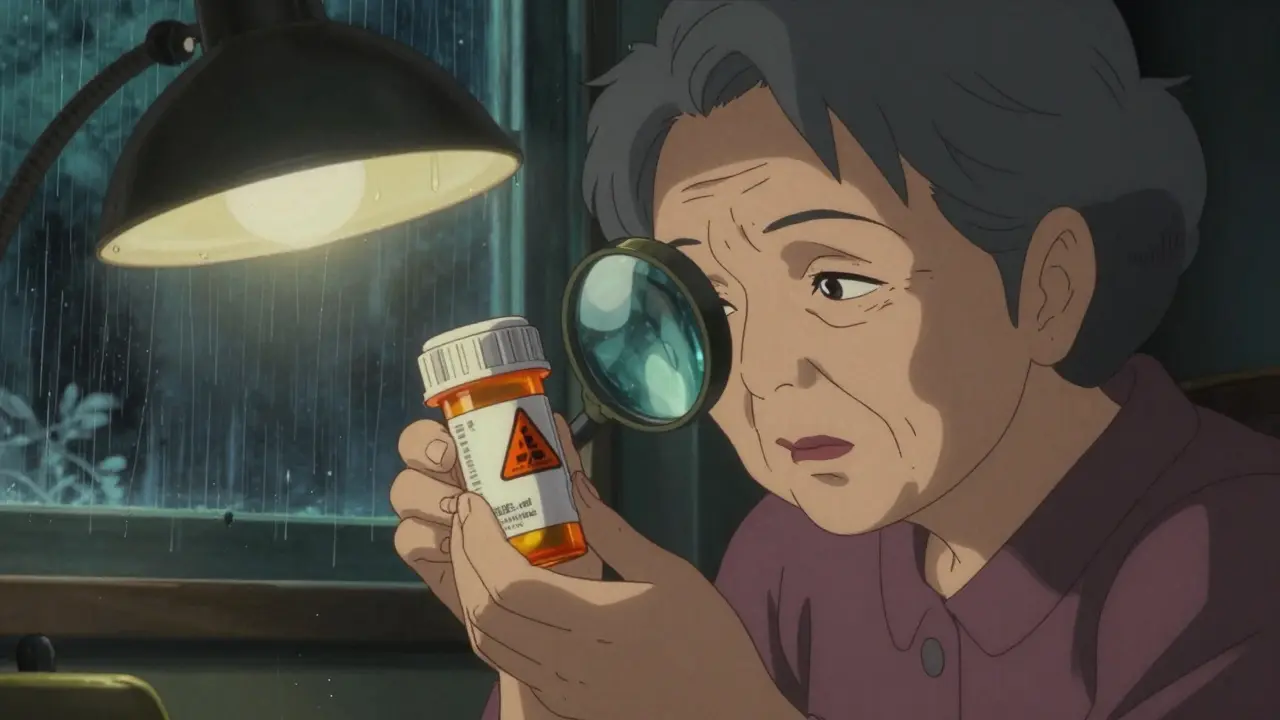
Imagine this: You’re 72, taking five different medications. Your eyesight isn’t what it used to be. The label says “take one by mouth daily,” but the font is so small you need a magnifying glass. Another bottle has a bright orange sticker that says “OPIOID RISK,” but you don’t know what that means for you. This isn’t rare. In 2023, 68% of adults over 65 said they struggled to read their prescription labels. And it’s not just about age. People with limited English, low health literacy, or just busy lives are at risk of making dangerous mistakes.
What’s Actually Required on a Prescription Label?
The federal government doesn’t demand much. By law, your label must include your name, the drug name, the dose, and how often to take it. That’s it. Everything else? Optional. That’s why two people filling the same prescription at different pharmacies might get labels that look completely different-one clear, one cluttered, one with warnings, one without.
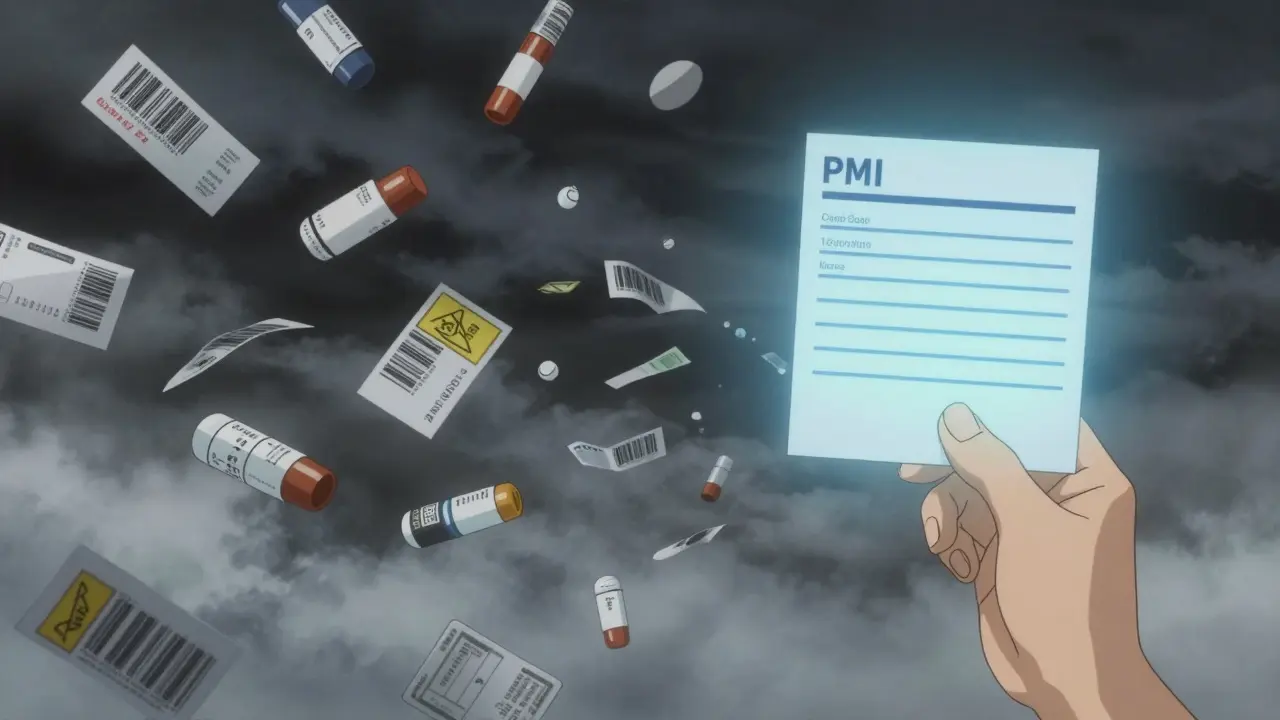
The FDA has been pushing for change since 2011. Their goal? A single, standardized format called the Patient Medication Information (PMI) rule. By January 1, 2025, every pharmacy in the U.S. will have to use this new format. It’s not just a redesign-it’s a revolution. The PMI will put the most important info first: what the medicine is for, how to take it, what to watch out for, and when to call your doctor. No more burying warnings at the bottom.
Warning Stickers: Why Some Are Bright Orange
If you’ve noticed a new fluorescent orange sticker on your opioid or controlled substance bottle, you’re not imagining it. Starting January 1, 2024, Connecticut became the first state to require a specific orange warning label-exactly 1.25 inches in diameter-on all prescriptions for opioids and other controlled drugs. It’s not just a suggestion. It’s the law.
Other states are following. As of 2024, 27 states now require some kind of opioid warning label. These stickers aren’t decorative. They’re meant to grab attention. Red text on white? Easy to miss. Fluorescent orange? Hard to ignore. And the message? Clear: “This medicine can cause addiction or overdose.”
But here’s the catch: There’s no national standard for what these stickers say or how big they are. In some states, it’s just a small red dot. In others, it’s a full paragraph. That’s why the FDA’s PMI rule is so important-it will finally bring consistency.
Fonts, Colors, and Barcodes: The Hidden Rules
There’s a science behind how these labels are designed. The USP (United States Pharmacopeial Convention) set voluntary guidelines in 2012 to fix the chaos. They recommend:
- Sans-serif fonts like Arial or Helvetica (easier to read)
- Minimum 6-point font for basic info, 8-point or larger for warnings
- High contrast-black text on white background, not gray on light yellow
- Clear spacing between lines so nothing runs together
And then there’s the barcode. Every prescription label now must have a GS1 DataMatrix or Code 128 barcode. It’s not just for scanning at the pharmacy counter. It holds your drug’s National Drug Code (NDC), expiration date, and lot number. Pharmacists scan it to make sure you’re getting the right pill, the right dose, and that it hasn’t expired. If the barcode doesn’t scan, the system flags it-before you even walk out the door.
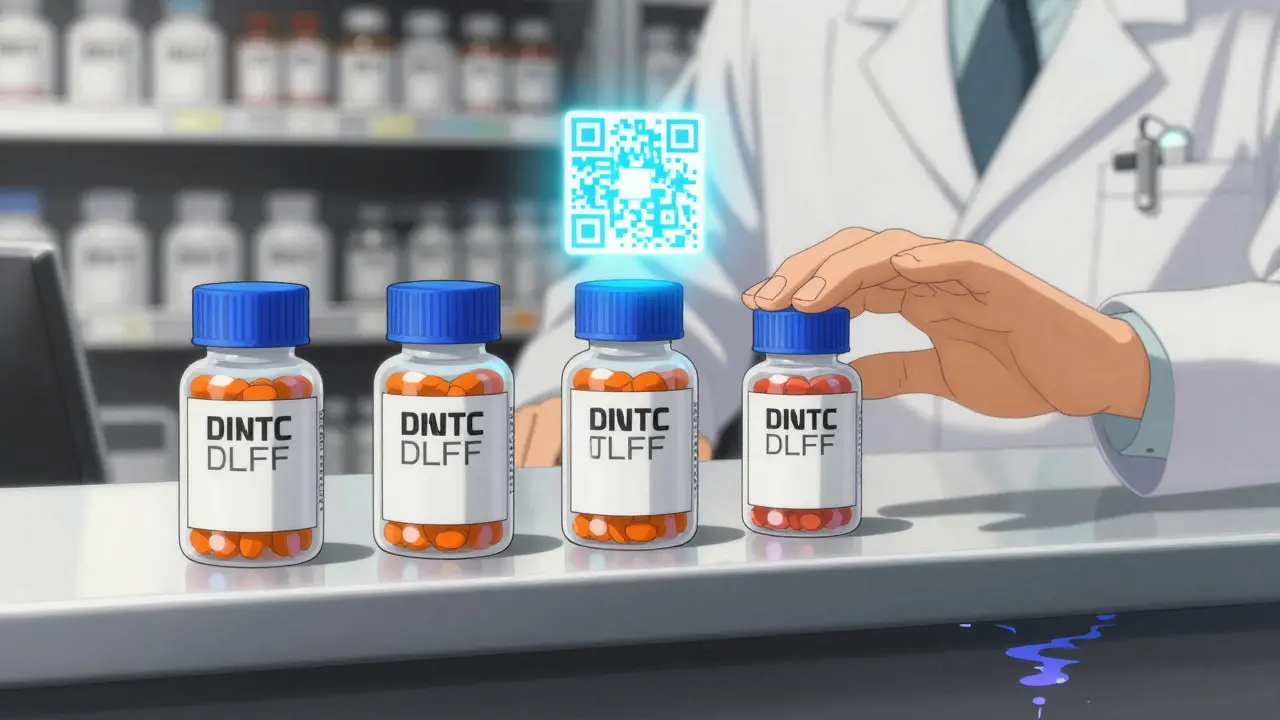
Some pharmacies are even adding QR codes. Scan it with your phone, and you’ll get a short video explaining how to take the medicine, what side effects to expect, and who to call if something goes wrong. It’s still rare-only about 18% of labels have them-but it’s growing fast.
Why So Many People Still Get It Wrong
Even with all these rules, mistakes happen. A 2022 report from the Institute for Safe Medication Practices found that 12% of medication errors in community pharmacies came from confusing labels. Similar drug names. Tiny fonts. Poor contrast. Labels that look too much alike.
One pharmacist on Reddit shared a story: three patients in one week mixed up their blood pressure pills with their diabetes meds because the labels looked nearly identical. Both had blue caps. Both had small print. Both said “take once daily.” The only difference? A tiny word in the middle of a long sentence.
People who speak languages other than English face even bigger hurdles. In California, 47% of patients with limited English proficiency said they didn’t understand their labels. That’s why some pharmacies now offer translated instructions. Some even print two labels-one in English, one in Spanish, Vietnamese, or Mandarin.
What You Can Do Right Now
You don’t have to wait for the 2025 changes to protect yourself. Here’s what to do today:
- Ask for a larger print label. Pharmacies are required to provide one if you ask. No extra charge.
- Read the warning sticker. If it says “OPIOID,” “CAUTION,” or “RISK OF OVERDOSE,” don’t ignore it. Ask your pharmacist what it means for you.
- Compare labels. If you take multiple pills, lay them out side by side. Do they look too similar? Ask if there’s a different brand or form that’s easier to tell apart.
- Use a pill organizer. Even if the label says “take once daily,” if you’re taking five different meds, a weekly organizer with morning/afternoon/evening slots can prevent mix-ups.
- Keep a list. Write down every medicine you take-name, dose, reason, and when to take it. Bring it to every doctor visit.
What’s Coming in 2025 (And Why It Matters)
The FDA’s PMI rule will change everything. By next year, every prescription label will follow the same layout:
- Top: What the medicine is for (e.g., “For high blood pressure”)
- Next: How to take it (“Take one tablet by mouth every morning with food”)
- Then: Key warnings (“May cause dizziness. Do not drive.”)
- Bottom: When to call your doctor and what side effects to watch for
No more buried warnings. No more confusing jargon. No more guessing. It’s designed for people-not pharmacists or lawyers.
It’s not perfect. Small pharmacies worry about the cost-up to $15,000 to upgrade software and train staff. But the payoff? The National Academy of Medicine says standardized labels could reduce medication errors by up to 30%. That’s tens of thousands of preventable hospital visits every year.
When to Call Your Pharmacist
You don’t need to be an expert to understand your meds. But you do need to ask questions. Call your pharmacist if:
- The label looks different from last time
- You don’t recognize the color or shape of the pill
- You’re unsure what the warning sticker means
- You’re taking something new and feel weird after the first dose
- You’re confused about when or how to take it
Pharmacists are trained to explain this stuff. They’re not busy just filling bottles-they’re your last line of defense against a dangerous mistake.
Final Thought: Your Label Is Your Safety Tool
Pharmacy labels aren’t just paperwork. They’re your personal safety manual. And if you can’t read them, they’re useless. The system is finally starting to catch up to the people it’s supposed to protect. But until then, you have to be your own advocate. Ask. Double-check. Speak up. Because when it comes to your meds, nothing should be left to chance.

waneta rozwan
Okay but let’s be real-why do pharmacies still use font sizes meant for ants? I had to hold my pill bottle up to the ceiling light just to read if it was my blood pressure med or my thyroid pill. And don’t get me started on the ‘OPIOID RISK’ sticker-it’s like they slapped a neon sign on my dignity. I’m not a junkie, I’m a 74-year-old woman with arthritis. I just want to walk without crying.
Also, why is the barcode the only thing that works consistently? The rest is chaos. My pharmacist said ‘just ask for large print’ like that’s some magical secret. It’s 2025. This shouldn’t be a negotiation.
And why do they print ‘take with food’ in the same font as ‘may cause hallucinations’? That’s not a warning-that’s a dare.
Someone needs to sue these companies. Or at least burn the whole system down and start over with emojis. 🚨💊👁️
kanchan tiwari
THEY’RE HIDING SOMETHING. WHY DO THEY USE ORANGE STICKERS ONLY FOR OPIOIDS? WHAT ABOUT THE ANTIDEPRESSANTS THAT MAKE YOU WANT TO JUMP OFF A BRIDGE? WHAT ABOUT THE BLOOD PRESSURE PILLS THAT MAKE YOU DIZZY FOR HOURS? WHY ISN’T THERE A GLOWING RED STICKER ON THOSE?
I’ve seen this before-first they scare you with orange, then they give you ten more pills that do the same thing. It’s a trap. Big Pharma wants you addicted to the system, not the drugs. They’ll slap a sticker on one bottle and pretend they’re helping while the real killers fly under the radar.
And QR codes? Please. That’s just so they can track your phone. You think they care if you read the label? They care if you scan it. They’re watching. Always watching.
And don’t even get me started on the ‘translated labels’-half the time the Spanish version says something completely different. I’ve seen it. I’ve seen the ghost words.
They’re not protecting you. They’re conditioning you.
Bobbi-Marie Nova
Okay but I just asked for a large print label and the pharmacist handed me a giant sticky note with a Sharpie scrawl that said ‘take one at night.’ I swear to god, I think they just drew it themselves. I’m not mad, I’m impressed. We’re basically living in a Mad Max pharmacy wasteland and somehow we’re still alive.
Also, the QR code on my statin? It led to a video of a guy in a lab coat saying ‘don’t eat grapefruit’ in 17 languages. I laughed so hard I spilled my coffee. That’s the kind of innovation we need. More videos. Less tiny fonts. More sarcasm. Less bureaucracy.
Also, I asked for a pill organizer and they gave me a plastic egg carton. I’m not mad. I’m just… proud?
God bless the pharmacists who are trying. And God help the rest of us.
Joie Cregin
I used to think labels were just paperwork until my mom mixed up her insulin and her blood pressure med because the caps were the same shade of blue. She ended up in the ER. That’s when I started asking for big print, asking about the stickers, even asking for the QR code videos. Turns out, pharmacists love it when you ask. They’re not robots-they’re humans who’ve seen too many mistakes.
One of them even printed me a laminated card with all my meds in plain language, with little drawings of pills and times of day. I keep it in my wallet. I call it my ‘Survival Cheat Sheet.’
It’s not perfect, but asking is the only superpower we’ve got. And honestly? It feels good to be the one holding the pen, not the one being scribbled on.
Also, if you’re reading this and you’re scared to ask? Just say ‘I’m confused.’ That’s all it takes. They’ll drop everything. I promise.
Corey Sawchuk
Been working in a pharmacy for 12 years. The new PMI format is long overdue. We’ve been begging for it. The old system was a mess. Pharmacies are small businesses. Upgrading software costs more than our monthly rent. But the tradeoff? Fewer calls from panicked patients. Fewer errors. Less liability.
And yeah, the orange sticker? It’s not about scaring people. It’s about stopping someone from mixing opioids with alcohol or sleeping pills. That’s how people die. Not because they’re careless. Because they didn’t know.
Most of us just want to get it right. The system’s broken. But we’re trying.
And yes, I’ve given out Sharpie labels too. I’m sorry.
brooke wright
My aunt took her blood thinner and the label said ‘take with food’ but didn’t say what food so she ate a whole bag of chips and ended up in the hospital with internal bleeding. I’m not exaggerating. The label didn’t say ‘avoid fatty foods’ or ‘take with a light meal’-it just said ‘take with food’ like that’s enough. How is that a warning? That’s a suggestion for a lazy person who doesn’t care if you live or die.
And why do they put the expiration date in the same font as the name of the drug? I’ve seen people take pills that expired in 2019 because they couldn’t find the date. It’s not a puzzle. It’s a death sentence waiting to happen.
And don’t even get me started on the ‘take once daily’ when it’s actually supposed to be taken every 8 hours. That’s not a mistake. That’s negligence.
Someone needs to be fired. Or sued. Or both.
vivek kumar
The FDA’s PMI rule is a step forward but it is not sufficient. The problem lies not only in formatting but in the lack of mandatory inclusion of pharmacokinetic warnings, drug interaction alerts, and patient-specific contraindications. Why is it optional to list interactions with common foods like grapefruit or dairy? Why is the language still clinical and not plain? Why is there no requirement for audio instructions for visually impaired patients? These are not minor details-they are life-or-death gaps.
Furthermore, the absence of a standardized color-coding system for drug classes (e.g., cardiovascular = red, CNS = blue) means that even with large fonts, patients still cannot visually categorize their medications. This is not innovation. This is minimal compliance dressed as reform.
Until these structural flaws are addressed, the PMI is a Band-Aid on a hemorrhage.
Nick Cole
I’ve worked in ER for 15 years. I’ve seen the aftermath of bad labels. People showing up with their meds in a Ziploc bag because they couldn’t tell which was which. One guy took his wife’s thyroid med instead of his own and went into cardiac arrest. He survived. She didn’t.
It’s not about font size. It’s about design thinking. Why are we still using paper? Why not a digital label linked to your phone? Why not a voice assistant that reads your meds aloud? Why are we still pretending this is 1998?
Pharmacists are heroes. But they’re drowning in bad systems. The PMI rule? It’s a start. But we need tech, not just typography.
And yes-I’ve held a 90-year-old woman’s hand while she cried because she thought her blue pill was poison. She didn’t know it was her heart med. That’s not her fault. That’s our failure.
Riya Katyal
Oh wow. So now we’re going to have a ‘standardized’ label that still says ‘take one by mouth daily’ like that’s helpful? Who even uses the word ‘daily’? I say ‘once a day’ or I say ‘every 24 hours’ or I say ‘don’t forget your little blue pill at 8am’-but no, we’re stuck with corporate jargon.
And the QR code? Yeah, sure. Scan it. And then what? A 30-second video from a guy who sounds like he’s reading a script written by a lawyer who hates people?
Meanwhile, my 80-year-old neighbor still uses a pill organizer she made out of toilet paper rolls. And she’s the one who remembers to take her meds. Not the label. Not the sticker. Not the QR code. Her. The human.
Maybe we should stop designing for the label and start designing for the person.
Henry Ip
Biggest win? Asking for large print. No shame. No extra cost. Just say it. ‘Can I get this in big letters?’ They’ll do it. I’ve done it for my dad. He’s 82, blind in one eye, and still drives himself to the pharmacy. He doesn’t want to be a burden. But he doesn’t want to die from a typo either.
Also, if you take five meds? Get a pill organizer. Not the fancy one. The cheap one from Walmart. The kind with the little compartments. It’s not glamorous. But it’s the difference between ‘I took my pill’ and ‘I took three pills.’
And if you’re scared to ask your pharmacist? Just say ‘I’m not sure I understand.’ They’ve heard it a thousand times. They won’t judge you. They’ll thank you.
That’s the real revolution. Not the sticker. Not the font. Just asking.
Nicholas Gabriel
Let me just say-this is not just about labels. This is about dignity. This is about respect. This is about treating older people, non-native speakers, people with disabilities, and people who are just tired as if they are human beings-not data points in a pharmacy’s inventory system.
And yes, the orange sticker? It’s a start. But why is it only for opioids? Why not for benzodiazepines? Why not for antipsychotics? Why not for the cocktail of five pills that makes you feel like you’re walking through molasses?
And why is the only ‘help’ offered a QR code that requires a smartphone, Wi-Fi, and the ability to read a screen without squinting?
Real change isn’t a new font. It’s a new mindset. It’s asking: ‘How do we make this work for the person holding the bottle-not the person who printed it?’
Until then, I’ll keep handing out my own laminated cheat sheets. And yes, I will keep asking for the big print. And yes, I will keep yelling at the pharmacy counter. Because someone has to.
Cheryl Griffith
My grandma used to say, ‘If you don’t understand it, don’t take it.’ She didn’t know about PMI or barcodes or orange stickers. She just knew that if something felt off, she should ask. And she did. Every time.
She lived to 96. I think that’s the real lesson here.
Don’t be afraid to ask. Don’t be afraid to say ‘I don’t get it.’ Don’t be afraid to call the pharmacy back. They’re not busy. They’re just overwhelmed.
And if you’re lucky? You’ll find a pharmacist who writes you a note in the margin of the label. I have one. It says ‘Take with water. Not coffee.’
That note saved her life.
waneta rozwan
Wait-did anyone else get the QR code for their blood thinner that just played a 10-second loop of someone saying ‘DO NOT STOP TAKING THIS MEDICINE’ in a robotic voice? I thought it was a glitch. Then I realized it was the whole video. No visuals. No examples. No explanation. Just that one sentence. Over and over.
I laughed. Then I cried.
That’s our future.