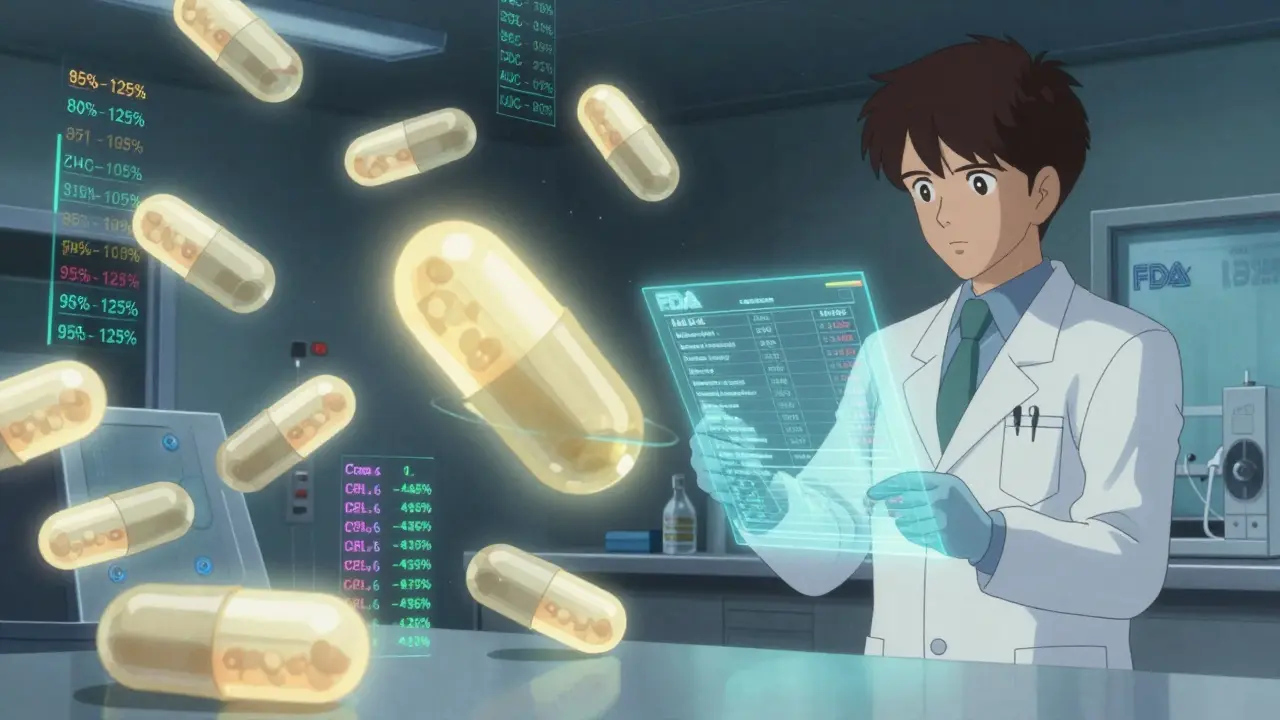
When you pick up a prescription for a generic drug, you might assume it’s just a cheaper version of the brand-name medicine. But here’s the truth: generic drugs aren’t just similar-they must be identical in how they work, how safe they are, and how strong they are. The U.S. Food and Drug Administration (FDA) doesn’t approve generics because they’re affordable. They approve them because they meet the exact same standards as the original drug. And those standards are strict-some of the most rigorous in modern medicine.
What Makes a Generic Drug Approved?
The entire system for approving generic drugs was built on one idea: if a drug works the same way as the brand-name version, it should be allowed on the market. This isn’t a shortcut. It’s a science-backed process designed to cut costs without cutting corners. The legal foundation is the Hatch-Waxman Act of 1984, which created the Abbreviated New Drug Application (ANDA) pathway. Instead of repeating full clinical trials, generic manufacturers prove their product performs the same as the brand-name drug-called the Reference Listed Drug (RLD).
There are four non-negotiable requirements:
- Same active ingredient
- Same dosage form (tablet, capsule, injection, etc.)
- Same strength
- Same route of administration (oral, topical, intravenous, etc.)
That’s the baseline. But what happens inside your body? That’s where bioequivalence comes in.
Bioequivalence: The Science Behind the Match
A generic drug doesn’t just need to look like the brand-name drug. It needs to behave like it. That’s tested through bioequivalence studies. These aren’t guesswork-they’re highly controlled experiments.
In a typical study, 24 to 36 healthy volunteers take both the brand-name drug and the generic version, in random order, with a washout period in between. Blood samples are taken at regular intervals to measure how much of the drug enters the bloodstream and how fast.
The key metrics are:
- Cmax: The highest concentration of the drug in the blood
- AUC0-t: The total drug exposure over time until the last measurable level
- AUC0-∞: The total drug exposure extrapolated to infinity
For the generic to be approved, all three must fall within 80% to 125% of the brand-name drug’s values. This range isn’t arbitrary. It’s based on decades of clinical data showing that variations within this range don’t affect safety or effectiveness for most drugs.
But what about drugs with a narrow therapeutic index? These are medications where even a small change in blood level can cause serious side effects-like warfarin, lithium, or levothyroxine. For these, the FDA tightens the rules. Instead of 80%-125%, the acceptable range is narrowed to 90%-111%. For levothyroxine, it’s even tighter: 95%-105%. That’s not a suggestion. It’s a requirement.
Quality Isn’t Optional-It’s Built Into Every Step
Quality doesn’t start in the lab. It starts in the factory. The FDA requires every generic manufacturer to follow Current Good Manufacturing Practices (cGMP), outlined in 21 CFR Parts 210 and 211. This isn’t a checklist you fill out once. It’s a continuous system of controls over every batch.
Here’s what that means in practice:
- Raw materials must be tested for identity and purity before use
- Equipment must be calibrated and cleaned according to validated procedures
- Each production batch must be tested for strength, uniformity, and stability
- Manufacturing records must be kept for at least one year after the drug’s expiration date
The FDA conducts about 1,200 pre-approval inspections every year. And if they find even one major deficiency-say, inconsistent tablet hardness or unvalidated cleaning procedures-the application gets a Complete Response Letter. No approval. No exceptions.
Take the case of Hetero Labs’ generic version of Jardiance. In 2021, the FDA rejected it because tablet hardness varied across batches. That’s not a small detail. It affects how fast the drug dissolves. And if it dissolves too slowly or too fast, the patient gets too little or too much of the drug. That’s why the FDA doesn’t just inspect the final product-they inspect the entire process.
Complex Drugs Are a Different Ballgame
Not all drugs are created equal. A simple tablet? Easy. An inhaler? A topical cream? An extended-release capsule? These are complex drug products-and they’re where most generic applications fail.
Why? Because you can’t just measure blood levels. You have to prove the drug behaves the same way in the body. For inhalers, that means matching particle size, spray pattern, and lung deposition. For topical creams, it’s about skin absorption rates. For extended-release tablets, it’s about how the drug releases over 12 or 24 hours.
Take the EpiPen. Between 2015 and 2020, only 3 out of 27 generic applications were approved. Why? The auto-injector device itself is part of the drug. It has to deliver the exact same dose, at the same speed, with the same reliability. A generic that looks similar isn’t enough. It has to function identically.
Complex generics take longer, too. While a standard oral tablet might be approved in 28.5 months, a complex product like a nasal spray or injectable can take 47.2 months. And the cost? Up to $25 million, compared to $1.3 million for a simple generic.
Why Do So Many Applications Get Rejected?
You’d think the abbreviated pathway would mean faster approvals. But here’s the twist: less than 10% of generic applications are approved on the first try. Compare that to 90% of new brand-name drugs, which get approved on the first review.
Why the difference? Because the bar for generics is higher in practice. The FDA doesn’t just check paperwork. They dig into the science. Common reasons for rejection:
- Insufficient bioequivalence data
- Manufacturing inconsistencies
- Missing stability data
- Unclear labeling
- Failure to address patent or exclusivity issues
Manufacturers often underestimate the depth of documentation required. A typical ANDA submission is 5,000 to 10,000 pages long. It includes chemistry data, manufacturing protocols, clinical studies, labeling, and quality control procedures. One missing page can delay approval by months.
Real-World Outcomes: Are Generics Safe?
Some patients worry: “Is this really the same?” The answer isn’t opinion-it’s data.
Post-marketing surveillance from the American Medical Association shows that for 98.7% of therapeutic categories, there are no clinically meaningful differences between generics and brand-name drugs. That’s not a guess. It’s based on 15 years of real-world data.
And the numbers speak for themselves. In 2022, generics made up 90.3% of all prescriptions filled in the U.S. But they accounted for only 22.8% of total drug spending. That’s $373 billion saved in one year. If generics weren’t safe and effective, that kind of savings wouldn’t be possible.
Even complex drugs like the first generic of Humira (adalimumab), approved in December 2023, were held to the same standards. The FDA reviewed over 100,000 pages of data before approval. It wasn’t rushed. It was thorough.
What’s Changing in 2026?
The FDA isn’t resting. In 2023, they released a new draft guidance for complex generics, and under GDUFA III (the latest user fee program), they’ve set a goal: by 2027, 50% of complex generic applications should be approved within two review cycles. Right now, it’s only 28%.
They’re also expanding support. In 2023, the FDA held over 1,200 pre-ANDA meetings with manufacturers-up from 800 in 2019. These aren’t formal reviews. They’re guidance sessions where companies can ask questions before submitting. Over 85% of manufacturers report high satisfaction with these meetings.
And the pipeline is growing. The FDA’s 2023 report identified 127 complex brand-name drugs with no generic competition-representing $52 billion in annual sales. That’s not just opportunity. It’s a public health priority.
Final Word: No Compromises
Generic drugs aren’t cheaper because they’re lower quality. They’re cheaper because they don’t need to repeat the billion-dollar clinical trials that brand-name drugs do. But they still must prove they are the same-down to the last molecule.
The FDA’s system works because it doesn’t rely on trust. It relies on data. On inspections. On measurable science. And on the understanding that when a patient takes a generic drug, they’re not taking a substitute. They’re taking the same medicine.
If you’ve ever been told, “It’s just a generic,” remember: it’s not just a copy. It’s a certified match.
Are generic drugs as safe as brand-name drugs?
Yes. The FDA requires generic drugs to meet the same safety and effectiveness standards as brand-name drugs. Every approved generic must contain the same active ingredient, strength, dosage form, and route of administration. Bioequivalence testing ensures they work the same way in the body. Post-marketing data shows no clinically meaningful differences in safety for 98.7% of therapeutic categories.
Why do some generic drugs seem to work differently?
If a patient feels a difference, it’s rarely because the drug is ineffective. More often, it’s due to inactive ingredients (like fillers or dyes), which can affect how fast the drug dissolves or how it’s absorbed. For most people, this has no clinical impact. But for drugs with a narrow therapeutic index-like warfarin or levothyroxine-the FDA requires tighter bioequivalence limits. If you notice a change, talk to your doctor or pharmacist. Switching between generics or brands should be done under medical supervision.
How long does it take to get a generic drug approved?
The average time from submission to approval is 32.7 months. For simple oral tablets, it’s about 28.5 months. For complex products like inhalers or extended-release formulations, it can take 47.2 months. The FDA aims to complete standard reviews within 10 months of submission, and priority reviews within 8 months under the Generic Drug User Fee Amendments (GDUFA).
What’s the difference between a generic and a biosimilar?
Generics are chemically identical copies of small-molecule drugs, like aspirin or metformin. Biosimilars are highly similar to complex biological drugs-like insulin or Humira-that are made from living cells. Biosimilars require more extensive clinical testing because their structure can’t be exactly replicated. The FDA treats them as separate pathways. A generic cannot be approved for a biologic drug.
Can a generic drug be recalled?
Yes. All drugs-brand-name or generic-are subject to FDA oversight. If a manufacturing defect, contamination, or safety issue is found, the FDA can require a recall. In 2021, multiple generic versions of valsartan were recalled due to contamination with a cancer-causing impurity. The same standards apply regardless of whether the drug is branded or generic.
How can I verify if a generic drug is FDA-approved?
Check the FDA’s Orange Book, which lists all approved drug products with therapeutic equivalence evaluations. You can search by brand name or generic name at the FDA’s website. If a drug is listed as AB-rated, it means the FDA considers it therapeutically equivalent to the brand-name drug. If it’s not listed, it hasn’t been approved.
