
Medication Organizer Selector
Find Your Ideal Medication System
This tool will help you identify the best medication organization solution for your specific situation based on your medication needs and lifestyle.
How many medications do you take daily?
How complex is your medication schedule?
Do you need caregiver alerts?
How comfortable are you with technology?
What's your budget consideration?
Why Medication Organization Matters
Every year in the U.S., around 7,000 people die because of medication errors. That’s more than traffic accidents in some years. Many of these deaths happen because someone took the wrong pill, took too much, or forgot entirely. It’s not just older adults-anyone on multiple medications is at risk. If you’re juggling five, ten, or even more pills a day, keeping track isn’t just helpful-it’s life-saving.
Studies show that only about half of people take their medications as prescribed. For conditions like high blood pressure, diabetes, or heart disease, missing doses can lead to hospital visits, worsening symptoms, or even death. The good news? Simple tools and smart tracking methods can cut those risks dramatically. The key is finding the right system for your needs-not the fanciest one, but the one you’ll actually use.
Manual Pill Organizers: Simple, Affordable, Reliable
Basic pill organizers are still the most popular choice. These are plastic boxes with compartments for each day of the week and times of day: morning, noon, evening, bedtime. You fill them once a week. They cost between $3 and $25. No batteries. No Wi-Fi. No app to download.
They work best for people who take the same pills every day at the same time. If your schedule is simple-like one pill in the morning and one at night-this is all you need. Many come with large, easy-to-read labels and even locking lids to keep kids or pets out.
But they have limits. If you need to take different doses on different days (like a steroid taper), or if you’re supposed to take a pill only when your blood pressure spikes, a standard organizer won’t help. And if you forget to refill it, you’re back to square one. A 2023 study found that people using manual organizers still missed about 38% of doses. That’s better than nothing, but not enough for high-risk regimens.
Digital Pill Dispensers: Automation That Actually Works
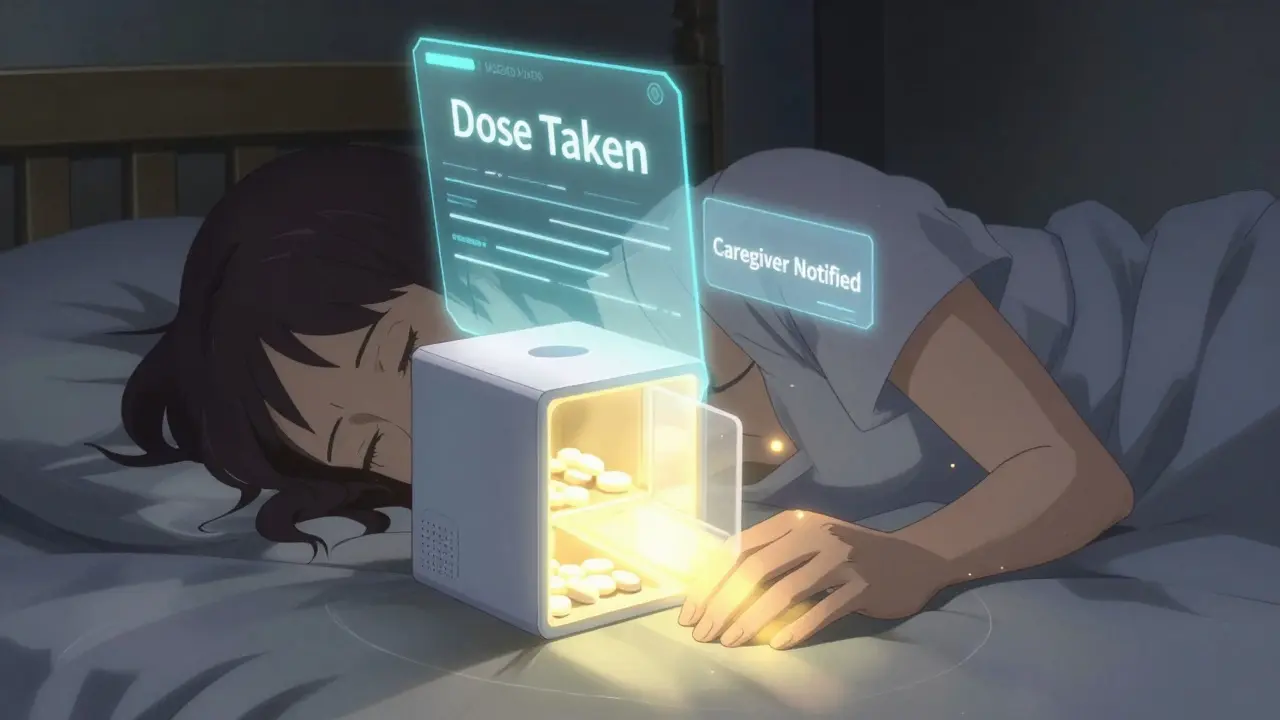
If you’re tired of guessing whether you took your pill or worried your family doesn’t know if you’re safe, digital dispensers are a game-changer. Devices like MedaCube and Hero Health are designed to do the work for you. They hold up to 90 days of medication, dispense pills automatically at set times, and send alerts through speakers, flashing lights, or phone notifications.
Here’s how they help in real life:
- When it’s time for your dose, the device beeps and the compartment opens.
- If you don’t open it within 15 minutes, it texts your caregiver.
- You can check your adherence history through a web app-even if you live across the country.
One 73-year-old woman in Washington State told reviewers her daughter, who lives 300 miles away, now sleeps better knowing she’s taking her pills. That’s the kind of peace of mind these devices offer.
Cost is a barrier-MedaCube runs $1,499 with no monthly fees. But compared to one hospital visit from a missed dose, that price looks different. Some insurance plans or Medicare Advantage programs cover part of the cost if your doctor writes a letter of medical necessity.
Pharmacy-Integrated Systems: For Complex Regimens
If you’re on a complicated schedule-say, eight different medications with varying doses, some taken only on certain days, others with food or at night-your pharmacy might offer a better solution. Companies like DosePacker provide pre-filled blister packs delivered monthly. Each dose is sealed in its own pocket, labeled with the time and day. No more sorting pills yourself.
These systems connect directly to your pharmacy’s records and your doctor’s electronic health system. If your doctor changes your warfarin dose, the pharmacy updates your pack automatically. No phone calls. No confusion.
But there’s a catch: these are mostly for care facilities or home health agencies, not individual consumers. They cost over $12,000 to install and require staff to manage. Still, if you’re working with a home nurse or care coordinator, ask if they use this system. It’s the most accurate way to prevent errors.
Apps and Digital Tracking: For the Tech-Savvy
Not everyone wants a physical device. Many people under 65 use phone apps to track medications. Apps like Medisafe, PillDrill, and MyTherapy let you set reminders, log when you take pills, and even sync with smartwatches. Some can alert family members if you miss a dose.
They’re cheap-often free or under $5 a month. And they’re great if you’re already comfortable with your phone. But they rely on you actually opening the app. If your phone dies, you forget it, or you’re not home when the alarm goes off, the system fails. A 2022 study found that app-based tracking improved adherence by 18-26%, but only if users opened the app consistently.
For seniors, this is a hurdle. Nearly 47% of people over 80 struggle with touchscreen devices. If you’re not tech-savvy, an app might add stress instead of relief.
What to Watch Out For
Even the best systems have flaws. Here are the most common problems-and how to fix them:
- Power outages: If your dispenser loses power, it stops working. Solution: Get one with a backup battery, or keep a manual organizer as a backup.
- Wrong pills loaded: About 34% of errors in automated systems happen because someone put the wrong pill in the wrong slot. Solution: Always double-check with your pharmacist when loading. Use color-coded stickers or labels.
- Wi-Fi drops: Some devices need internet to send alerts. If your home signal is weak, you’ll miss notifications. Solution: Choose a model with cellular backup (available for $30/month).
- Too complicated: If setting up the device takes more than two hours, you’re likely to give up. Look for systems with video tutorials or free setup help.
Also, don’t assume automation means zero risk. In 2022, a software glitch caused 14 patients to get the wrong doses at a Midwest clinic. Human oversight still matters. Always keep a written list of your meds, dosages, and times-even if you have a device.
Choosing the Right System for You
Here’s how to pick:
- How many pills? Under 5 a day? A $10 organizer works. More than 8? Look at digital or pharmacy systems.
- How complex is your schedule? Same time every day? Manual is fine. Variable doses? You need an app or dispenser.
- Who helps you? If you live alone and have no family nearby, get a device with caregiver alerts. If you have someone who can refill your organizer weekly, go simple.
- Are you tech-friendly? If you struggle with smartphones, skip apps. Go for audio alerts and physical buttons.
- Can you afford it? Don’t buy a $1,500 device if you can’t maintain it. Ask your pharmacist or doctor if your insurance covers any options.

Real People, Real Results
One man in Seattle, 78, used to take his blood thinner at random times. He ended up in the ER twice from bleeding. After getting a MedaCube, he started taking it at 8 a.m. every day. His INR levels stabilized. His doctor said he hadn’t seen such consistent numbers in years.
A woman in Oregon, 81, couldn’t read the tiny labels on her bottles. Her daughter bought her a large-print pill organizer with a built-in magnifier. She now fills it every Sunday with help from her granddaughter. She says, “I finally feel like I’m in control.”
These aren’t stories about gadgets. They’re about dignity, safety, and independence.
What’s Next for Medication Safety
Technology is getting smarter. New versions of MedaCube now use AI to predict when you’re likely to miss a dose and nudge you earlier. Some systems integrate with Alexa or Google Home so you can ask, “Did I take my pill today?”
Pharmacies are also rolling out pre-filled, barcode-scanned packs that sync with your EHR. In 2025, 92% of major U.S. pharmacies will support this. That means fewer errors and less work for you.
But the biggest change won’t come from a device. It’ll come from asking for help. Talk to your pharmacist. Ask your doctor if you qualify for a medication therapy management program. These free services (often covered by Medicare) include one-on-one reviews of your meds, side effect checks, and refill coordination.
Start Today
You don’t need to overhaul your whole system right now. Pick one small step:
- Buy a $7 weekly pill organizer and fill it this Sunday.
- Download a free medication app and enter your first two pills.
- Call your pharmacy and ask if they offer pre-filled blister packs.
Medication safety isn’t about buying the most expensive tool. It’s about finding the one that fits your life-and sticking with it. Your body doesn’t care how fancy your organizer is. It only cares if you take the right pill, at the right time, every time.
Are pill organizers safe for all medications?
Most pill organizers are safe for standard tablets and capsules. But some medications shouldn’t be removed from their original packaging. These include time-release pills, capsules that need to stay dry, or drugs that degrade in light or air. Always check with your pharmacist before transferring any medication. If in doubt, keep it in the original bottle.
Can I use a pill organizer if I have arthritis?
Yes. Look for organizers with large, easy-open lids, magnetic closures, or one-touch release mechanisms. Some models come with built-in pill splitters or gripper tools. If you struggle with small lids, consider a digital dispenser that opens automatically-no manual handling needed.
Do insurance plans cover pill dispensers?
Some Medicare Advantage plans and private insurers cover automated dispensers if your doctor provides a letter of medical necessity. Medicaid coverage varies by state. Basic pill organizers are rarely covered, but you can often use HSA or FSA funds to buy them. Ask your pharmacist or insurance provider for details.
What if I travel with my pill organizer?
Travel-sized organizers are available in compact, TSA-friendly sizes. For digital dispensers, most models have built-in batteries that last 24-48 hours without charging. Always carry a printed list of your medications and dosages in case your device is lost or confiscated at security. Never pack medications in checked luggage-keep them in your carry-on.
How often should I clean my pill organizer?
Clean it once a week when you refill it. Use warm water and mild soap. Don’t use bleach or put it in the dishwasher unless the manufacturer says it’s safe. Dry completely before adding new pills. Mold or residue buildup can contaminate medication.
Can I use an app instead of a physical organizer?
Apps are great for reminders and tracking, but they don’t physically hold your pills. If you forget your phone, you still need a way to access your meds. Many people use both: an app for alerts and a simple organizer for the actual pills. This combo gives you the best of both worlds.
What’s the difference between MedaCube and Hero Health?
Both are top-rated automated dispensers. MedaCube holds up to 90 days of meds, has a touch screen, and sends caregiver alerts via web portal. Hero Health uses a simpler interface, connects to Alexa, and offers a lower upfront cost ($999). Hero also includes a monthly subscription for cloud storage and support. Choose MedaCube if you want full control and no fees; choose Hero if you prefer voice control and lower upfront cost.

Aurora Daisy
Oh great, another article telling us we’re all just lazy idiots who can’t remember to take pills. Newsflash: most of us don’t have time, money, or energy to juggle $1,500 robots just to stay alive. My grandma uses a $5 plastic box and still outlives half the tech bros in this thread.
Paula Villete
I love how this article assumes everyone has access to Wi-Fi, a smartphone, or a daughter who lives 300 miles away and cares enough to get notified. What about the people living in rural areas with no cell service? Or the ones who can’t afford to replace a broken MedaCube because their insurance 'doesn’t cover wellness gadgets'? It’s not about being tech-savvy-it’s about being treated like a human, not a data point.
Katie Taylor
STOP buying plastic organizers. They’re a death trap. I watched my uncle die because he mixed up his blood thinner with his thyroid med-both white pills, same size. He trusted the box. The machine didn’t. Get a Hero Health. It’s cheaper than a hospital stay. And if you’re still using apps? You’re one dead phone away from disaster.
Payson Mattes
Did you know the FDA quietly approved a chip that gets swallowed with your pill and transmits data to your phone? No? That’s because Big Pharma doesn’t want you to know they’re already tracking your compliance. The MedaCube? It’s just the tip of the iceberg. They’re building a system where your meds report your behavior to insurers. Next thing you know, your premiums go up if you miss a dose. Wake up. This isn’t safety-it’s surveillance.
Isaac Bonillo Alcaina
The fact that you’re even considering an app over a physical dispenser shows how disconnected you are from reality. Apps don’t prevent errors-they create them. People forget their phones. Phones die. Screens crack. The only reliable system is the one that doesn’t require you to remember to interact with it. And if you’re still using a manual organizer without a locking lid? You’re not just irresponsible-you’re dangerous.
Bhargav Patel
The philosophical underpinning of medication adherence lies not in technological augmentation, but in the restoration of human dignity. To reduce the act of taking one’s prescribed medicine to a logistical problem-solvable by plastic compartments or algorithmic nudges-is to neglect the existential burden borne by the chronically ill. One does not cure neglect with automation; one cures it with presence. The real innovation is not in the dispenser, but in the caregiver who remembers to ask, 'Did you eat today?'
Steven Mayer
The adherence metrics cited are statistically significant but methodologically flawed. The 38% non-adherence rate in manual organizers conflates intentional non-compliance with cognitive impairment. Furthermore, the assumption that digital dispensers reduce hospitalizations lacks longitudinal control for confounding variables-comorbidity burden, socioeconomic status, caregiver availability. Without multivariate regression analysis, these claims are anecdotal at best.
Charles Barry
Let’s be real: this whole system is designed to make you feel guilty so you’ll buy more shit. They don’t care if you live or die-they care if you spend $1,500 on a box that beeps. And the fact that only 47% of seniors can use apps? That’s not a design flaw-that’s a feature. They want you dependent on someone else to manage your life. Wake up. This isn’t healthcare. It’s corporate control dressed up in pastel colors.
Rosemary O'Shea
I suppose the $10 organizer is perfectly adequate for peasants. But for those of us who actually care about precision, elegance, and the sanctity of our pharmacological regimen, anything less than a MedaCube with Bluetooth sync, AI-driven dose prediction, and a custom engraved lid is simply… gauche. If you’re not investing in your health like it’s a luxury item, you’re not taking it seriously. And frankly, that’s why so many of you end up in the ER.