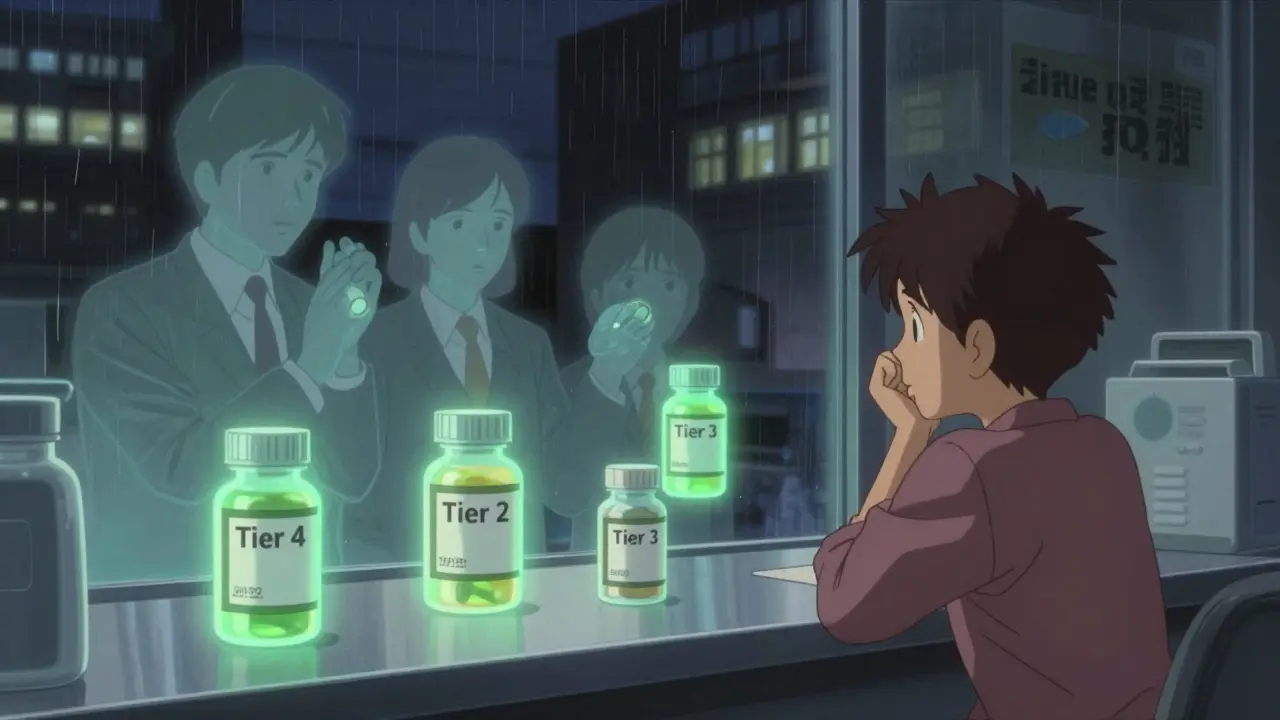
When you pick up a prescription at the pharmacy, you might not think about why one drug costs $10 and another costs $75 - even if they treat the same condition. The reason lies in your employer’s health plan and how it uses generic drugs to control costs. Most large employers don’t just cover prescriptions - they shape them. And understanding how that system works can save you hundreds, even thousands, of dollars a year.
How Your Employer’s Drug Plan Really Works
Your employer’s health plan doesn’t just pay for meds. It controls which ones you can get, and at what price. That control comes through something called a formulary - a list of approved drugs sorted into tiers. Tier 1 is usually generic medications. Tier 2 is preferred brand-name drugs. Tier 3 is non-preferred brands. And Tier 4? That’s where specialty drugs live - the expensive ones for conditions like cancer, rheumatoid arthritis, or multiple sclerosis. The structure is simple: lower tier = lower cost. For example, in Ohio’s state employer plans, generics cost $10 per fill. Preferred brands? $40. Non-preferred brands? $75. If a brand-name drug you’ve been taking suddenly gets a generic version, your plan will automatically move the brand to Tier 4. That means if you still want the brand, you’ll pay $75 instead of $10. The generic? Still $10. This isn’t just policy - it’s strategy. Generic drugs are FDA-approved to be just as safe and effective as brand-name versions. But they cost 80-85% less because manufacturers don’t need to spend millions on clinical trials or TV ads. That’s why 99% of large employer plans include prescription coverage - and why nearly all of them push generics hard.Why Generics Are the Default Choice
You might wonder: why do employers care so much? The answer is money. Generic drugs save the U.S. health system over $150 billion every year. That’s $3 billion a week. For an employer with 5,000 employees, switching even half the prescriptions from brand to generic can cut pharmacy costs by 30-40% in a single year. But here’s the catch: those savings don’t always show up in your pocket. The middlemen - Pharmacy Benefit Managers (PBMs) like OptumRx, CVS Caremark, and Express Scripts - negotiate rebates with drugmakers. They get paid back by the manufacturer after you buy the drug. The difference between the list price and what the PBM actually pays is called the gross-to-net (GTN) spread. On average, that’s 55%. That means if a drug’s list price is $100, the PBM might only pay $45 after rebates. But you still pay your $10 copay for the generic - even though the PBM made $55 on the deal. So while your employer saves money, you’re not necessarily seeing the full benefit. The system is designed to lower overall spending, not necessarily your out-of-pocket costs. That’s why it’s critical to know what tier your drug is on - and whether a cheaper generic exists.What Happens When Your Drug Disappears
In January 2024, each of the three biggest PBMs removed more than 600 drugs from their formularies. That’s over 1,800 medications no longer covered - not because they’re unsafe, but because the manufacturers didn’t offer big enough rebates. If your medication was on that list, you suddenly have two choices: pay full price or ask for an exception. Formulary exclusions are negotiation tools. PBMs use them to pressure drugmakers into lowering prices. But the pressure lands on you. If you’re taking a drug for diabetes, high blood pressure, or asthma, and it gets pulled, you might be stuck with a much more expensive alternative - or worse, no coverage at all. The good news? You can fight back. Most plans allow medical necessity exceptions. If your doctor writes a letter explaining why you can’t switch to a generic or preferred brand, your insurer may approve coverage for the original drug. But you need to act fast. Don’t wait until your refill runs out. Call your insurer the moment you hear a drug is being removed.
How to Find Out What’s Covered
You can’t rely on memory or your doctor’s word alone. Formularies change often - sometimes without notice. A drug that was covered last month might be gone this month. Here’s how to stay ahead:- Go to your insurer’s website and search for your plan’s drug list. Look for “formulary,” “drug list,” or “pharmacy benefits.”
- Check your Summary of Benefits and Coverage (SBC). It’s required by law and should include a sample drug cost chart.
- Call your insurer. Ask: “Is [drug name] covered? What tier is it on? Is there a generic?”
- Use your pharmacy’s app or website. Many show real-time pricing and coverage before you even fill the script.
What You Can Do Right Now
You don’t need to wait for open enrollment to save money. Here’s what to do today:- Look up your top three prescriptions. Find out their tier and copay.
- Search for generics. If one exists, ask your doctor if you can switch.
- If you’re on a brand-name drug with no generic, check if there’s a preferred brand on Tier 2. It might cost half as much.
- Ask your pharmacist: “Is there a lower-cost alternative?” Pharmacists often know about patient assistance programs or coupons you didn’t know existed.
- If your drug was recently removed from the formulary, contact your employer’s HR department. They may be able to help you file an exception or switch plans.

Kristin Dailey
Just check your tier. Switch to generic. Done.
Robert Davis
People don’t realize how much PBMs are skimming off the top. That 55% GTN spread? That’s not savings-that’s profit laundering. Your $10 generic copay? The PBM got $55 from the manufacturer and you paid $10. The employer saved money, sure, but you’re still getting screwed. And no one tells you this because the system’s designed to keep you confused. It’s not about cost control-it’s about corporate greed wrapped in a ‘health plan’ bow.
Andrew McLarren
Thank you for this comprehensive overview. The structural dynamics between employers, PBMs, and formularies are indeed under-discussed in public discourse. It is imperative that individuals take proactive measures to understand their specific formulary tiers and engage with their benefits administrators when discrepancies arise. Transparency in pharmaceutical pricing remains a systemic challenge, yet informed advocacy can mitigate personal financial exposure.
Andrew Short
Oh, so now we’re supposed to feel bad for the ‘poor’ employers who are ‘just trying to save money’? Wake up. PBMs are private equity-owned monsters that make billions while you’re choosing between insulin and rent. Your ‘generic’ isn’t cheaper because it’s better-it’s cheaper because the drugmaker paid off the PBM to bury the brand. This isn’t healthcare. It’s a rigged casino where the house always wins-and you’re the sucker at the table. Stop being a pawn. Fight back.
Aysha Siera
They’re using generics to track you. RFID chips in pills. The PBM’s not saving money-they’re building a database of every chronic condition you have. Next thing you know, your insurance denies you coverage because your ‘data profile’ says you’re ‘high risk.’ Don’t trust the system. They’re watching. Always watching.
Zoe Brooks
Just switched my blood pressure med to generic last month-went from $75 to $10. Same pill, same results. 🤯 I didn’t even notice a difference. If you’re paying more than $10 for a generic, you’re literally leaving money on the table. Go check your script right now. Your future self will thank you. 💪
Robert Cassidy
They say generics are ‘just as good’-but who says? The FDA? The same agency that let Purdue push OxyContin for years? This isn’t science-it’s corporate propaganda. You think they care if you live or die? No. They care if you pay your copay and stay quiet. The real drug crisis isn’t opioids-it’s the quiet erosion of your right to choose your own medicine. They want you dependent on their tiers, their rebates, their rules. Break free.
Tyler Myers
Wait. So you’re telling me the guy who invented the brand drug didn’t get paid? That’s why generics are cheaper-they’re just copycats. And now we’re supposed to be okay with that? What if your brand drug had a special delivery system? What if the generic doesn’t dissolve right? You think the FDA tests every single generic batch? Nah. They just rubber-stamp it because the PBM paid them off. This isn’t healthcare. It’s a Ponzi scheme with pills.