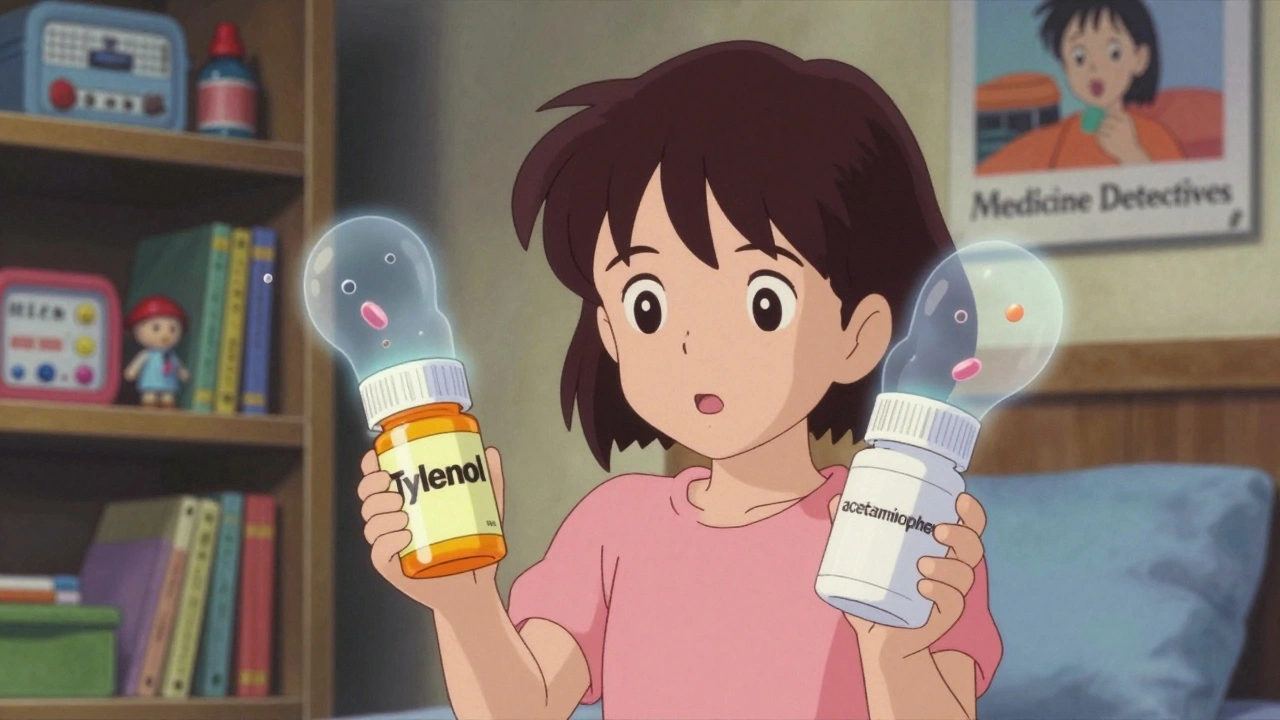
Most kids don’t know the difference between a brand-name pill and a generic one. They see the colorful packaging of Tylenol or Advil and assume that’s the only version that works. But here’s the truth: generic drugs are just as safe, just as effective, and often cost a fraction of the price. Teaching children about generic medications isn’t about pharmacy jargon-it’s about building smart, confident health habits early.
Why Kids Need to Understand Generic Drugs
Children are surrounded by medicine. They take syrup for coughs, pills for allergies, and patches for motion sickness. But when a parent says, "We’re switching to the cheaper version," kids often get confused-or worse, scared. They think, "Is this fake? Will it make me sick?"
The reality? Generic drugs are required by the U.S. Food and Drug Administration (FDA) to have the same active ingredients, strength, dosage form, and route of administration as their brand-name counterparts. They work the same way. They’re tested the same way. The only differences are in color, shape, or inactive fillers-things that don’t affect how the medicine works.
When kids understand this, they stop seeing medication as a mystery. They learn to ask questions like, "Is this the same as the blue pill?" instead of refusing to take it. That’s powerful.
How to Explain Generic Drugs to Young Kids (Ages 3-7)
For little ones, keep it simple and visual. Use toys or drawings.
- Grab two identical-looking toy pills-one red, one blue. Say, "These both have the same medicine inside, just like two different crayons can both be red. One is called "HappyCalm," the other is "CalmEasy." They do the same job!"
- Use a story: "Imagine your favorite superhero has two capes. One is fancy and costs $20. The other is simple and costs $3. But both help them fly just the same. That’s what generic medicine is. Same power, less money."
- Let them help pick the pill bottle at the pharmacy. Say, "Look, the pharmacist gave us the green bottle today instead of the yellow one. They’re both for your tummy ache. Which one do you want to take?" This gives them control and normalizes the switch.
Studies show that when children feel involved in their own care, they’re 40% more likely to take medicine without fuss (Journal of Pediatric Psychology, 2021). That’s not magic-it’s understanding.
For Older Kids (Ages 8-12): Building Critical Thinking
By this age, kids can handle more detail. Use real-life examples.
Start with something familiar: ibuprofen. Show them the box of Advil and the box of store-brand ibuprofen. Point out the active ingredient: "Both say ‘ibuprofen 200 mg’ right here on the label. That’s the part that helps your headache. The rest? That’s just flavor, color, or packaging."
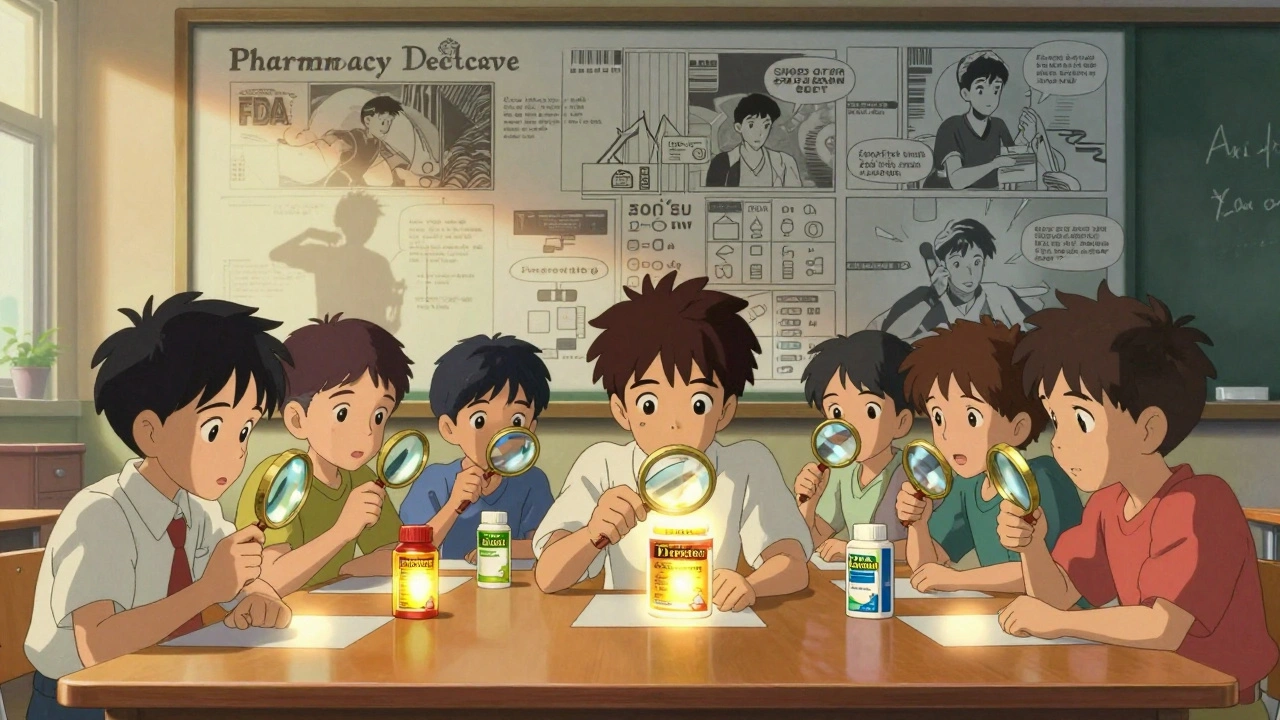
Turn it into a game: "Let’s play Pharmacy Detective. Find the active ingredient on three different medicine bottles. Are they the same?" Most kids love finding patterns-and they’ll be shocked to see how many brands use the exact same words.
Explain cost in a way they understand: "If your school bought one notebook for $5 and another for $1, but both had the same paper and lines, which would you pick? Same thing with medicine. We save money so we can buy more of the things we need."
And don’t avoid the elephant in the room: "Why do companies spend so much on fancy packaging?" That’s a great conversation starter. Kids quickly realize it’s about marketing-not medicine.
Teaching Teens: Connecting to Real-World Decisions
Teens are bombarded with ads, influencers, and misinformation. They hear, "Brand name is better," and believe it. But here’s what they need to know:
- Generics make up over 90% of all prescriptions filled in the U.S. (FDA, 2024).
- They’re held to the same strict standards as brand-name drugs.
- Many hospitals and insurance plans use generics by default because they’re just as good.
Use real data: "Did you know that the same company that makes Advil also makes the store-brand ibuprofen? They just put a different label on it."
Challenge them: "If you had $50 to spend on medicine for your family this year, would you rather buy 10 brand-name pills or 50 generic ones? What if the generic ones worked just as well?"
Teens respond to honesty and logic. Don’t lecture. Ask questions. Let them arrive at the conclusion themselves.
What Parents and Teachers Should Avoid
Don’t say things like:
- "This is the cheap one." (Kids hear "inferior.")
- "The doctor chose this for us." (Makes them feel powerless.)
- "Just take it. You don’t need to know why." (Teaches them not to ask questions.)
Instead, say:
- "This medicine has the same medicine inside as the other one, but costs less. That means we can use the money for something else we need."
- "You’re learning how to be a smart health helper. That’s a superpower."
- "Let’s look at the label together. What’s the same? What’s different?"
Research from the American Academy of Pediatrics shows that children who are taught to read medicine labels are 60% more likely to notice if something changes-like a new pill shape or color-and will speak up if they’re worried. That’s safety.
How Schools Are Helping
Programs like Generation Rx, started by The Ohio State University, now reach over 1.5 million U.S. students each year. They don’t just teach kids not to take drugs-they teach them how to understand the medicines they’re prescribed.
In elementary classrooms, kids play "Medication Safety Patrol," learning to identify pills by shape and color, not brand. In middle school, they compare price tags and active ingredients. In high school, they analyze insurance formularies and learn why pharmacies choose generics.
These aren’t just lessons-they’re life skills. Kids who understand medicine are less likely to be misled by scams, less likely to hoard or misuse pills, and more likely to ask for help if something feels off.
What to Do Next
If you’re a parent:
- Check your medicine cabinet. Find one generic and one brand-name version of the same drug. Show your child the label. Point out the active ingredient.
- Next time you pick up a prescription, ask the pharmacist: "Can you explain why we’re getting this one?" Let your child listen.
- Use free resources like GenerationRx.org. They have printable coloring sheets for young kids and worksheets for teens.
If you’re a teacher:
- Ask your school nurse if they use Generation Rx or NIDA’s free lesson plans. If not, request them.
- Add a "Medicine Monday" to your health unit. One 15-minute lesson a month can make a big difference.
- Invite a pharmacist to visit your class. Kids love seeing the real people behind the counter.
Common Questions Kids Ask (and How to Answer)
Why does the generic pill look different?
The medicine inside is the same, but the company that makes the generic can’t copy the exact color or shape of the brand-name version. That’s the law. Think of it like two different brands of cereal-same oats, different box.
Is the generic medicine weaker?
No. The FDA requires generics to work the same way, in the same amount of time, and with the same strength. They’re tested on thousands of people before they’re sold. If they didn’t work, they wouldn’t be allowed on the shelf.
Why do some doctors write the brand name?
Sometimes doctors are used to writing the brand name, or they think it’s clearer. But you can always ask: "Can I get the generic?" Most doctors will say yes. If they don’t, ask why. You have the right to know.
What if the generic makes me feel weird?
Sometimes the fillers (the non-medicine parts) in a generic can cause a slight difference in how you feel-like a different taste or a small stomach upset. But that doesn’t mean it’s not working. Tell your parent or doctor. They might switch to a different generic brand, or go back to the original. The key is speaking up.
Why do pharmacies give me different ones every time?
Pharmacies choose generics based on cost and what’s in stock. It’s like getting different brands of milk from the same store. The milk is still milk. The medicine is still the medicine. If you’re worried, ask the pharmacist: "Is this the same as last time?" They’ll show you the label.
Final Thought: Empowerment Over Fear
Teaching kids about generic drugs isn’t about saving money-it’s about giving them control. When children understand how medicine works, they stop being passive receivers. They become active participants in their own health.
That’s the real win. Not just knowing what’s in a pill-but knowing they have the right to ask, to compare, to understand. And that’s a lesson that lasts far longer than any prescription.

Anthony Breakspear
Man, I wish I had this when I was a kid. My mom would just hand me a pill and say 'take it'-no explanation, no choice. I thought generics were like knockoff sneakers-looks the same, but falls apart after a week. Turns out? They’re just the same shoe, different box. Mind blown. Now I always check the label. Thanks for this.
Chris Wallace
I’m a pediatric nurse and I’ve seen kids refuse meds because they ‘look wrong.’ One boy cried because his ADHD pill went from orange to white-he thought it was a different drug. We started using the crayon analogy you mentioned. He picked the blue one every time after that. Little things like this build trust. Also, the pharmacy detective game? Genius. I’m stealing it for my next group session.
Chelsea Moore
This is so dangerous!! You’re teaching kids to be cheap!! What if the generic makes them sick?! Who’s responsible then?! The pharmacist? The parent? The school?! This is a slippery slope to neglect and negligence!! I’ve seen kids with rashes from fillers-this isn’t just about money, it’s about safety!!
John Biesecker
bro this is so cool 😍 i never thought about medicine like this. my mom always just gave me the blue pill and i never asked why. now i’m gonna go check my cabinet and play pharmacy detective with my little sister. she’s 6 and she thinks the red pill is ‘magic’-maybe she’ll learn it’s just the same magic, cheaper 🤓
Eddy Kimani
As someone who works in pharma logistics, I can confirm that 92% of generics are manufactured in the same facilities as brand names, often on the same lines. The only difference is the label and the price tag. The FDA’s bioequivalence standards are brutal-generics have to perform within 80–125% of the brand’s pharmacokinetics. That’s tighter than most food safety standards. This isn’t ‘cheap medicine.’ It’s smart medicine.
Allan maniero
It’s funny how we treat medicine like it’s some sacred artifact, when it’s just chemistry with a marketing team. I remember my dad switching my asthma inhaler to generic and me freaking out because the color was different. He sat me down with two identical Lego bricks-one red, one blue-and said, ‘Same pieces, different paint.’ I didn’t get it then, but now I’m a pharmacist. The real tragedy isn’t that people don’t understand generics-it’s that we’ve trained them to fear the unfamiliar. We’ve turned medicine into a brand loyalty contest instead of a health tool. And honestly? The more we normalize this, the less power pharma has over our choices. That’s not just education-that’s liberation.
Paul Santos
Interesting perspective, but let’s not romanticize this. The FDA’s bioequivalence criteria are a legal fiction. Real-world variability? Oh yeah. Some people *do* react differently to fillers-especially with SSRIs or epilepsy meds. I’m not saying generics are bad, but we’re ignoring pharmacogenomics here. Some folks metabolize differently. It’s not just about ‘same active ingredient.’ It’s about the *entire system*. Also, why are we teaching kids to be price-sensitive consumers instead of demanding better drug pricing? This feels like a Band-Aid on a hemorrhage 🤷♂️
Doug Hawk
My son had a bad reaction to a generic omeprazole-stomach cramps, nausea. Switched back to Prilosec and it vanished. Same active ingredient, different binders. It’s rare but it happens. I’m not against generics, but I’m against pretending they’re always identical. Kids should learn to track how they feel, not just accept labels. If they feel weird, they should speak up. That’s the real skill here-not recognizing the pill, but knowing their body.
Saket Modi
bro why are we even talking about this 😴 i just take the cheap one and don’t think about it. if it works, it works. if it don’t, i switch. stop overcomplicating kids’ lives. also why is everyone so into teaching kids about medicine? they just need to take it and go play outside 🤷♂️
Sheryl Lynn
How quaint. You’re teaching children to be economically compliant consumers in a system that exploits them at every turn. Do you really think a 7-year-old needs to understand pharmaceutical cost structures? Or are you just performing progressive parenting for Instagram? The real issue isn’t generics-it’s that we’ve outsourced healthcare literacy to parents who are drowning in debt and sleep deprivation. This feels like virtue signaling wrapped in a coloring sheet.
Kristen Yates
My grandmother in Mexico always said, ‘La medicina es la medicina, no la caja.’ The medicine is the medicine, not the box. We didn’t have brand names where I grew up-just the pills, the labels in Spanish, and trust in the pharmacist. I never knew what ‘ibuprofen’ meant until I moved to the U.S. and saw the ads. Teaching kids to read labels? That’s not American. That’s human.
John Morrow
Let’s be brutally honest: this is a corporate strategy disguised as education. The FDA allows generics because it reduces systemic costs-not because it’s better for patients. The pharmaceutical industry profits from this system by selling the same molecule under two labels. Teaching kids to accept generics isn’t empowerment-it’s normalization of a two-tiered healthcare model where the poor get the ‘good enough’ version and the rich get the ‘premium’ one. This isn’t a lesson in autonomy. It’s a lesson in resignation.
Genesis Rubi
Generic meds are for losers. If you can't afford the real thing, you shouldn't be taking medicine at all. America makes the best drugs in the world. Why would you let your kid take some cheap knockoff from India? This is why our country is falling apart. We're teaching kids to be satisfied with mediocrity. Brand name = quality. End of story.
Anthony Breakspear
Just read the comment above and had to reply. Bro, you’re not protecting your kid by making them scared of generics-you’re making them scared of medicine. My cousin’s daughter has asthma. Her parents used to buy the brand-name inhaler every month. Then they switched to generic after a hospital financial counselor showed them the math. Same results. Same breathing. Same life. Now they can afford her piano lessons. That’s not ‘mediocrity.’ That’s smart parenting. You don’t need a fancy box to save a kid’s lungs.