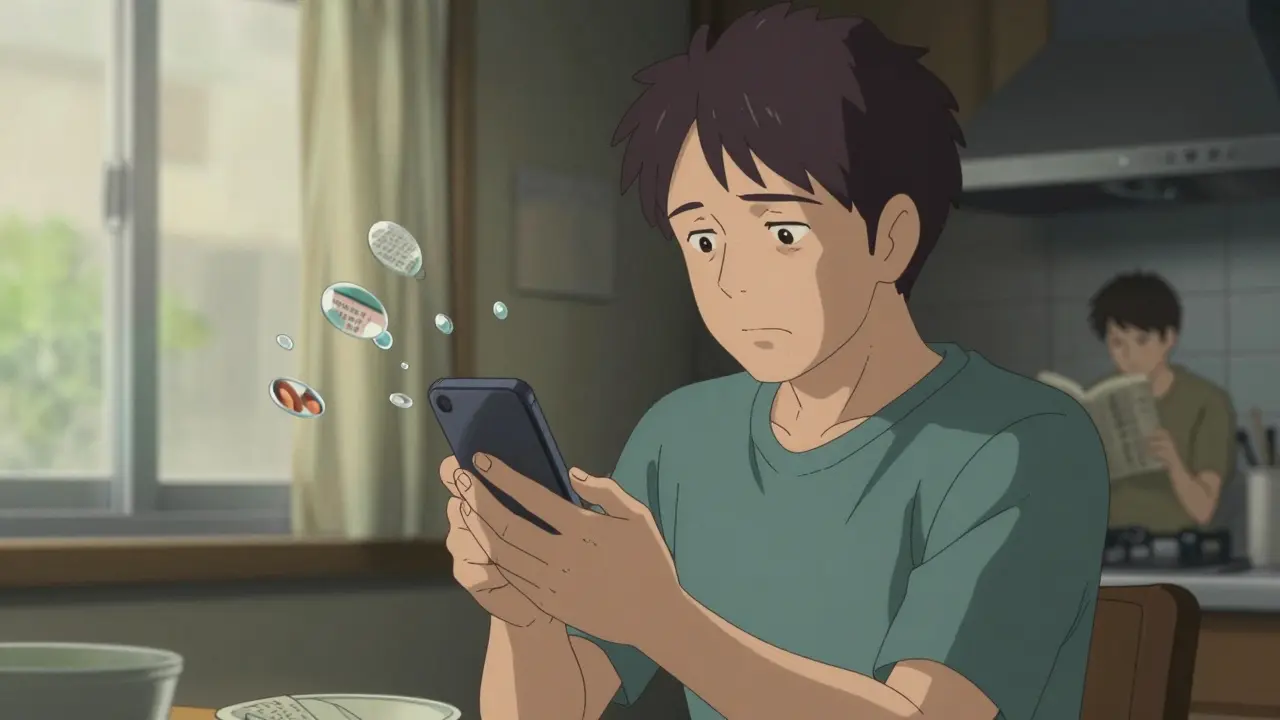
By the time you hit your mid-40s, you might start holding your phone farther away to read text. Or you’re squinting at restaurant menus, then grabbing reading glasses you didn’t need last year. This isn’t just bad lighting or tired eyes-it’s presbyopia. It’s not a disease. It’s not your fault. It’s simply what happens to every human being as they age. And it’s happening to more than 1.8 billion people right now.
What Exactly Is Presbyopia?
Presbyopia is the natural loss of your eye’s ability to focus on close objects. It’s caused by your lens-那个软软的、像果冻一样的结构 inside your eye-getting stiffer and thicker over time. When you were young, that lens could bend easily to focus light on your retina whether you were looking at a book or a mountain. But as you age, the lens loses flexibility. Think of it like an old rubber band that won’t snap back anymore. It can’t change shape to bring near things into focus. This isn’t the same as being farsighted. Farsightedness is about the shape of your eyeball. Presbyopia is about the lens aging. And unlike cataracts or glaucoma, you can’t prevent it. No eye exercises, no special diet, no blue light filters will stop it. The National Eye Institute says it affects 100% of people by age 45. It’s as inevitable as gray hair.When Does It Start and How Does It Get Worse?
Most people first notice symptoms between 40 and 45. You might find yourself reaching for reading glasses at the dinner table, or struggling to read small print on medicine bottles. At age 10, your eyes can focus on something as close as 7 centimeters. By 60, that distance grows to over 100 centimeters. That’s why you’re holding your phone at arm’s length. The need for correction increases steadily. Around 45, most people need +1.00 diopter lenses. By 55, it’s usually +2.00. By 65, many need +2.50 to +3.00. That’s why you keep needing stronger readers every few years. It’s not getting worse because you’re using your eyes too much-it’s because your lens keeps hardening.Reading Glasses: The Simple Fix
The easiest solution? Over-the-counter reading glasses. You can buy them at Walmart, CVS, or Amazon for under $20. They come in strengths from +0.75 to +3.50, in 0.25-diopter steps. For most people starting out, +1.00 to +1.50 is enough. But here’s the catch: these aren’t custom-made. They assume both eyes are the same strength, and they don’t account for differences in pupil distance or how your glasses sit on your face. About 35% of people who buy them off the shelf end up with the wrong strength, which can cause headaches or eye strain. They’re great for occasional use-reading a label, checking your phone, flipping through a magazine. But if you’re reading for long periods, working on a computer, or need to switch between near and far vision often, they’re not ideal. You’re constantly taking them off and putting them back on. And if you have astigmatism or different prescriptions in each eye, they won’t help at all.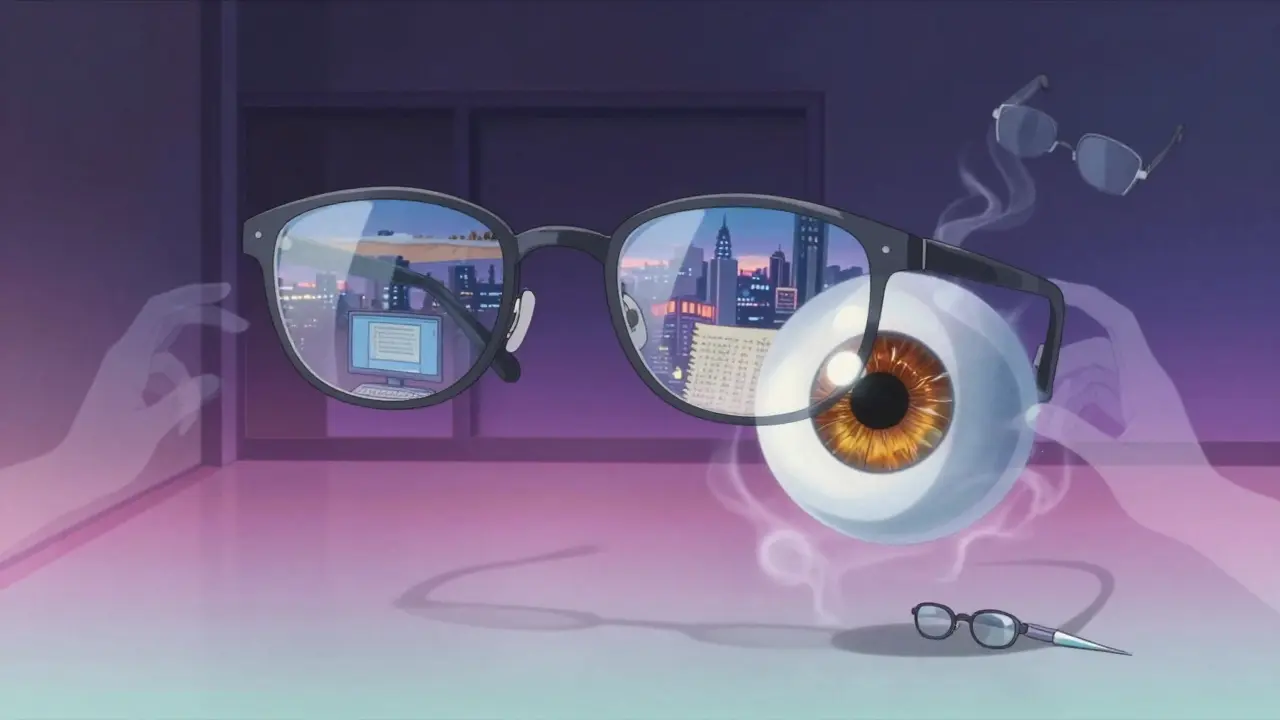
Progressive Lenses: The Seamless Alternative
If you already wear glasses for distance, progressives might be your best bet. These are single lenses with multiple focal zones: top for distance, middle for computer distance, bottom for reading. No visible lines like in bifocals. They cost more-$250 to $450 depending on the brand and lens material-but they let you see clearly at all distances without switching glasses. The trade-off? There’s a learning curve. About 25% of first-time wearers feel dizzy or get peripheral distortion, especially when looking sideways. It takes 2 to 4 weeks to adapt. Your brain has to relearn how to move your head instead of just your eyes to find the right focus zone. Newer designs like Essilor’s Eyezen Progressive 2.0, released in 2023, have wider near zones and better peripheral clarity based on data from 10,000 wearers. If you’re a graphic designer, writer, or anyone who spends hours on screens, these can be a game-changer.Contacts and Surgery: More Advanced Options
If you hate wearing glasses, contact lenses are an option. Monovision contacts correct one eye for distance and the other for near vision. About 80% of people adapt to this, but 15% lose depth perception, which can be dangerous for driving or sports. For a permanent fix, surgical options exist. LASIK monovision reshapes the cornea to mimic monovision contacts. It costs $2,000-$4,000 per eye, and 85% of patients report satisfaction. But 35% get dry eyes, and 10-15% need a second procedure within five years. Refractive lens exchange replaces your natural lens with an artificial multifocal one-same procedure as cataract surgery. It costs $3,500-$5,000 per eye. You’ll likely never need reading glasses again. But you might see halos at night, and contrast sensitivity can drop by 15%. The risk of serious infection is low-0.04%-but it’s still surgery. A newer option is the Presbia Flexivue Microlens, a tiny implant placed in the cornea. Approved in Europe in 2022, it restores near vision without removing your natural lens. In trials, 78% of users achieved 20/25 near vision after a year.What Experts Say
Dr. Paul Ajamian at Mount Sinai says: “Presbyopia is not a disease. It’s the price of having a working eye for decades.” The National Eye Institute confirms: “No supplement, eye drop, or exercise can reverse it.” The American Academy of Ophthalmology recommends a full eye exam starting at age 40. Why? Because presbyopia often shows up alongside other age-related conditions like glaucoma or macular degeneration. A basic vision screening at the drugstore won’t catch those.
What Works Best for You?
Here’s a quick guide:- Try reading glasses if you only need them occasionally and have no other vision problems.
- Choose progressives if you already wear distance glasses and want seamless vision without switching lenses.
- Consider monovision contacts if you’re active, hate glasses, and don’t mind a slight drop in depth perception.
- Think about surgery only if you’re tired of glasses, have healthy eyes, and understand the risks and trade-offs.
What to Avoid
Don’t buy the cheapest reading glasses just because they’re $5. Poor-quality lenses can cause headaches, blurry vision, and eye fatigue. Look for brands with clear labeling of diopter strength and optical-grade materials. Don’t delay your eye exam. If you’re struggling to read, it’s not just presbyopia. You could have undiagnosed astigmatism, dry eye, or early cataracts. Don’t assume your current readers are still right. Your prescription changes every 2-3 years. What worked at 45 might be too weak at 50.The Future of Presbyopia Correction
In 2023, Johnson & Johnson got FDA approval for a new multifocal contact lens with better near vision. Researchers are testing eye drops like VP-025 that temporarily make the pupil smaller to improve focus-similar to how reading glasses work, but without wearing them. Early trials show a 1.0-1.5 diopter improvement for up to 6 hours. But for now, the market is still dominated by optical solutions. Reading glasses make up 65% of all corrections by volume, even though they’re cheap. Surgical options are growing, but they’re still only 5% of total corrections. The bottom line? Presbyopia is universal. It’s not a flaw. It’s a sign you’ve used your eyes well. And with the right correction, you can keep reading, working, and seeing clearly for decades to come.Can presbyopia be prevented with eye exercises or diet?
No. Presbyopia is caused by the natural aging of the eye’s lens, which becomes stiffer over time. No amount of eye exercises, vitamins, or supplements can stop or reverse this process. The National Eye Institute confirms it’s as inevitable as gray hair. While good nutrition supports overall eye health, it won’t preserve lens flexibility.
Are over-the-counter reading glasses safe to use long-term?
They’re safe for occasional use, but not ideal for daily, prolonged tasks. Since they’re not custom-fitted, they may not match your exact prescription, especially if your eyes have different strengths or you have astigmatism. This mismatch can cause headaches, eye strain, or blurred vision. For regular use, a prescription from an eye doctor is better.
How often should I get my reading glasses prescription updated?
Every 2 to 3 years, or sooner if you notice symptoms worsening. Your near-vision needs increase as your lens stiffens. What worked at age 45 might be too weak by 50. A comprehensive eye exam with cycloplegic refraction is the only way to get an accurate measurement, since standard tests can underestimate your needed add power by up to 0.5 diopters.
Why do progressive lenses make me feel dizzy at first?
Progressive lenses have a gradual change in power from top to bottom, which creates slight distortion in the periphery. Your brain needs time to adjust to using head movement instead of eye movement to find the right focus zone. Most people adapt within 2-4 weeks. If dizziness lasts longer, your lenses may be improperly fitted-check your pupillary distance and frame alignment with your optician.
Is surgery worth it for presbyopia?
It depends on your lifestyle and expectations. Surgery like refractive lens exchange can eliminate the need for reading glasses permanently, but it carries risks like night halos, reduced contrast sensitivity, and infection. LASIK monovision works well for some but isn’t perfect-about 10-15% need retreatment. It’s best for people who are highly motivated to avoid glasses and understand the trade-offs. Always get a second opinion and test monovision with contacts first.

Annie Choi
Finally someone explains this without making it sound like a medical horror story. I hit 43 and suddenly my phone became a distant object. Bought $12 readers from CVS and life changed. No more squinting at food labels. No more drama. Just glasses on, read, glasses off, live. Simple. Effective. No magic pills needed.
Also, stop believing in ‘eye yoga’. It’s not a spiritual awakening, it’s biology.
Ayush Pareek
As someone who’s been wearing readers since 41, I can say this: the real win isn’t the glasses-it’s realizing you’re not broken. We’ve all been told aging is failure, but presbyopia? It’s proof you’ve read enough books, stared at enough screens, watched enough sunsets to earn this. The lens doesn’t fail-you just outgrew its original design.
And yes, progressives are worth the cash if you’re on the computer all day. Took me three weeks to stop turning my head like a confused owl, but now I don’t miss a single email.
Nishant Garg
Back in Mumbai, my uncle used to say, ‘Beta, your eyes are not broken-they’re just remembering how old you are.’ We don’t have reading glasses in every corner store here, so people squint, lean in, hold the newspaper at weird angles. Some use magnifying lamps. Others just ask their grandkids to read the medicine bottle out loud.
But you know what? No one calls it a disease. We just accept it like monsoon season. You don’t fight the rain-you carry an umbrella. And in 2024, that umbrella costs less than a chai.
Also, the ‘eye drops coming soon’ hype? Please. If they worked, we’d have seen results by now. This isn’t a glitch-it’s the system updating.
Frank Geurts
It is of paramount importance to underscore, with the utmost clarity and scholarly rigor, that presbyopia constitutes a universal, non-pathological, and biologically deterministic phenomenon-unrelated to digital device usage, environmental factors, or lifestyle choices-thereby affirming the veracity of the National Eye Institute’s position, which is grounded in longitudinal, peer-reviewed, epidemiological data spanning over four decades. Furthermore, the assertion that over-the-counter reading spectacles are ‘safe’ is, in fact, a gross oversimplification that may lead to ocular strain, musculoskeletal compensation, and potential exacerbation of undiagnosed refractive anomalies. I implore all readers to consult a licensed optometrist prior to self-prescribing optical correction, lest they risk irreversible visual fatigue.
Arjun Seth
People are so weak. You can’t handle a little blurry text? You think your body owes you perfect vision forever? You’re 45, not 25. Get over it. Stop wasting money on $300 lenses. Just use your phone’s zoom feature. Or better yet-don’t read so much. Maybe you’d be better off doing something useful with your time. All this ‘progressive lens’ nonsense? It’s just capitalism selling you a fix for a natural process. You’re not special. Your eyes are aging. Deal.
Mike Berrange
Wait. So you’re telling me that after 40, you can’t read your own phone without glasses? And this is news? I’ve been holding my phone at arm’s length since 2017. I thought everyone did. Also, I’ve never bought reading glasses. I just turn up the brightness and squint harder. It’s free. And I’ve got 20/20 vision in my left eye, so I just close the right one. Problem solved. Why are people making this into a whole thing? It’s not a crisis. It’s a minor inconvenience. Stop monetizing aging.
Amy Vickberg
I love how this post doesn’t shame people for needing glasses. That’s rare. I started wearing readers at 42 after I cried reading my daughter’s birthday card because the letters were blurry. I thought I was going blind. Turns out I just got older. And now? I have three pairs: one at work, one in my purse, one by the bed. I even bought a cute pair with cats on them. It’s not a weakness. It’s a badge of honor. We’re still here. Still reading. Still loving. Still seeing. Even if we need a little help.
Iona Jane
They’re lying. This isn’t aging. It’s the 5G towers. Or the fluoride in the water. Or the government putting microchips in our eyes through vaccines. I’ve been tracking this since 2020. My neighbor’s cat started squinting too. Coincidence? I don’t think so. They want us dependent on lenses so they can sell us more. They’re controlling our vision. And progressives? Those are just the new ‘smart glasses’-they’re listening. Don’t trust the optometrist. They’re paid by Big Optics.
Jaspreet Kaur Chana
Bro, I’m 39 and already holding my phone at arm’s length. My mom says I’m ‘ahead of the curve’. But honestly? I’m kinda proud. I’ve been reading novels since I was 12. I’ve stared at code for 15 years. I’ve read bedtime stories to my kid every night. My eyes earned this. I’m not scared of reading glasses. I’m excited. I’m gonna get a pair with gold rims. And I’m gonna wear them like a crown. Because I’ve lived. And I’m still reading.
ellen adamina
Does anyone know if presbyopia affects color perception? I’ve noticed reds look duller lately. Is that part of it or something else? I’ve been avoiding eye exams because I’m scared of what else they’ll find. But maybe I should just go. I don’t want to miss out on seeing my granddaughter’s face clearly.
Gloria Montero Puertas
How can you recommend over-the-counter readers? Are you seriously suggesting that people with complex visual systems-some with astigmatism, some with dry eye, some with corneal irregularities-just buy $10 lenses from a drugstore? This is irresponsible. You’re not a doctor. You’re not an optician. You’re not even a licensed optometrist. This is dangerous. People could damage their retinas. You’re promoting amateur medical practice under the guise of ‘convenience’. Shame on you.
Tom Doan
So let me get this straight. You’re telling me that after 40, your eyes turn into a broken camera lens-and the solution is to buy a $15 filter? That’s not science. That’s capitalism with a side of denial. And progressives? Sure, they’re fancy. But you’re paying $400 to avoid the social stigma of wearing reading glasses? That’s not vision correction. That’s identity management. We’ve turned aging into a product line. Congratulations, America. You’ve monetized your own decline.
Sohan Jindal
This is why America is weak. We’re so obsessed with comfort that we’ll spend $5,000 on eye surgery just so we don’t have to hold a book. In my country, we just use sunlight and patience. No glasses. No surgery. Just eyes that work the way they’re supposed to. You don’t need tech to read. You need discipline. And if you can’t read without help, maybe you’re not meant to read at all.