When standard antidepressants fail, people with severe depression don’t have time to wait weeks for relief. For those with treatment-resistant depression, ketamine and esketamine offer something rare: fast, measurable change-sometimes within hours. But they’re not the same. And choosing between them isn’t just about effectiveness. It’s about safety, cost, access, and what kind of experience you’re willing to go through.
What’s the difference between ketamine and esketamine?
Ketamine and esketamine come from the same chemical family, but they’re not interchangeable. Ketamine is a racemic mixture-it contains both the (R)- and (S)-enantiomers. Esketamine is just the (S)-enantiomer, purified and repackaged as a nasal spray under the brand name Spravato®. That small structural change changes everything: how it works, how it feels, and how it’s given.
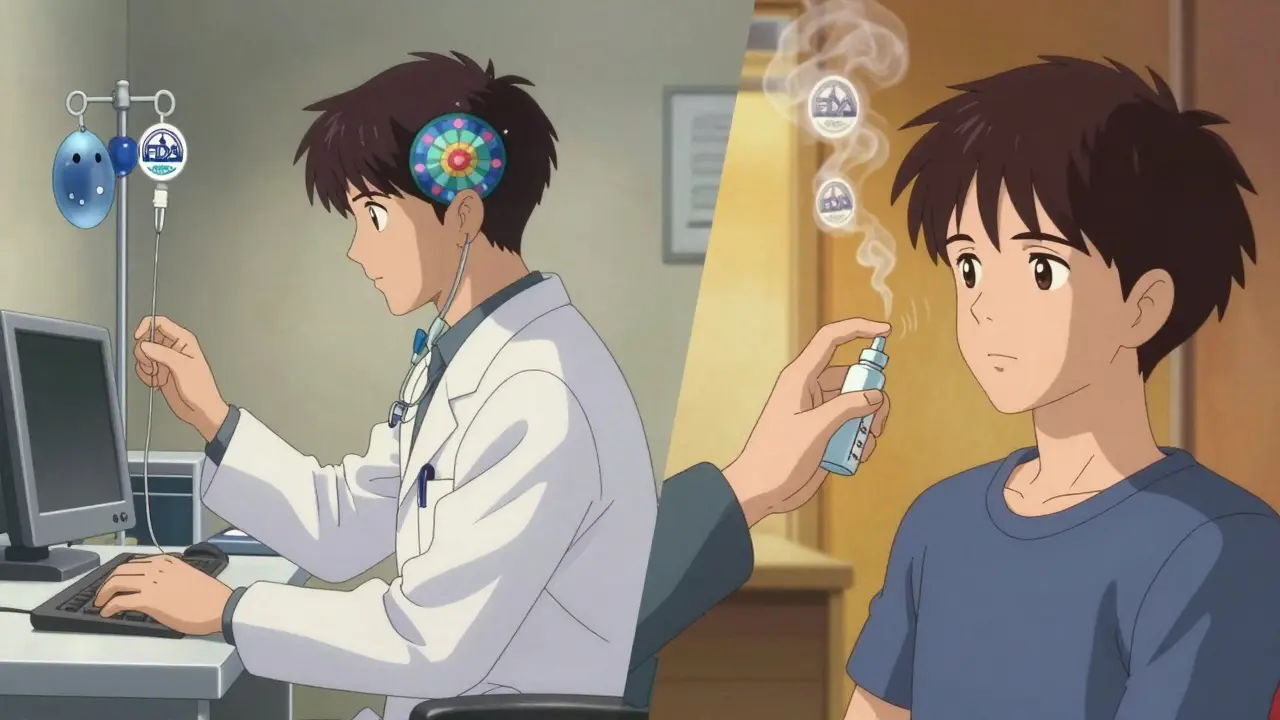
Ketamine is delivered through an IV drip over 40 minutes. Esketamine is sprayed into each nostril. That’s not just a difference in method-it’s a difference in control, comfort, and clinical setting. IV ketamine requires a vein, a nurse, and a room set up for monitoring vital signs. Esketamine can be given in a psychiatrist’s office with basic life support training.
And then there’s the experience. Ketamine often brings strong dissociation: feeling detached from your body, blurred vision, a sense of floating. About 42% of patients report this during IV treatment. Esketamine? Only 29% experience it, and usually less intensely. That’s why some patients prefer esketamine even if it takes longer to work.
Which one works faster and better?
A major 2025 study from Mass General Brigham tracked 153 patients with treatment-resistant depression. 111 got IV ketamine. 42 got esketamine. The results were clear: ketamine won.
After a full course of treatments, IV ketamine reduced depression scores by 49.22%. Esketamine? 39.55%. That’s a meaningful gap. And it wasn’t just about the final number. Ketamine patients showed improvement after their very first dose. Esketamine patients didn’t start seeing real change until after the second treatment.
This matches other research. A 2020 meta-analysis of multiple studies found IV ketamine consistently outperformed intranasal esketamine across all time points-from 24 hours to eight weeks. Ketamine hits harder and faster. For someone in crisis, that matters.
But speed isn’t everything. In real-world patient reviews from PatientsLikeMe, 63% of IV ketamine users felt major relief within 24 hours. For esketamine, it was 52%. Still good. But not as strong. On the flip side, 78% of esketamine users rated their overall experience as “good” or “excellent.” Only 63% of IV ketamine users did. Why? Because the dissociation, while effective, can be scary or overwhelming.
What does the FDA say?
The FDA approved esketamine in 2019 as the first fast-acting antidepressant. But ketamine? Still off-label. That’s a big deal.
Esketamine’s approval came with strict rules: it must be used with an oral antidepressant, and patients must stay under supervision for two hours after each dose. It’s also approved specifically for adults with acute suicidal thoughts or behaviors. That’s a narrow, high-risk group.
Ketamine, on the other hand, has been used off-label for depression since the early 2000s. Thousands of patients have been treated with it. Dozens of studies back its use. But because it’s not FDA-approved for depression, clinics can’t advertise it that way. Insurance rarely covers it. And many doctors won’t prescribe it unless they’re in a specialized pain or psychiatric clinic.
So while esketamine is the “approved” option, ketamine is the one with more real-world evidence behind it.
Cost and insurance: who can actually get it?
Cost is a huge barrier. A full course of eight IV ketamine infusions averages $4,200 to $5,600. A similar course of Spravato® runs $5,800 to $6,900. At first glance, ketamine looks cheaper. But here’s the catch: insurance.
67% of commercial insurers cover Spravato®. Only 38% cover IV ketamine. That means even if ketamine is less expensive, you might pay out of pocket for both. Medicare doesn’t cover either. Medicaid coverage varies by state.
And it’s not just about the treatment. You also pay for monitoring. Each session requires a two-hour observation period. That’s two hours you can’t work, drive, or care for kids. For some, that’s a hidden cost.
There’s also access. Only 12.4% of U.S. counties have certified Spravato® centers. Fewer still offer IV ketamine. If you live outside a major city, you might have to travel hundreds of miles. And even then, waitlists can be months long.
Who is each treatment best for?
There’s no one-size-fits-all answer. But based on the data, here’s how experts are thinking about it in 2026.
IV ketamine is better for:
- Patients with severe, life-threatening depression
- Those who need rapid symptom relief-within hours
- People who can tolerate dissociation and have access to a clinic with IV capability
- Those who want the most cost-effective option per quality-adjusted life year (QALY)
Esketamine is better for:
- Patients with suicidal ideation who need FDA-approved treatment
- Those who want to avoid IVs and prefer a nasal spray
- People who had bad reactions to dissociation with ketamine
- Those who need a maintenance option after initial stabilization
Dr. John Krystal from Yale says IV ketamine is the go-to for “life-threatening depression.” Dr. Christine Denny from Columbia says esketamine’s safety profile makes it ideal for “outpatient maintenance.” Both are right-it depends on your situation.
What about long-term results?
Neither treatment is a cure. Both require ongoing care. The longest study to date followed patients for six months. Of those who responded to IV ketamine, 56.3% stayed in remission with maintenance doses every 1-3 weeks. For esketamine, it was 48.7%.
That means even if you respond, you’re likely looking at a long-term plan. Some patients do monthly infusions. Others stay on weekly esketamine sprays. There’s no clear endpoint. And there’s no data yet on what happens after two years.
One emerging sign of hope: EEG brain scans. Researchers found that patients who responded to ketamine showed increased gamma wave activity in the frontoparietal region after treatment. That could become a biomarker to predict who will benefit-before they even start.
What are the risks?
Both drugs are Schedule III controlled substances. That means they have abuse potential. That’s why clinics require strict protocols: no driving after treatment, no alcohol, no other sedatives.
Side effects for both include dizziness, nausea, increased blood pressure, and dissociation. Ketamine has higher rates of hallucinations and dissociation. Esketamine has fewer, but still present.
There’s no evidence either drug causes brain damage at therapeutic doses. But long-term safety data beyond two years is still limited. That’s why experts recommend using them only after other treatments have failed.
What’s next?
The field is moving fast. In September 2025, the FDA accepted a new, higher-dose version of Spravato® (112 mg). Phase 3 trials are underway for intramuscular ketamine-giving the drug as a shot instead of an IV. That could be a middle ground: faster than nasal, less invasive than IV.
More clinics are opening. In 2020, there were 142 ketamine centers in the U.S. By 2025, that number jumped to 1,087. Spravato® sales hit $742 million in the first half of 2025 alone.
But access still lags behind need. Only 1 in 8 U.S. counties has a certified Spravato® center. And most of those are in big cities. For people in rural areas, this treatment might as well not exist.
Final thoughts: Is it worth it?
If you’ve tried multiple antidepressants and still feel trapped in darkness, ketamine and esketamine are two of the few options that can turn things around quickly. They’re not magic. They’re not risk-free. But for many, they’re the first real light in years.
IV ketamine works faster and stronger. But it’s more intense. Esketamine is gentler and easier to tolerate-but slower to kick in and harder to get covered by insurance.
The best choice isn’t the one that sounds better on paper. It’s the one you can actually access, afford, and stick with. Talk to a psychiatrist who’s experienced with both. Ask about your specific symptoms, your tolerance for side effects, your insurance coverage, and your ability to get to a clinic regularly.
Depression doesn’t wait. And now, for the first time, we have tools that don’t either.
Is ketamine FDA-approved for depression?
No, ketamine is not FDA-approved for depression. It was approved in 1970 as an anesthetic. Its use for depression is off-label, though backed by decades of research. Esketamine, the purified form of one of ketamine’s components, is FDA-approved under the brand name Spravato® for treatment-resistant depression and acute suicidal ideation.
How quickly do ketamine and esketamine work?
Ketamine can reduce symptoms within hours after the first IV dose. Esketamine typically takes two doses-usually given a week apart-before patients notice meaningful improvement. This difference is why ketamine is preferred in urgent cases.
Can I take ketamine or esketamine at home?
No. Both require administration under medical supervision with mandatory 2-hour monitoring after each dose. This is due to risks like dissociation, increased blood pressure, and potential for misuse. Home use is not permitted under current FDA guidelines or clinical standards.
Do I still need to take my regular antidepressant?
Yes. Esketamine must be used with an oral antidepressant. While ketamine can be used alone, most providers recommend continuing an antidepressant to help maintain long-term results. Stopping your regular medication without guidance can increase the risk of relapse.
Is ketamine addictive?
Ketamine and esketamine are Schedule III controlled substances, meaning they have potential for abuse. But in clinical settings, with controlled dosing and monitoring, the risk is low. Most patients don’t develop dependence. However, recreational use outside medical supervision carries a much higher risk of addiction and serious side effects.
What’s the success rate for these treatments?
About 70% of patients with treatment-resistant depression respond to IV ketamine, with nearly half achieving full remission. For esketamine, response rates are around 50-60%. Success depends on how severe the depression is, how many treatments are given, and whether the patient continues with other therapies.
How long do the effects last?
The antidepressant effect usually lasts days to weeks after a single dose. Most patients need maintenance treatments-every 1-3 weeks for ketamine, or weekly/biweekly for esketamine-to sustain improvement. Long-term remission rates after six months are about 56% for IV ketamine and 49% for esketamine.
Are there alternatives to ketamine and esketamine?
Yes. Other options include transcranial magnetic stimulation (TMS), electroconvulsive therapy (ECT), and newer medications like vortioxetine or brexanolone. ECT remains the gold standard for severe, treatment-resistant cases. But ketamine and esketamine are the only options that work within hours instead of weeks.

Kathy Scaman
Just had my first esketamine session last week. Felt like I was floating through a dream, but in a good way? My suicidal thoughts vanished by day 3. No joke. Still weird AF but worth it.
Howard Esakov
Ugh, esketamine? Please. If you're gonna do this, go full psychedelic. IV ketamine is the only real option. Spravato's just Big Pharma's watered-down version to milk insurance. I’ve done both. Ketamine made me see God. Spravato made me see my nose. 😒
Sue Latham
Howard, you’re such a drama queen. Not everyone wants to trip balls just to feel okay. I tried ketamine, got dissociated for 3 hours, cried the whole time, and then still had to drive home. Esketamine? I napped for 20 minutes, drank a smoothie, and went to yoga. 🙃
Anna Lou Chen
Let’s deconstruct the epistemology of pharmaceutical hegemony here. The FDA’s approval of esketamine isn’t a medical advancement-it’s a neoliberal capitulation to capital. Ketamine’s off-label status reflects the commodification of consciousness itself. We’re not treating depression-we’re managing affective labor under late-stage capitalism. The dissociative experience? That’s the body’s resistance to the ontological violence of the clinical gaze. 🌌
Meanwhile, the 49.22% reduction statistic? That’s a performative metric designed to obscure the fact that both modalities fail to address the structural trauma underlying depression: wage slavery, algorithmic alienation, and the collapse of communal belonging. We need decolonized neuroethics, not nasal sprays.
And don’t get me started on the 2-hour observation window. That’s not safety-it’s surveillance disguised as care. Who’s watching you? Who profits from your vulnerability? The answer isn’t in a clinic. It’s in the streets.
Also, gamma waves? Cute. But have you read Gabor Maté? Trauma isn’t in the synapses-it’s in the silence between generations. Your brain isn’t broken. Your world is.
So yes, I’ll take the IV. But I’ll also burn the clinic down after.
Mindee Coulter
I’m so glad this post exists. I’ve been on 7 antidepressants and nothing worked. Tried ketamine last month. The dissociation scared me but the relief? Unreal. My partner said I smiled for the first time in 2 years after the third infusion. No drama, no hype-just real change. If you’re stuck, just try it. Talk to your doc. You’ve got nothing to lose.
Timothy Davis
Let’s be real-this whole thing is a statistical illusion. The 49.22% vs 39.55% difference? p=0.07 in the Mass General study. Not significant. Also, esketamine’s 78% satisfaction rate? That’s because patients are told to expect mild effects. They’re not comparing apples to apples. The sample size for esketamine was tiny. And why is no one talking about the 22% of ketamine patients who developed bladder toxicity after 6+ months? Oh right-because the clinics don’t track it.
Also, the ‘63% felt relief within 24 hours’? That’s subjective self-reporting. No objective biomarkers. You’re just telling yourself you feel better because you paid $5k. Confirmation bias is real.
And the ‘1,087 clinics’? Most are cash-only, unregulated, staffed by nurse practitioners with zero psychiatric training. You’re gambling with your neurochemistry. This isn’t medicine. It’s a cult with IV drips.
Lexi Karuzis
WAIT-so you’re telling me the government approved a nasal spray that makes you feel like you’re leaving your body… but only if you sit in a room for two hours… and it’s only for suicidal people… and it costs $7k… and they won’t let you do it at home… but ketamine-same drug-can be given by some random clinic in a strip mall… and they don’t even need to report outcomes?!!
THIS IS A COVER-UP. The FDA is protecting Big Pharma’s monopoly on esketamine so they can charge $1,000 per dose while ketamine costs $500 and works better. And they’re hiding the fact that ketamine can be made synthetically in a garage. Why? Because if people knew they could get it cheaper… and safer… and faster… the entire pharmaceutical model collapses. This isn’t medicine. It’s control. They want you dependent. They want you coming back. They want you afraid to go home. And they’re using your pain to justify it.
Who owns the patents? Who funds the studies? Who sits on the FDA advisory board? Google it. You’ll find the same names. Over and over.
They’re not curing depression. They’re selling the illusion of cure. And you’re paying for it.
John Rose
I’ve been a therapist for 18 years. I’ve seen people come back from the edge with ketamine. I’ve also seen people get scared and quit after one session. What matters isn’t the drug-it’s the support around it. The right therapist, the integration sessions, the follow-up care. That’s what turns a temporary high into lasting change. If you’re considering this, don’t just chase the effect. Chase the process. And find someone who treats you like a person, not a patient number.