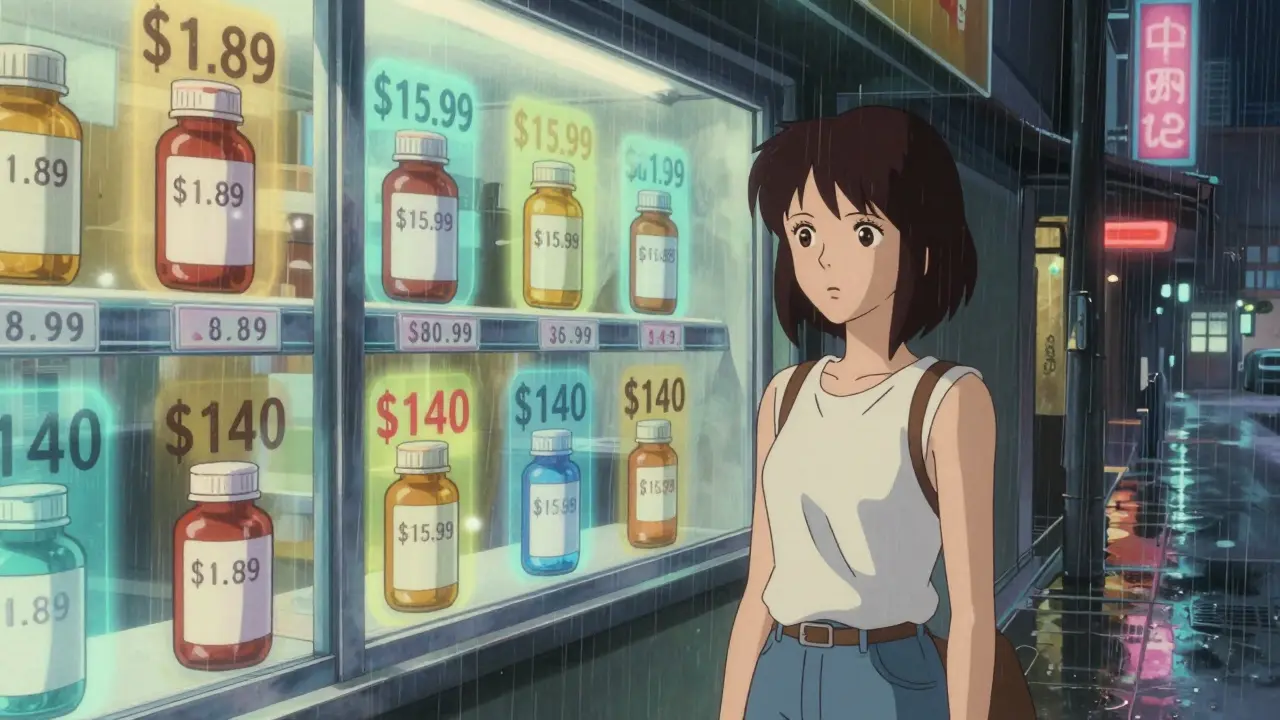
Did you know that the same pill can cost $2 at one pharmacy and $150 at another-right down the street? If you’re paying cash for your meds, you’re probably overpaying. Most people assume the price is fixed, but it’s not. Pharmacy pricing is wild. It’s not about brand loyalty, insurance, or even the pharmacy chain. It’s about shopping around.
Why Cash Prices Vary So Much
Pharmacies don’t set their own prices. They buy drugs from wholesalers who get them from manufacturers. The manufacturer gives different discounts to different buyers-insurance companies, PBMs (Pharmacy Benefit Managers), and even individual pharmacies. But when you pay cash, you’re stuck with the list price unless you use a discount tool. Here’s the kicker: the same generic metformin (used for diabetes) can cost $1.89 at a local independent pharmacy with a GoodRx coupon, but $15.99 at a national chain without one. That’s not a typo. In Springfield, Massachusetts, one study found Atorvastatin (generic Lipitor) ranged from $4.50 to $140 across just a few pharmacies. That’s over 3,000% difference. This happens because manufacturers use profit-maximizing pricing. They know some buyers are price-sensitive (like cash-paying customers), so they offer steep discounts to discount apps. Others, like big insurers, get rebates that never reach the consumer. You’re not getting those rebates unless you know how to ask for them.How Discount Apps Actually Work
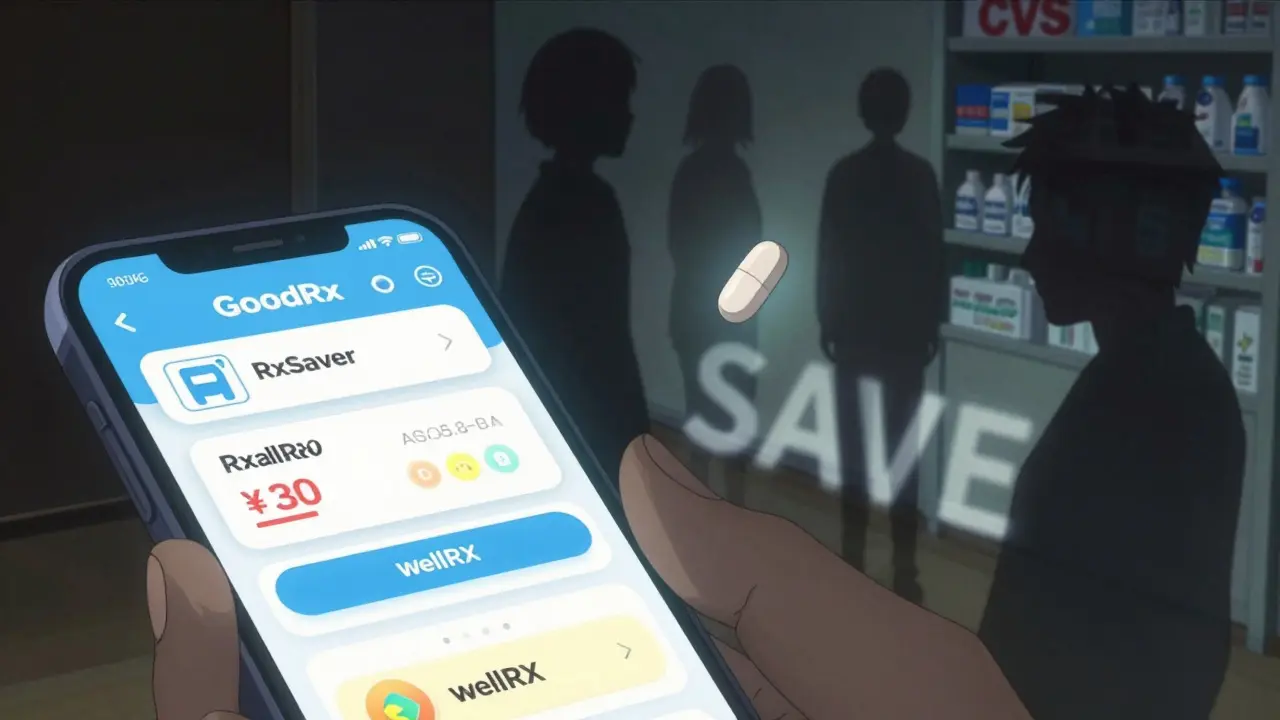
Apps like GoodRx, RxSaver, WellRX, and BuzzRx aren’t insurance. They’re negotiation engines. They partner with pharmacies to offer discounted cash prices in exchange for bringing them customers. Think of them as middlemen who’ve negotiated bulk deals-then passed the savings to you. GoodRx alone works with over 70,000 U.S. pharmacies. Their 2023 data shows users save an average of 88% on generics and 42% on brand-name drugs compared to the standard cash price. That’s not marketing fluff. A 2021 NIH study confirmed it: GoodRx discounts for generic cardiovascular drugs were nearly half the price at supermarkets versus national chains. But here’s what most people miss: these apps don’t always show the lowest price. Sometimes, the pharmacy’s own loyalty program or in-store discount is cheaper. That’s why you need to compare at least three apps before walking in.Which Pharmacies Are Cheapest?
Not all pharmacies are created equal. Here’s what the data shows:- Supermarkets (like Kroger, Safeway, Albertsons): Best for generics. Kroger’s $4/$9 program for 30-day supplies of common generics is hard to beat.
- Mass merchandisers (Walmart, Target, Costco): Walmart’s $4 list for many generics is legendary. Target and Costco often undercut national chains, especially if you’re not using insurance.
- National chains (CVS, Walgreens): Usually the most expensive for cash payers. But they sometimes have loyalty programs or coupons that can help.
- Independent pharmacies: These are the dark horses. They often have the lowest cash prices because they don’t have corporate pricing mandates. Ask if they have an unadvertised discount-38% of them do, according to UnityPoint Health.
Step-by-Step: How to Find the Lowest Price
You don’t need to be a pharmacist to save hundreds a year. Just follow these steps:- Ask for the cash price first. Never let the pharmacist start with your insurance. Say, “What’s the cash price?” You might be surprised. Sometimes, cash is cheaper than your insurance copay, especially with high-deductible plans.
- Check three discount apps. Open GoodRx, RxSaver, and WellRX on your phone. Compare prices for the exact same drug, dose, and quantity. Don’t trust one app. Prices vary by location and even by pharmacy branch.
- Call ahead. If the app shows $5, but the pharmacy says $12, ask why. Sometimes, the app price is for a different location. Call the specific branch. Pharmacies update prices daily, and apps can lag.
- Ask about store discounts. At Kroger, Target, or Walmart, ask if they have a $4/$9 program. At independent pharmacies, say, “Do you offer any discounts for cash payers?” Don’t be shy. Pharmacists are used to it.
- Consider mail-order. If you take the same med every month, try RXOutreach.com. It’s a nonprofit that gives generic drugs at deep discounts to people earning under $45,000/year. You don’t need insurance.
What About Medicare?
If you’re on Medicare, you still need to shop. Medicare Part D plans have different formularies and preferred pharmacies. During Open Enrollment (October 15-December 7), use Medicare’s Plan Finder tool to compare your current plan’s cost for your meds versus others. Even with Medicare, you can use GoodRx. It’s legal. You just can’t stack it with your Part D coverage. But if your copay is $30 and GoodRx says $8, pay cash. Save the difference.Real Stories, Real Savings
On Reddit, a user named u/MedSaver2023 paid $1.89 for metformin at a local pharmacy using GoodRx. The same drug at Walgreens was $15.99. That’s $14 saved every month-$168 a year. Another user in Chicago found insulin prices ranging from $98 to $345 for the same vial across four pharmacies within two miles. That’s $247 in potential savings per vial. Imagine that on a monthly med. A Trustpilot review from October 2023 says: “Saved $112 on my Synthroid at Walmart versus what my insurance would have charged.” That’s not an outlier. It’s the norm.
When Discount Apps Don’t Help
Some drugs won’t save you much. Brand-name drugs like Humira, Enbrel, or biologics rarely have big discounts. That’s because manufacturers don’t offer rebates to discount apps for these. But here’s the trick: ask your doctor if a biosimilar is an option. Biosimilars are cheaper, FDA-approved copies of biologics. For Humira, biosimilars like Amjevita can cut costs by 50% or more. Also, some apps show prices that are outdated. A 2022 Consumer Reports study found 12.7% of price listings were wrong. Always call ahead.Long-Term Strategy: Build a Savings System
This isn’t a one-time fix. Make it a habit:- Set a reminder every 3 months to check your top 3 meds.
- Keep a note in your phone with the cheapest pharmacy for each drug.
- Ask your pharmacist if they know of any new discounts.
- Switch to mail-order for maintenance meds (like blood pressure or cholesterol drugs).
Final Thought: You’re Not Being Lazy-You’re Being Smart
Pharmacies don’t want you to know prices vary. They rely on you assuming the price is fixed. But you’re not the only one doing this. Millions are. The system is broken, but you don’t have to be a victim of it. You don’t need a degree in pharmacology. You just need 10 minutes. A phone. And the willingness to ask, “What’s the cash price?”Is it legal to use GoodRx instead of insurance?
Yes. You can choose to pay cash with a GoodRx coupon instead of using your insurance. This is especially useful if your insurance copay is higher than the cash price. Just tell the pharmacist you’re paying cash and using a coupon. They can’t refuse you.
Can I use GoodRx with Medicare Part D?
You can’t combine GoodRx with Medicare Part D coverage, but you can use GoodRx instead of your Part D plan. If the GoodRx price is lower than your copay, pay cash. That money won’t count toward your deductible or out-of-pocket maximum, but you’ll save money upfront.
Why is my prescription cheaper at Walmart than my local pharmacy?
Walmart negotiates directly with manufacturers for bulk generic drugs and passes the savings to customers. Many local pharmacies don’t have the same buying power. Walmart’s $4/$9 program is a special deal for high-volume, low-cost generics. Independent pharmacies may have better prices on specialty meds, but not on common ones.
Do pharmacies ever match prices?
Some do, especially independents. If you show them a lower price from another pharmacy, they might match it or beat it. It’s not guaranteed, but it’s worth asking. Pharmacists want to keep customers, especially if you’re a regular.
Are there any medications that don’t have cash discounts?
Yes. Brand-name drugs with no generic alternative-like Humira or Enbrel-often have little to no discount through apps. Also, some specialty drugs used for rare conditions may not be included in discount programs. Always check multiple sources and ask your doctor about alternatives.
How often should I check my prescription prices?
Check every 3 to 6 months. Prices change often. A drug that was $10 last month might be $5 this month due to a new manufacturer entering the market. Also, during Medicare Open Enrollment (October-December), your plan’s pricing may shift, so it’s a good time to reassess.
Can I get discounts on insulin?
Yes. Many pharmacies now offer insulin at $25-$35 per vial without insurance. Walmart’s ReliOn brand insulin is $25 per vial. Also, RxOutreach.com offers insulin at deep discounts for qualifying incomes. In 2023, the Inflation Reduction Act capped insulin at $35/month for Medicare Part D users, but cash payers can still save more by shopping around.

Lance Nickie
Why are we even talking about this like it’s a revelation? Everyone knows pharmacies are a scam.
Damario Brown
Bro, you’re telling me people don’t know that GoodRx exists? That’s like saying ‘did you know water is wet?’ The real issue is that Big Pharma and PBMs are rigged to make you feel dumb for not knowing how to game a broken system. You think this is about shopping? Nah. It’s about surviving capitalism with a $1000 deductible and a heart condition.
I had a friend on insulin who paid $380 at CVS until she found a local pharmacy that matched Walmart’s $25 price after she showed them the GoodRx app. They didn’t even blink. Just said, ‘We do that for regulars.’ That’s the real lesson here-ask, beg, bargain. No one’s coming to save you.
And don’t even get me started on how Medicare Part D plans hide the true cost until you’re at the counter. I’ve seen people cry because their ‘covered’ drug was $120 and the cash price was $17. That’s not healthcare. That’s extortion with a stethoscope.
Also, most apps are outdated. I checked RxSaver for my metformin and it said $1.99. Called the pharmacy. $12. Called another. $3.25. Apps are just a starting point. Like using Yelp to find a restaurant and then realizing the one with 3 stars has better food because the reviews are fake.
And yeah, biosimilars are the future. If your doctor’s too lazy to suggest them, go elsewhere. They’re not ‘inferior.’ They’re FDA-approved clones. It’s like buying a generic battery instead of Duracell. Same voltage, half the price.
John Pope
Let’s be real for a second-this isn’t about shopping. This is about the collapse of the social contract. We used to trust that medicine was a right, not a commodity you haggle over like a used car. Now you need a spreadsheet, three apps, and a PhD in pharmacoeconomics just to get your blood pressure pills.
And the worst part? The people who need this the most-low-income, elderly, disabled-are the least equipped to do this legwork. They’re tired. They’re scared. They don’t have time to call five pharmacies. So they pay $150 for a pill that should cost $5. And then they skip doses. And then they end up in the ER. And then the system blames them for being ‘noncompliant.’
This isn’t empowerment. It’s exploitation dressed up as a life hack. We’ve turned healthcare into a game of Whack-a-Mole where the mallet is your dignity.
And don’t get me started on how pharmacies hide the cash price until you ask. That’s not customer service. That’s psychological manipulation. They want you to feel guilty for wanting to pay less.
But hey, at least we’ve got GoodRx. Right? Like that’s some kind of moral victory. A nonprofit app saving us from a system that was supposed to protect us. What kind of world are we living in?
John Tran
Okay, so I’ve been doing this for years and I just want to say-this whole post is basically a 2000-word Reddit post written by someone who just discovered Google and thinks they’re the first person to figure out that pharmacies aren’t charities.
But here’s the thing I learned the hard way: sometimes, the cheapest price isn’t the best. I once got a generic version of my thyroid med from a discount pharmacy and it gave me panic attacks. Turns out, the filler ingredients were different. Same active ingredient, different binders. My body didn’t like it. I went back to the $18 version and felt like a human again.
So yeah, shop around. But also, pay attention to how you feel. Don’t just chase the lowest number like it’s a video game leaderboard. Your body isn’t a spreadsheet. Sometimes, paying a little more means you’re not spending $2000 on an ER visit because your meds didn’t work right.
Also, I tried RxOutreach. Took 6 weeks to get my meds. I was out for a month. Not worth it unless you’re on a waiting list for a kidney transplant.
And why do people act like GoodRx is some kind of miracle? It’s a coupon. A really good one. But it’s not magic. It’s not justice. It’s just capitalism with a little extra glitter on top.
And don’t even get me started on the ‘ask your pharmacist’ advice. Most pharmacists are overworked, underpaid, and have 12 people in line. They don’t have time to explain why your $4 metformin at Walmart isn’t the same as the $3.50 one at the corner store that uses a different manufacturer. They just scan and smile.
Also, I once called 17 pharmacies in my city for my dad’s blood thinner. One had it for $1.99. Another for $142. The one in the middle? $47. Why? Because the manager was a nice lady who remembered my dad from last year. She gave me a discount because she knew he was a veteran. That’s the real secret. Not apps. Not coupons. Human kindness. And that’s not something you can find on a website.
So yeah. Shop around. But also… be kind. And maybe, just maybe, the person behind the counter will be kind back.
Scottie Baker
Why are we still talking about this like it’s news? I’ve been doing this since 2017. You think this is hard? Try being on dialysis and having to choose between your meds and your rent. This isn’t a ‘life hack.’ This is survival. And if you’re acting like you just discovered it, you’ve been living in a bubble. Get off your high horse and help someone who actually needs it.
Priyanka Kumari
Thank you for sharing this so clearly! I’ve been helping my elderly neighbors navigate this for years, and it’s heartbreaking how many don’t know they can save hundreds. I always tell them: ‘Don’t be embarrassed to ask. Pharmacists are here to help, not to judge.’
I’ve even made a simple checklist I print out for them: 1) Ask cash price, 2) Check GoodRx and RxSaver, 3) Call the store, 4) Ask about loyalty programs, 5) Write down the best price.
One lady saved $89/month on her diabetes meds just by switching from CVS to Kroger. She cried when she realized she could afford her groceries again. That’s the real win here-not the savings, but the peace of mind.
Also, if you’re on Medicare, don’t forget to check your plan’s formulary during Open Enrollment. A small change can save you hundreds. I help people do this every year-it takes 20 minutes, but it’s worth it.
And yes, biosimilars are a game-changer. If your doctor doesn’t mention them, ask. They’re safe, effective, and way cheaper. You’re not giving up quality-you’re choosing wisdom.
Let’s make this knowledge more accessible. Share this with someone who needs it. No one should have to choose between medicine and dinner.
Anny Kaettano
As someone who works in pharmacy admin, I see this every day. People come in stressed, confused, sometimes in tears because they can’t afford their meds. The system is broken, but there are still good people behind the counter.
I’ve had patients show me a GoodRx coupon and I’ve matched it-even when corporate told me not to. Why? Because I remember what it was like growing up poor. I know what it feels like to skip a dose.
Also, the ‘$4 generics’ program? It’s real. But not all pharmacies advertise it. If you’re at Walmart, Target, or Kroger, just ask: ‘Do you have the $4 list?’ They’ll pull it up. No shame. No questions.
And if you’re on insulin? Look up the ‘Insulin Patient Assistance Programs.’ Many manufacturers give free or low-cost insulin to people under 400% of the poverty line. You don’t need to be homeless to qualify.
Don’t just save money-save lives. And if you’re reading this and you’re healthy? Help someone who isn’t. Buy their meds. Share this post. Whisper it to your grandma. It matters.
Trevor Whipple
Ugh. Another ‘how to save money on meds’ post. Newsflash: if you’re paying cash for anything beyond Tylenol, you’re already doing it wrong. The real solution is single-payer. Or at least price controls. Not some hacky app that lets you play pharmacy roulette.
And don’t get me started on GoodRx. It’s not a discount. It’s a loophole. A way for Big Pharma to offload their overpriced generics onto the cash-paying poor while still raking in billions from insurers. They don’t care if you save $100 a year. They care that you’re still buying their drugs.
Also, ‘ask your pharmacist’? Yeah, good luck with that. Most are overworked, underpaid, and legally prohibited from telling you the real price unless you ask. That’s not customer service. That’s a feature of the system.
And Walmart’s $4 list? It’s a marketing stunt. They only include the cheapest generics. If your med isn’t on it, you’re screwed. And if you need something like a specialty thyroid med? Good luck finding a $4 version.
Stop treating this like a game. This is a humanitarian crisis. And you’re all just optimizing your survival inside a burning building.
Clay .Haeber
Wow. A whole essay on how to not get robbed by pharmacies. I’m so proud of us. We’ve turned healthcare into a scavenger hunt with extra steps and zero reward. Congrats, America. You’ve mastered the art of paying for your own exploitation.
Let me get this straight: you need a smartphone, three apps, a calling list, and a PhD in corporate pharmacy pricing just to get your blood pressure pills? And the system is proud of you for doing it?
Meanwhile, in Canada, you walk in, hand over your card, and pay $5. No questions. No coupons. No drama. Just medicine.
But no, we’re better. We’re the land of the free, where your health is a negotiation and your life is a spreadsheet.
I’m just waiting for the next post: ‘How to Negotiate Your Child’s Vaccination Price.’
Robin Williams
Man, I used to think money was the problem. Then I realized it’s not about the cash. It’s about the shame. You feel like a beggar asking for a discount. Like you’re doing something wrong for wanting to pay less. But here’s the truth: you’re not asking for charity. You’re asking for fairness.
I used to pay $120 for my statin. Then I found a pharmacy that sold it for $3.99. I cried. Not because I saved money. Because I realized I’d been paying too much for three years. And no one told me. No one cared.
It’s not about GoodRx. It’s about being seen. About being treated like a human, not a revenue stream.
So yeah. Shop around. But also? Tell someone. Tell your mom. Tell your neighbor. Tell the guy at the gas station. Because if you don’t, someone else will keep paying $150 for a pill that costs $5.
We’re not broken. We’re just silent. Time to speak up.
mike swinchoski
You’re all wrong. The real problem is people who don’t have insurance. If you had insurance, you wouldn’t need this. Stop complaining. Get a job with benefits.
John Pope
Wow. Someone actually said it. The real issue isn’t pricing-it’s the fact that we’ve normalized this. We don’t ask why insulin costs $300. We just ask where to get the coupon. We’ve turned survival into a hobby.
And the worst part? We’re proud of it. Like we’re winning a game. But we’re not. We’re just learning to bleed slower.