
Adverse Event Checker
Is Your Experience Reportable to the FDA?
The FDA defines a serious adverse event as one that:
- Caused death
- Was life-threatening
- Required hospitalization
- Resulted in permanent disability
- Caused a birth defect
- Required medical or surgical intervention to prevent permanent harm
The FDA says: "If you think it's serious, report it." Better to report too much than too little.
Describe Your Experience
Report Eligibility Results
Please complete the form above to check if your experience qualifies for reporting.
Every year, millions of people take prescription drugs, over-the-counter medicines, or use medical devices like glucose monitors or insulin pumps. Most of the time, they work as expected. But sometimes, something goes wrong. A rash appears out of nowhere. A heart starts racing for no reason. A device fails during use. These aren’t just bad luck-they’re signals. And the FDA needs to hear about them.
That’s where MedWatch comes in. It’s not a fancy app or a government hotline. It’s the official system the FDA uses to collect reports of harmful side effects, device failures, and other safety problems. You don’t need to be a doctor. You don’t need to be a scientist. If you or someone you care about had a bad reaction to a medicine or medical product, you can report it. And your report matters.
What Exactly Is MedWatch?
MedWatch is the FDA’s safety reporting program. It’s been around since the 1990s and collects information on problems with drugs, medical devices, biologics (like blood products and gene therapies), even some cosmetics and CBD products. It’s not just for hospitals or drug companies-it’s for you.
The FDA doesn’t test every medicine under every possible condition before it hits the market. Clinical trials involve thousands, not millions, of people. Rare side effects, interactions with other medications, or failures in real-world use often only show up after the product is widely used. That’s where MedWatch steps in. It’s the eyes and ears of the public health system.
According to the FDA, MedWatch gets about 1.2 million reports each year. Eighty percent come from doctors, nurses, and drug manufacturers. The other 20% come from patients and caregivers like you. That’s why your report counts.
When Should You Report?
You don’t need to wait for a hospital stay or a life-threatening event to report. But the FDA defines a serious adverse event as one that:
- Caused death
- Was life-threatening
- Required hospitalization
- Resulted in permanent disability
- Caused a birth defect
- Required medical or surgical intervention to prevent permanent harm
Let’s say you started a new blood pressure medication and developed severe dizziness that made you fall. You didn’t go to the ER, but you were out of work for three days. That’s worth reporting. Or your glucose meter gave a false reading and you took too much insulin. Even if no one was hurt, the device malfunctioned. Report it.
The FDA says: “If you think it’s serious, report it.” Better to report too much than too little.
How to Report: Two Simple Forms
The FDA made it easy with two forms-one for you, one for professionals.
For patients and caregivers: Use Form FDA 3500B
This is the consumer version. It’s shorter. It’s in plain language. You’ll need:
- Your name and contact info (optional-you can report anonymously)
- The name of the medicine, device, or product
- When you started using it
- When the problem happened
- A description of what happened
- Whether you saw a doctor
- Any other medicines you were taking
It takes about 10 to 20 minutes. You can fill it out online at the MedWatch website, download and mail it, or call 1-800-FDA-1088.
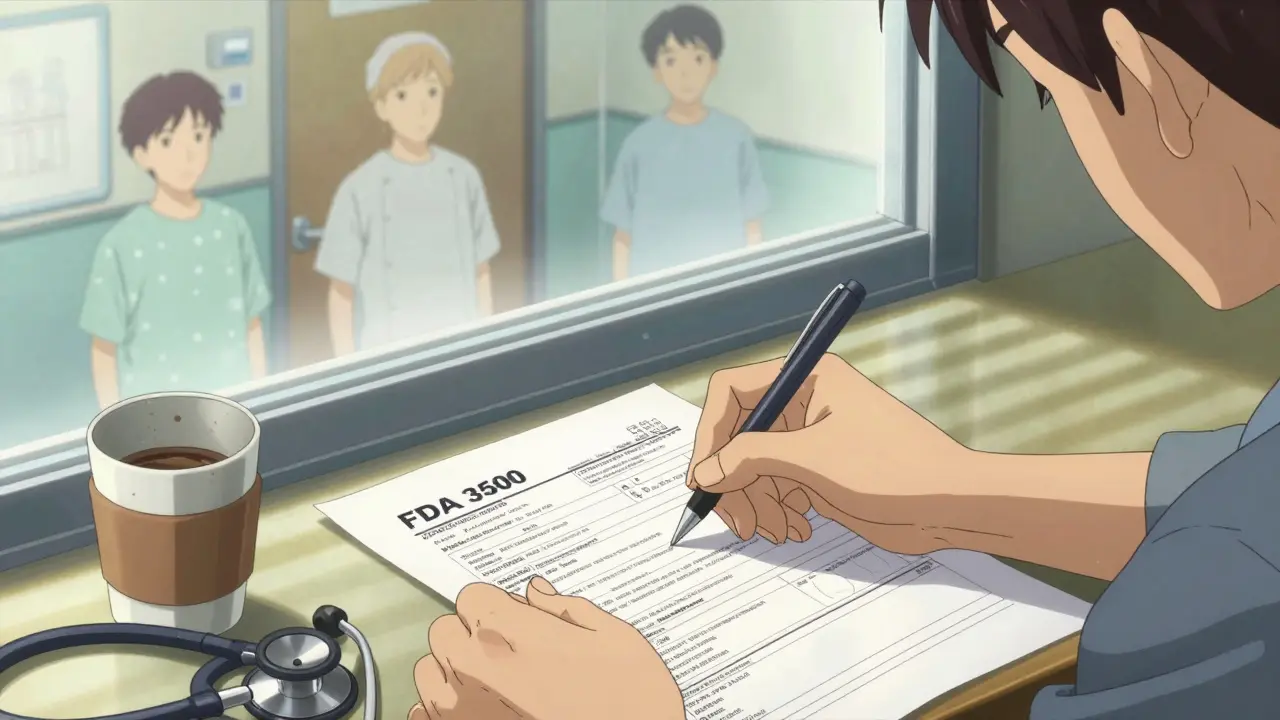
For healthcare providers: Use Form FDA 3500
Doctors, nurses, pharmacists, and hospitals use this form. It’s more detailed. You’ll include your license number, specialty, and clinical notes. If you’re a professional, you’re expected to report serious events. But even if you’re not, you can still use this form if you have more details to share.
Both forms are available in English and Spanish. The FDA redesigned the online portal in 2021 to work better on phones and tablets. Buttons are bigger. Text is clearer. It’s not perfect-but it’s a lot better than it used to be.
What Happens After You Report?
Nothing dramatic. No one will call you. No lawsuit will start. But here’s what actually happens:
- Your report goes into a database with over 10 million entries.
- FDA analysts look for patterns. If 10 people report the same rare rash from the same drug, that’s a signal.
- If enough signals appear, the FDA may update the drug label to warn others.
- They might require the manufacturer to run a new safety study.
- In rare cases, they may pull a product off the market.
One real example: In 2019, dozens of patients reported severe skin reactions after using a popular acne treatment. The FDA reviewed the reports, confirmed the pattern, and added a black box warning-the strongest type-to the label. That warning saved lives.
You won’t get a thank-you note. But you might get a confirmation email if you leave your address. And that’s enough. Because your report could be the one that triggers change.
Why So Few People Report
Here’s the hard truth: the FDA estimates that only 1% to 10% of serious side effects are ever reported. That means 90% to 99% go unnoticed.
Why? People don’t know how. They think it’s the doctor’s job. They’re afraid of getting in trouble. Or they think, “It’s just me.”
But here’s what the FDA says: “Your health care provider is NOT required to report to the FDA.” That means if you don’t report, no one might.
Patients often get stuck on confusing terms like “event abated” or “dose frequency.” The FDA admits the forms can feel intimidating. That’s why they recommend: “Take the form to your doctor.” You don’t have to fill it out alone. Your doctor can help you explain what happened in medical terms.
One nurse practitioner in Seattle told the FDA: “I had a patient who had a reaction to her new insulin pump. I sat with her for 20 minutes. We filled out the form together. She felt heard. And I knew we might help someone else down the line.”
What’s Not Covered
MedWatch doesn’t handle everything. You can’t report:
- Vaccines (use the Vaccine Adverse Event Reporting System, or VAERS)
- Animal medications (use the FDA’s Center for Veterinary Medicine)
- Tobacco products
- Food or dietary supplements (use the FDA’s MedWatch for dietary supplements)
But for everything else-prescription drugs, OTC meds, contact lenses, hearing aids, insulin pens, even topical creams-you can use MedWatch.
What You Can Do Right Now
Don’t wait for a crisis. Here’s what to do today:
- Go to fda.gov/medwatch
- Click “How to Report”
- Download Form FDA 3500B (for consumers)
- Print it or fill it out online
- Ask your doctor to help if you’re unsure
- Submit it by mail, phone, or online
Set a reminder. If you’ve taken a new medication in the last 30 days, check in. Did anything unusual happen? If yes, report it.
Or better yet-keep a copy of the form in your health folder. You never know when you’ll need it.

Why This Matters More Than You Think
MedWatch isn’t just a form. It’s a safety net. It’s how the FDA learns what’s really happening out there-not in a lab, but in real homes, in real bodies.
Dr. Janet Woodcock, former head of the FDA’s drug center, said: “MedWatch reports are essential for identifying safety signals that may not have been evident during clinical trials.”
Think about it. A 78-year-old woman takes a new arthritis pill. She gets confused, forgets to eat, and ends up in the hospital. Her doctor doesn’t report it. No one else knows. Months later, another woman has the same reaction. And another. If no one reports, the FDA never sees the pattern. The drug stays on shelves. More people get hurt.
Your report breaks that chain.
It’s not about blame. It’s about safety. It’s about making sure the next person doesn’t have to go through what you did.
Frequently Asked Questions
Do I need to be a doctor to report to MedWatch?
No. Anyone can report-patients, family members, caregivers, or even bystanders. The FDA encourages consumers to report directly using Form FDA 3500B. You don’t need medical training. Just describe what happened, when, and with what product.
Can I report anonymously?
Yes. You are not required to give your name, address, or phone number. But if you want a confirmation that your report was received, you can include your contact details. The FDA keeps all reports confidential and does not share personal information publicly.
How long does it take to fill out the form?
For patients, the consumer form (FDA 3500B) usually takes 10 to 20 minutes. If you have your medication name, dates, and symptoms ready, it goes faster. Healthcare professionals using Form FDA 3500 may take longer due to additional clinical details.
What if I’m not sure if it was the drug or something else?
Report it anyway. The FDA’s job is to sort out the cause. Even if you’re uncertain, your report adds valuable data. Many safety signals start with a single unclear report that later connects with others.
Will reporting cause problems for my doctor or pharmacist?
No. Reporting is not a complaint or accusation. It’s a safety observation. The FDA does not punish providers for reports. In fact, they encourage professionals to report. Your report helps improve the safety of all medications and devices.
Can I report a problem with a dietary supplement?
Yes. Dietary supplements are covered under MedWatch. You can report side effects from vitamins, herbal products, or weight-loss pills using the same consumer form. The FDA tracks these reports to identify unsafe ingredients or misleading claims.
Next Steps
If you’ve had a bad reaction, don’t wait. Go to the MedWatch website today. Print the form. Write down what happened. If you’re unsure, call 1-800-FDA-1088. A real person will help you.
If you’re a healthcare provider, make reporting part of your routine. When a patient tells you something went wrong, ask: “Have you reported this to the FDA?” If not, help them do it.
MedWatch isn’t perfect. It’s slow. It’s not always easy. But it’s the only system that connects everyday people to the FDA’s safety network. And right now, it needs you.

Kipper Pickens
MedWatch is the unsung hero of pharmacovigilance. The system operates on a signal detection model where disproportionate reporting ratios (PRRs) are calculated across millions of entries to identify adverse event clusters. The FDA's CBER and CDER divisions use this data to trigger Risk Evaluation and Mitigation Strategies (REMS) when statistical thresholds are breached. Most patients don't realize that their 10-minute form submission contributes to a Bayesian updating algorithm that reshapes labeling protocols. This isn't bureaucracy-it's real-time post-marketing surveillance at scale.
Aurelie L.
I took that new migraine pill and my tongue swelled up. Didn't report it. Now I'm terrified.
Sally Dalton
OMG I just read this and I’m crying 😭 I had a crazy reaction to my blood pressure med last year and I didn’t know I could report it!! My doctor just said ‘it’s probably nothing’ but I felt so alone. I just submitted my form on my phone!! Thank you for writing this!! 🙏 I’m telling all my friends!!
Allie Lehto
They want you to report… but who’s really watching? The FDA’s underfunded, the pharma lobby owns Congress, and your ‘important’ report just gets buried in a database with 10 million other entries. You think you’re helping? You’re just feeding the machine that lets them keep selling dangerous crap. Wake up. It’s all a controlled narrative. 🤡
Henry Jenkins
Interesting breakdown, but I think we’re missing a bigger point. MedWatch relies entirely on voluntary reporting, which introduces massive selection bias. Patients who have severe reactions are more likely to report than those with mild ones. Meanwhile, healthcare providers underreport due to time constraints and fear of liability. The 20% patient-reported figure sounds impressive until you realize it’s skewed toward dramatic cases. We need mandatory reporting for hospitals and pharmacies-like how we report infectious diseases. Otherwise, we’re just collecting noise, not signals. The FDA’s own studies show that 87% of serious events go unreported even among providers. This system is a band-aid on a hemorrhage.
Dan Nichols
MedWatch is a joke. You think your little form changes anything? The FDA gets a million reports a year and acts on maybe 3. Most of the time they just slap on a warning label and call it a day. Meanwhile, the drug makers keep making billions. You’re not saving lives-you’re giving them plausible deniability. And don’t get me started on the forms. They’re designed to confuse. If you’re not a nurse or a lawyer you’ll miss half the fields. This isn’t transparency-it’s theater.
Renia Pyles
So let me get this straight-I’m supposed to trust the FDA after they let OxyContin kill half the country? After they approved Vioxx knowing it caused heart attacks? After they ignored thousands of reports on fen-phen? Your ‘safety net’ is a sieve. And now you want me to fill out a form like I’m some good little citizen? No thanks. I’ll take my chances with the pharmacy.
Rakesh Kakkad
Respected authorities, I must respectfully submit that the MedWatch system, while commendable in its intent, lacks integration with the Indian pharmacovigilance program (India PV). In my clinical practice in Mumbai, I have observed that patients often discontinue medications due to adverse events but are unaware of reporting mechanisms. I recommend cross-border data sharing protocols and multilingual form accessibility to enhance global signal detection. Thank you for your tireless service to public health.
Nicholas Miter
Just wanted to say I filled out the form last week after my knee brace snapped during a walk. Didn’t think it mattered, but figured why not. Took me 15 mins. Didn’t even need to call my doctor-just typed what happened. No drama. No yelling. Just… did it. If you’ve ever had something weird happen with a med or device, just do it. It’s not about being right or wrong. It’s about being the kind of person who helps before it’s too late.
Suresh Kumar Govindan
MedWatch is a psyop. The FDA is a subsidiary of Big Pharma. Every report you submit is logged, analyzed, and used to refine product design-not to protect you. The ‘black box warning’ you admire? It’s a marketing tool to limit liability. The real danger lies in the unreported cases-the ones that never make it into the system because the patient died quietly at home. This is not safety. This is surveillance disguised as service.
George Rahn
Let’s be crystal clear: this country was built on grit, not government forms. We don’t need some bureaucrat in D.C. telling us what’s safe. If you got hurt, sue the company. That’s American justice. Not some 10-minute form that gets tossed into a digital black hole. This isn’t patriotism-it’s submission. And if you think your report changes anything, you’ve been drinking the Kool-Aid from the FDA’s PR department.