
Imagine your child has a fever. You grab the bottle of liquid medicine from the cabinet. The prescription says "give 5 mL." You reach for a kitchen spoon because that’s what you have on hand. You pour it in, but was it really 5 mL? Or was it 7 mL? Or only 3 mL?
If you’ve ever given liquid medicine at home, you know this moment well. It feels simple, but the stakes are high. Wrong-dose errors with liquid medications represent a critical patient safety concern where patients receive incorrect volumes of pharmaceuticals. These mistakes aren’t just minor slips; they can lead to hospital visits or worse.
In fact, about 80% of medication errors made at home involve children, according to a 2023 study in the Journal of Pediatrics. Nearly half of caregivers give doses that are off by more than 20%. That’s not just a rounding error-that’s a safety gap we need to close. This guide breaks down exactly why these errors happen and, more importantly, how you can stop them before they start.
Why Liquid Medication Dosing Goes Wrong
To fix the problem, we first need to understand where it comes from. It’s rarely just one thing. Usually, it’s a combination of confusing labels, the wrong tools, and human fatigue.
The biggest culprit is the measuring device. Many parents still use household spoons. Here is the hard truth: a standard teaspoon varies wildly in size. One brand’s teaspoon might hold 4 mL, while another holds 6 mL. Neither is the true 5 mL metric standard. When you rely on kitchenware, you’re guessing.
Then there is the issue of units. For years, prescriptions used terms like "teaspoon" or "tablespoon." The American Academy of Pediatrics (AAP) banned this practice in 2015, mandating milliliter (mL) markings only. Yet, confusion persists. If a doctor writes "tbsp" and a parent reads it as "tsp," the dose could be three times too high or low.
Packaging also plays a role. Look-alike bottles for different strengths of the same drug can trick even experienced nurses. In hospitals, the Institute for Safe Medication Practices (ISMP) lists wrong-dose liquid errors as a top hazard. At home, it’s often simpler: poor lighting, rushing, or lack of training leads to misreading the meniscus (the curve of the liquid in the cup).
The Right Tools: Syringes vs. Cups vs. Spoons
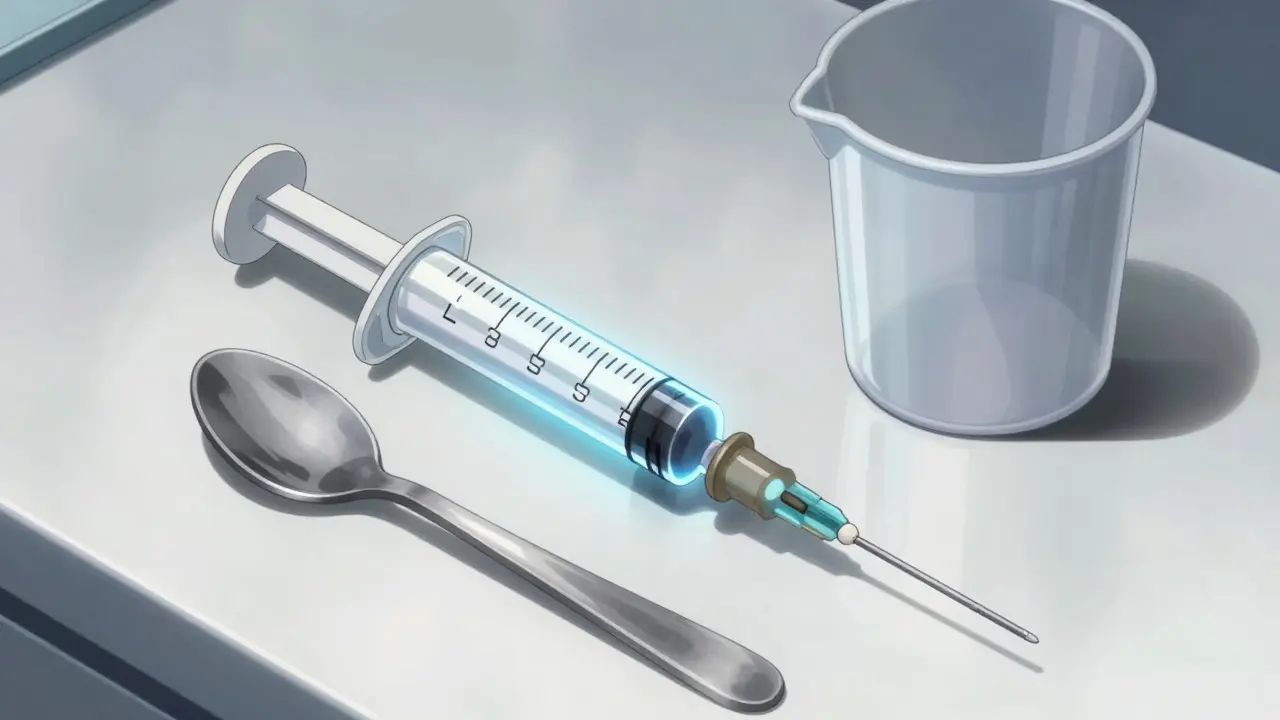
Not all measuring devices are created equal. If you want accuracy, you need the right tool for the job. Let’s look at the data comparing the most common methods.
| Device Type | Accuracy Rate (for small doses) | Error Risk | Best Use Case |
|---|---|---|---|
| Oral Syringe | 94% | Low | Doses under 5 mL; precise control |
| Dosing Cup | 76% | Moderate | Larger doses (>5 mL); less precision needed |
| Kitchen Spoon | 62% | High | Avoid entirely |
As the table shows, oral syringes provide significantly greater accuracy than dosing cups or household spoons for small liquid medication volumes. A randomized controlled trial published in Pediatrics found that syringes are 37% more accurate than cups. Why? Because syringes allow you to see the exact volume against clear graduations. Cups, especially when viewed from an angle, hide the true level of the liquid.
For doses under 1 mL, use a syringe with 0.1 mL markings. For doses between 1 and 5 mL, use one with 0.5 mL markings. Never use a large 10 mL syringe to measure 0.5 mL-the margin for error is too big. Match the tool to the dose.
Step-by-Step: How to Measure Accurately
Having the right tool is only half the battle. Technique matters just as much. Follow these steps every time you administer liquid medication:
- Shake the bottle. Most liquid suspensions settle. Shake for 10 seconds to ensure the medicine is evenly mixed.
- Draw the dose slowly. Pull the plunger back smoothly. Fast drawing creates air bubbles, which take up space and reduce the actual medicine volume.
- Check for bubbles. Tap the syringe gently to move bubbles to the top. Push the plunger slightly to expel them until the liquid reaches the correct line.
- Eye-level verification. Hold the syringe at eye level. Do not look down from above or up from below. The bottom of the meniscus (the curve) should align perfectly with the measurement mark.
- Administer correctly. Place the tip inside the cheek, near the back molar. Aim away from the tongue to prevent choking or spitting out the bitter taste.
This routine takes an extra minute, but it eliminates guesswork. Consistency is key. If you change techniques every time, you introduce variables that lead to errors.
Technological Safeguards in Healthcare
While home care relies on manual diligence, hospitals and pharmacies use technology to catch errors before they reach the patient. Understanding these systems helps you advocate for better care.
Barcode Medication Administration (BCMA) systems reduce wrong-dose errors by 48% compared to manual checks. Nurses scan the patient’s wristband and the medication barcode. If the dose doesn’t match the electronic order, the system alerts them immediately. However, BCMA only works if compliance is 100%. Workarounds, like scanning after administration, defeat the purpose.
In prescribing, Computerized Physician Order Entry (CPOE) systems with clinical decision support flag doses that fall outside safe weight-based parameters. A 2023 Cochrane Review showed this reduces pediatric liquid medication errors by 58%. Imagine a doctor typing in a dose for a 10 kg child, and the system instantly warning that the amount is too high. That’s a safety net that saves lives.
Another major innovation is the ENFit connection system, mandated by ISO standards since 2016. ENFit connectors are geometrically incompatible with IV lines. They physically prevent enteral (tube feeding) medications from being accidentally injected into veins. This single change reduced wrong-route administration errors by 98% in adopting hospitals.
Advocating for Safer Prescriptions
You play a vital role in preventing errors. Don’t be afraid to ask questions at the pharmacy. Here is what you should expect:
- Metric-only labels. The prescription label should say "5 mL," not "1 teaspoon." If it doesn’t, ask for clarification.
- A proper dosing device. Every liquid prescription for a child should come with an oral syringe or calibrated cup. If the pharmacist hands you a bottle without one, ask for it. It costs less than a dollar per unit and is worth the investment.
- Clear instructions. Ask the pharmacist to demonstrate how to measure the dose. Watch them do it once. Then do it yourself while they watch. This "teach-back" method confirms understanding.
Pharmacies are increasingly required to follow ANSI Z535.4-2011 safety label standards, using bold "FOR ORAL USE ONLY" warnings on amber containers. This visual distinction helps prevent mix-ups with eye drops or other liquids.

Common Pitfalls to Avoid
Even with the best intentions, habits can creep in. Be wary of these common traps:
Using old devices. Throw away worn-out dosing cups. Faded markings make reading difficult. If the plastic is cloudy or cracked, replace it. Accuracy depends on visibility.
Assuming consistency. Different brands of the same generic drug may have different concentrations. Always check the label on the specific bottle you are holding, not the memory of the last one you bought.
Rushing. Medication errors spike during busy mornings or late nights. If you are tired, set a timer. Take 60 seconds to measure carefully. Fatigue impairs judgment and fine motor skills.
Future Trends in Medication Safety
The fight against wrong-dose errors is evolving. New technologies promise even greater precision. Smartphone apps with augmented reality are currently in trials to help users verify doses visually. RFID-tagged syringes that communicate directly with Electronic Health Records (EHRs) are being piloted in major hospitals, showing an 89% reduction in errors.
Regulatory bodies are tightening standards. The FDA’s 2024 draft guidance requires all over-the-counter liquid medications to include enclosed dosing devices meeting ASTM F3100-23 standards. This means future purchases will likely come with pre-calibrated, metric-only tools, removing the guesswork from the start.
By combining these technological advances with personal vigilance, we can drastically cut the rate of errors. The goal is zero harm. Every correct dose brings us closer to that target.
What is the most accurate way to measure liquid medication?
The most accurate method is using an oral syringe marked in milliliters (mL). Oral syringes offer 94% accuracy for small doses, significantly outperforming dosing cups (76%) and household spoons (62%). Ensure the syringe has appropriate graduations for the specific dose volume.
Should I use teaspoons or milliliters for dosing?
Always use milliliters (mL). The American Academy of Pediatrics recommends eliminating non-metric units like teaspoons because they vary in size and cause confusion. Metric measurements provide a standardized, precise volume that minimizes error risk.
Why are dosing cups less accurate than syringes?
Dosing cups are prone to parallax errors, where viewing the liquid level from an angle distorts the reading. Additionally, the wide opening makes it harder to judge the meniscus accurately. Syringes allow for eye-level verification and precise control over the volume drawn.
How can I prevent air bubbles in my medication dose?
Draw the liquid slowly into the syringe to minimize bubble formation. After drawing, tap the barrel gently to dislodge bubbles to the top, then push the plunger slightly to expel them until the liquid aligns with the correct measurement mark.
What is the ENFit system and how does it help?
ENFit is a standardized connector system for enteral tubes that prevents accidental connection to intravenous lines. Its geometric incompatibility reduces wrong-route administration errors by 98%, ensuring tube-fed medications go only into the stomach.
Do I need a new measuring device for every prescription?
Ideally, yes. Pharmacies should provide a dedicated device with each liquid prescription to avoid cross-contamination and ensure the device matches the dose volume. Reusing devices across different medications can lead to residue buildup and inaccurate readings.
What should I do if I miss a dose or give the wrong amount?
If you suspect a wrong dose, contact your healthcare provider or pharmacist immediately. Do not double up on the next dose unless instructed. For significant overdoses, seek emergency medical attention. Keep a log of doses to track any irregularities.

Lilith Stepanyan
It is genuinely pathetic how many adults still rely on kitchen utensils for medical dosing. The data in this post is irrefutable, yet people ignore it because they are too lazy to read the label or buy a proper syringe. You want to blame the pharmaceutical industry for confusion while you’re using a spoon from your junk drawer? Delusional.
Josh Atkinson
Hey there! :D It’s actually really interesting to see the stats laid out like that. I mean, who knew that a teaspoon could vary so much? It makes you wonder about all those other household measurements we take for granted. I always thought my grandma’s spoons were accurate but maybe not? :o Anyway, great info!
Tegan Morey
This is such a helpful guide! I’ve been struggling with getting my toddler to take his medicine without spitting it out, and aiming for the cheek instead of the tongue sounds like a game changer. Thanks for sharing these tips, really appreciate the clear steps.
charlie student
There is a deeper issue here regarding trust in systems. We expect precision from machines but accept chaos from human habits. The shift to metric isn't just about math; it's about standardizing reality so we can communicate safety effectively. It’s a small step toward order in a chaotic world.
Gary Browne
I work in a clinic and I see this every single day. Parents come in with cups that have no markings or spoons that are clearly not standardized. It’s frustrating because the solution is so simple yet they resist change. Why do people fight against basic accuracy?
Christina Thygesen
i totally get why this is scary. last year i accidentally gave my son double the dose because the bottle was dark and i couldn't see the line properly. i felt so guilty afterwards. reading this now makes me feel a bit better knowing there are specific ways to avoid it next time
Minal Aditi
Oh wow, look at all these experts telling us how to breathe. 'Just use a syringe,' they say. As if life is so simple. My energy is drained just reading this condescending list of rules. Can’t we just enjoy the mystery of medicine? Or is that too dangerous for your precious safety standards? 😒
Diane Nash
One must acknowledge the profound significance of adhering to standardized protocols in pediatric care. The utilization of oral syringes is not merely a suggestion but a necessity for optimal health outcomes. Let us strive for excellence in our daily practices to ensure the well-being of future generations through rigorous attention to detail.
Alli Crumley
The epistemological crisis of home healthcare is evident here. We are dealing with a paradigm shift where the subjective experience of 'a spoonful' clashes with the objective reality of milliliters. It is crucial to deconstruct these linguistic barriers to achieve true dosing efficacy. 🧠✨
Marc H
Oh, brilliant. Another article telling us we’re all idiots for using spoons. Groundbreaking stuff. I’m sure the FDA loses sleep over my teaspoon usage. But sure, let’s pretend that buying a $2 syringe fixes the entire global healthcare crisis. Drama queen alert! 🙄