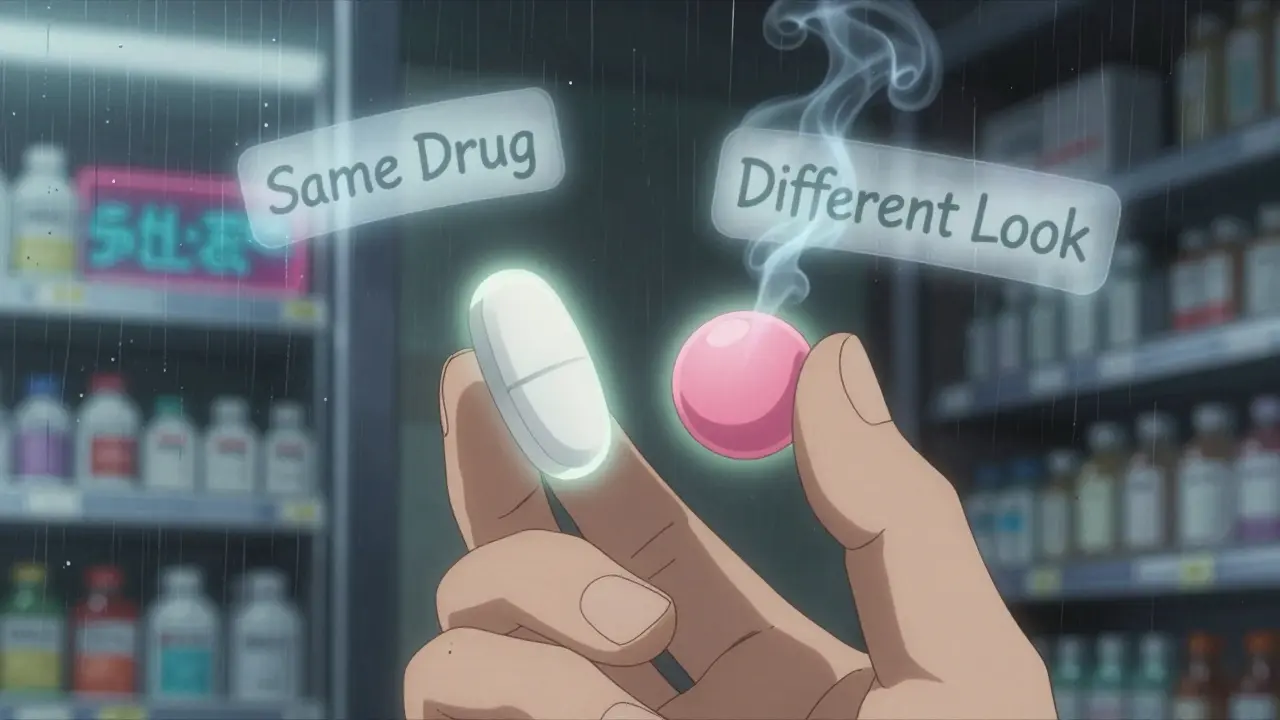
Ever opened your pill bottle and thought, ‘This isn’t the same pill I’ve been taking for years’? You’re not alone. Every month, millions of Americans get a generic medication that looks different from the last refill-different color, different shape, different markings. It’s legal. It’s safe. But it’s also one of the most common reasons people stop taking their meds.
Why Do Generic Pills Look Different?
Generic drugs are exact copies of brand-name drugs in every way that matters: same active ingredient, same strength, same effect. But they don’t have to look the same. That’s not an accident-it’s the law.In the U.S., trademark rules block generic manufacturers from copying the exact color, shape, or logo of brand-name pills. So instead of matching Zoloft’s blue oval, a generic version of sertraline might be a white round tablet. Or a green oval. Or a peach capsule. It all depends on which company makes it.
The FDA doesn’t require matching appearances. What it does require is bioequivalence: the generic must deliver the same amount of active drug into your bloodstream at the same rate as the brand. That’s it. Fillers, dyes, coatings? Those can change. And they do-often.
Over 70% of all prescriptions filled in the U.S. are for generic drugs. That means most people on long-term meds-like blood pressure pills, antidepressants, or diabetes drugs-will see their pills change shape or color at least once a year. One patient reported nine different appearances for the same medication over 15 years.
Is It Safe When the Pill Looks Different?
Yes. Absolutely.The FDA approves every generic before it hits the shelf. Each batch must meet the same strict standards for purity, strength, and stability as the brand-name version. The color change? Just dye. The shape? Just the mold. The size? Different filler amounts. None of it affects how the drug works in your body.
But here’s the catch: your body doesn’t care about FDA approvals. Your brain does. And your brain associates pills with safety. If your antidepressant was always a small white oval, and now it’s a large pink circle, your mind might scream, ‘This isn’t right.’
That’s not irrational fear-it’s human psychology. A 2023 UCLA Health study found that 34% of patients stopped taking their medication after a color change. After a shape change? That number jumped to 66%. One man stopped his blood pressure meds because they turned from white to pink. He thought he’d been given the wrong drug. He didn’t call his pharmacist. He just quit.
Legality: Why This Isn’t a Scam
It’s not illegal. It’s not a loophole. It’s federal policy.The FDA allows appearance differences to avoid trademark infringement. If a generic looked exactly like Zoloft, Pfizer could sue. So generic makers pick their own look. That’s why you might get a sertraline pill from Teva one month and from Mylan the next-and they’ll look nothing alike.
There’s no rule forcing manufacturers to keep the same appearance. Pharmacies choose the cheapest option available. So if Teva drops their price from $5 to $3 for a 30-day supply, your pharmacy will switch-no warning needed. That’s why your pill changes month to month. It’s economics, not quality.
And while the FDA doesn’t require appearance consistency, it does require manufacturers to update labels if the brand-name drug changes its labeling. The MODERN Labeling Act of 2020 gave the FDA more power to push for faster updates, especially around safety warnings. But appearance? Still up to the manufacturer.
Who Gets Hit the Hardest?
It’s not just older adults. It’s not just people with complex regimens. It’s everyone on chronic meds.Patients taking psychiatric drugs like sertraline, fluoxetine, or gabapentin are especially vulnerable. These medications often take weeks to work. If you stop because you think the pill changed, you lose progress. You might relapse. You might need to restart the whole process.
Diabetics on metformin, heart patients on lisinopril, and people on thyroid meds like levothyroxine also face big risks. A 2022 survey by the American Pharmacists Association found that 42% of patients had at least one appearance change in their regular meds in the past year. Nearly 30% said they were worried enough to consider skipping doses.
People with memory issues, vision problems, or cognitive decline are at even higher risk. One woman with Alzheimer’s stopped her potassium pills because they went from bright orange to white. She didn’t recognize them. She thought they were vitamins. She didn’t take them for two weeks. Her potassium level dropped dangerously low.
What You Can Do to Stay Safe
You don’t have to guess. You don’t have to panic. Here’s what works:- Keep a written list of every medication you take-name, dose, and what it looks like. Take it to every doctor visit. Show it to your pharmacist.
- Check the pill before you leave the pharmacy. If it looks different, ask: ‘Is this the same drug?’ Pharmacists are trained to explain these changes.
- Use the FDA’s pill identifier at medscape.com/pillidentifier. Snap a photo, enter the imprint, color, and shape. It’ll tell you exactly what it is.
- Ask your pharmacy to notify you when a change happens. As of 2023, 78% of pharmacies now include appearance change alerts with refill labels.
- Don’t rely on color alone. One patient thought her metformin was ‘wrong’ because it went from white to pink. But pink metformin is common. The imprint ‘M 50’ stayed the same. That’s the real clue.
What Pharmacists and Doctors Are Doing
Pharmacists are stepping up. Many now print a note on the label: ‘This is a different manufacturer. Same medicine.’ Some even include a small photo of the pill on the bottle.Independent pharmacies have ramped up pill identification programs. In 2020, only 32% had them. By 2023, that jumped to 63%. That’s not just good service-it’s a safety net.
Doctors are also asking more questions. Instead of just checking blood pressure, they’re asking: ‘Are you still taking your pills?’ and ‘Have they looked different lately?’ One UCLA doctor told patients: ‘Bring in all your bottles. I don’t care if they’re empty. I need to see what you’re actually taking.’
What’s Next? Could This Change?
Experts have been pushing for change for years. Drs. Uhl and Peters wrote in ACP Journals in 2014: ‘Bioequivalent generic drugs that look like their brand-name counterparts enhance patient acceptance.’ They were right.But changing the law? That’s hard. Trademark protections are strong. Drug companies won’t give up their brand identity. And the FDA doesn’t have the authority to force generic pills to match brand appearances.
Still, progress is happening. The FDA is monitoring adherence rates more closely. Some states are testing programs that require pharmacies to notify patients before switching generics. Others are exploring barcode systems on pill bottles that link to digital images of the pill.
Until then, the burden falls on you. Don’t assume the pill is wrong. Don’t stop taking it. Ask. Verify. Keep a list. Your health depends on it.

kumar kc
This is why people die from preventable causes-because they panic over pill colors instead of checking the imprint. No one cares about your anxiety; your life depends on facts, not feelings.
Stop being dramatic.
Edith Brederode
OMG YES this happened to me with my antidepressant 😭 I thought I was going crazy until my pharmacist showed me the FDA identifier-same drug, different dye. I cried. Not from sadness-from relief. 🙏
Pharmacists are unsung heroes. Please ask them questions. They’re not just filling bottles.
Also-this post saved my life. Thank you.
Arlene Mathison
Okay, real talk-I’ve been on metformin for 8 years and I’ve had like 12 different pills. White. Yellow. Blue. Round. Oval. Even one that looked like a tiny UFO.
Here’s the thing: I keep a little notebook in my wallet. Name. Dose. Imprint. Picture. Done. No stress.
And if you’re scared? Call your pharmacy. Seriously. They’re paid to answer this stuff. No shame. No panic. Just ask.
Also-why is no one talking about how pharmacies switch based on the cheapest bid? That’s wild. We’re all just lab rats in a cost-cutting experiment.
But hey-at least the medicine works. So I’m not mad. Just… aware.
PS: Use the FDA tool. It’s free. And magic.
Emily Leigh
So… the government lets companies change the color of your life-saving pills… because of trademark law? …And you’re telling me this isn’t a dystopian nightmare? …I’m not taking my pills anymore. I’m just gonna… vibe with the universe. 🤷♀️
Renee Stringer
People don’t stop taking meds because of color. They stop because they’re not educated. It’s not the system’s fault-it’s the lack of basic health literacy.
Simple fix: teach it in high school. But no, we’d rather blame corporations.
Crystal August
Oh my god, this is why I hate America. You can’t even trust your own medicine. You get a pill, you don’t know if it’s real, if it’s fake, if it’s been switched for a cheaper version, if it’s gonna make you feel like a zombie or a ghost or nothing at all.
And the worst part? No one cares. The FDA says ‘it’s fine’-but fine for whom? Not for the 66% who quit. Not for the woman with Alzheimer’s who didn’t take potassium for two weeks. Not for anyone who’s scared.
It’s not just about pills. It’s about trust. And we’ve lost it.
And now I’m just gonna cry into my pink metformin.
Courtney Carra
It’s funny-how we treat medicine like a sacred object. A pill isn’t magic. It’s chemistry. A molecule in a shell.
But we anthropomorphize it. We assign meaning to color. To shape. To the brand name stamped on it.
Is it the drug that heals us? Or is it the ritual? The belief that ‘this is the one’?
Maybe the real problem isn’t the FDA or the manufacturers.
Maybe it’s us. We need to feel safe. So we cling to the wrong things.
And then we wonder why we’re so anxious.
thomas wall
It is an affront to public health that a nation as advanced as the United States permits such arbitrary and potentially lethal variability in the appearance of life-sustaining pharmaceuticals. The FDA’s hands are tied by corporate trademark law-a relic of the 19th century-and yet the consequences are measured in hospitalizations, relapses, and deaths.
There is no moral justification for this. No economic argument that outweighs human dignity. We have the technology to barcode, photograph, and digitally verify every pill. We have the legal precedent to mandate appearance consistency for bioequivalent drugs. We have the will-yet we lack the courage.
This is not a quirk of commerce. It is a systemic failure. And until policymakers recognize that a patient’s psychological stability is as vital as pharmacokinetics, we will continue to sacrifice lives on the altar of corporate branding.
Enough.