Why Your Online Prescription Needs a Second Look
You type in your symptoms, click through a slick website, and get a prescription delivered to your door. It sounds like the future of healthcare, and for many people, it is. But here is the catch: not every site that looks professional is actually legal or safe. In fact, the landscape of online pharmacy regulation is a complex web where federal agencies and state boards play very different roles. If you are buying meds online, understanding who watches whom can save you from counterfeit drugs, identity theft, or worse.
The United States does not have a single agency that polices every aspect of online pharmacies. Instead, we rely on a multi-layered system involving the Food and Drug Administration (FDA), the Drug Enforcement Administration (DEA), and individual state boards of pharmacy. Each has a specific job. The FDA cares about whether the drug itself is safe and labeled correctly. The DEA cares about controlled substances and preventing diversion. State boards care about whether the pharmacist dispensing your pill is licensed and operating within their jurisdiction. When any one of these layers fails, patients pay the price.
The Federal Watchdogs: FDA and DEA Responsibilities
At the federal level, two main agencies set the baseline for safety. The FDA is the primary regulator for drug safety, efficacy, labeling, and advertising. Their job is to ensure that the medication you receive contains what the label says it contains, in the right dose, without harmful contaminants. They also police how these drugs are marketed to consumers. Recently, the FDA has ramped up enforcement against misleading direct-to-consumer advertising, especially on social media platforms where paid influencers often gloss over serious side effects.
On the other side, the DEA is the agency responsible for overseeing controlled substances and preventing drug diversion. This includes everything from opioids to stimulants. The DEA’s role became even more critical with the rise of telemedicine. Under the Ryan Haight Online Pharmacy Consumer Protection Act of 2008, doctors generally had to see patients in person before prescribing controlled substances. However, recent rule changes have shifted this landscape significantly.
In January 2025, the DEA announced new telemedicine rules that create special registration categories for providers. These include standard registrations for Schedule III-V substances and advanced registrations for Schedule II medications for specific specialists like psychiatrists and pediatricians. While this expands access, it also requires practitioners to check Prescription Drug Monitoring Program (PDMP) data before prescribing. The goal is to balance patient access with safeguards against illicit market diversion.
State Boards: The Local License Checkers
While the FDA and DEA handle broad federal standards, the real day-to-day policing happens at the state level. Every state has a Board of Pharmacy that licenses pharmacies and pharmacists operating within its borders. If an online pharmacy ships pills to you in Texas, they must be licensed by the Texas Board of Pharmacy. If they ship to California, they need a California license. This creates a patchwork system where a pharmacy might be legitimate in one state but illegal in another if they fail to register properly.
State boards are the first line of defense for consumer complaints. In 2024, state boards collectively processed nearly 3,000 complaints about online pharmacies. California, Texas, and Florida reported the highest volumes, reflecting both population size and aggressive enforcement efforts. State boards maintain public databases where you can verify if a pharmacy is licensed. As of late 2025, 48 out of 50 states provide online verification tools, though Alabama and Massachusetts have limited public access.
The relationship between state and federal regulators is cooperative but sometimes fragmented. The FDA relies on state boards to identify unlicensed operations, while state boards look to the FDA for guidance on drug quality issues. This division of labor means that a pharmacy can technically comply with state licensing requirements but still sell unsafe products if the FDA hasn’t caught up to inspect them. That is why checking both levels of compliance is crucial for consumers.

Red Flags: How to Spot an Illegal Online Pharmacy
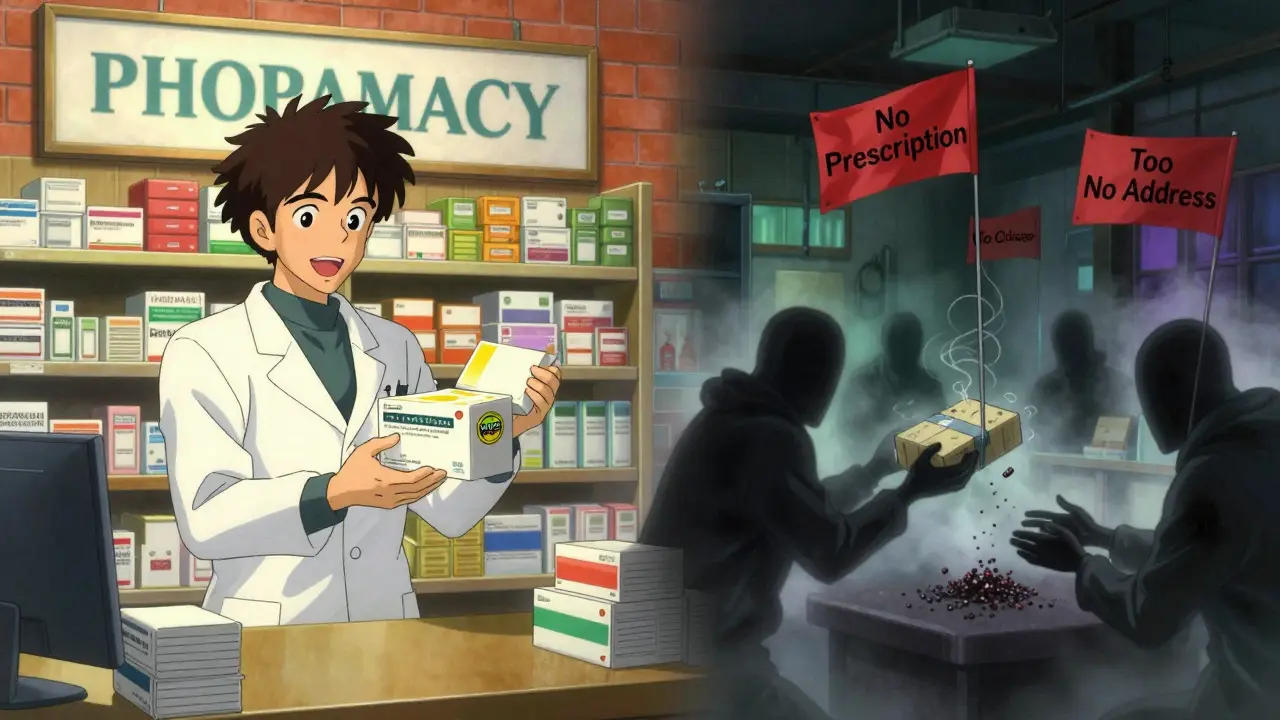
Not all online pharmacies are created equal. Some are extensions of reputable brick-and-mortar chains like CVS or Walgreens. Others are fly-by-night operations selling counterfeit meds from overseas. The FDA’s BeSafeRx program offers clear criteria to help you distinguish between the two. Legitimate online pharmacies will always require a valid doctor’s prescription. They will provide a physical U.S. address and a working phone number. Most importantly, they will have a licensed pharmacist available to answer your questions.
If a site offers deep discounts that seem too good to be true, run. Unsafe pharmacies often lure customers with prices far below market rate. They may also charge you for products you never ordered or sell your personal information to third parties. Another major red flag is the absence of adequate warnings. Real pharmacies display FDA-required risk disclosures prominently. Fake ones hide them or omit them entirely.
Counterfeit medications are a serious threat. The FDA warns that fake drugs may contain too much or too little of the active ingredient, the wrong ingredient entirely, or even harmful substances like heavy metals or pesticides. In 2025, the FDA issued 147 warning letters to illegal online pharmacies, a 32% increase from the previous year. Many of these violations involved selling unapproved drugs of unknown origin. When you buy from an unverified source, you are gambling with your health.
Navigating Telemedicine and Controlled Substances
The rise of telehealth has blurred the lines between traditional and online pharmacy services. For non-controlled substances, getting a prescription online is relatively straightforward. You consult with a provider via video or chat, get a digital prescription, and have it filled by a licensed pharmacy. But for controlled substances, the rules are tighter.
The DEA’s new Special Registration framework allows certain providers to prescribe Schedule III-V controlled substances via telemedicine without an initial in-person visit. However, this comes with strings attached. Providers must review PDMP data to check for potential misuse. For Schedule II substances, which include powerful painkillers and ADHD medications, only specialists with advanced certifications can prescribe remotely under strict conditions. This tiered approach aims to prevent abuse while maintaining access for patients who genuinely need these medications.
Patients should be aware that not all telemedicine platforms are created equal. Some operate within regulatory guidelines, while others exploit loopholes. The DEA has identified over 1,200 websites facilitating illegal sales of controlled substances as of October 2025, with most operating outside U.S. jurisdiction. Always verify that your telemedicine provider is registered with the DEA and that the pharmacy filling your prescription is licensed in your state.
Compounded Drugs: A Growing Gray Area
A significant portion of the online pharmacy market involves compounded medications. Compounding pharmacies mix ingredients to create customized doses for patients who cannot take standard formulations. There are two types: 503A and 503B. Section 503A pharmacies compound drugs for individual patients based on specific prescriptions. Section 503B facilities produce larger batches for general distribution.
Compounded drugs are not FDA-approved. This means the FDA does not verify their safety, effectiveness, or quality before they reach the market. Oversight falls primarily on state pharmacy boards. This lack of federal scrutiny has led to concerns, particularly regarding popular weight-loss drugs like Semaglutide and Tirzepatide. After these drugs were removed from the FDA’s shortage list in September 2025, only 503A pharmacies could legally compound them for specific patients. Yet, the market for compounded GLP-1 medications reached $4.2 billion in 2024, driven by high demand and supply constraints.
Consumers should exercise caution when buying compounded drugs online. Ensure the pharmacy is licensed as a 503A facility in your state and that you have a valid prescription from a licensed provider. Avoid sites that market compounded versions of brand-name drugs without clear medical justification. The FDA has increased scrutiny on compounding practices, but enforcement remains challenging due to the decentralized nature of the industry.
Verification Tools: Protecting Yourself
The best way to stay safe is to verify before you buy. The FDA recommends using the BeSafeRx tool to check a pharmacy’s credentials. You can search for the pharmacy’s name or URL to see if it is listed in state board databases. Additionally, look for accreditation from the National Association of Boards of Pharmacy’s Verified Internet Pharmacy Practice Sites (VIPPS) program. As of October 2025, 187 online pharmacies held VIPPS accreditation, signaling a higher standard of practice.
For telemedicine services, check if the platform partners with verified pharmacies. Reputable chains like CVS Caremark Online Pharmacy maintain high ratings and transparent policies. Unverified sites often have poor customer reviews and vague terms of service. Read recent feedback on independent platforms like Trustpilot, but beware of fake reviews. Cross-reference information with official sources whenever possible.
| Feature | Legitimate Online Pharmacy | Illegal Online Pharmacy |
|---|---|---|
| Prescription Requirement | Always required from a licensed doctor | Often optional or self-diagnosed |
| Contact Information | Physical U.S. address and phone number | Only email or no contact info |
| Pharmacist Access | Licensed pharmacist available for questions | No pharmacist or unverified staff |
| Licensing | Licensed in the state where patient resides | Unlicensed or licensed abroad only |
| Pricing | Competitive but realistic prices | Deep discounts, "too good to be true" deals |
Future Trends: What’s Next for Regulation?
The regulatory landscape for online pharmacies is evolving rapidly. The DEA plans to implement a nationwide Prescription Drug Monitoring Program (PDMP) by Q3 2026, which will give practitioners visibility into a patient’s full medication history across state lines. This move aims to reduce the burden of navigating 50 different state systems and improve patient safety.
The FDA is also expanding its BeSafeRx program to include real-time verification of telemedicine prescriptions by December 2026. Enhanced enforcement actions against misleading advertising, particularly on social media, are expected to continue. Industry analysts project a 22% increase in FDA warning letters targeting online pharmacies in 2026, with a focus on compounded medications and influencer marketing.
As technology advances, so do the methods used by illegal operators. Blockchain tracking, AI-driven fraud detection, and stricter identity verification protocols may become standard. For now, staying informed and vigilant is your best protection. The goal of regulators is to make safe access easier, but until then, the responsibility largely falls on the consumer to do their homework.
How do I know if an online pharmacy is FDA approved?
The FDA does not "approve" pharmacies directly; instead, it regulates the drugs they sell. To verify legitimacy, use the FDA's BeSafeRx tool to check if the pharmacy is licensed by a state board of pharmacy. Legitimate pharmacies will always require a valid prescription, provide a U.S. physical address, and have a licensed pharmacist on staff.
What is the difference between FDA and DEA oversight?
The FDA focuses on drug safety, efficacy, labeling, and advertising for all medications. The DEA specifically oversees controlled substances (like opioids and stimulants) to prevent diversion and abuse. Both agencies work together, but the DEA handles enforcement related to prescription practices and telemedicine rules for controlled drugs.
Are compounded drugs sold online safe?
Compounded drugs are not FDA-approved, meaning their safety and quality are not verified by the federal government before sale. Safety depends heavily on the reputation and licensing of the compounding pharmacy (503A vs 503B). Always ensure the pharmacy is licensed in your state and that you have a specific prescription from your doctor.
Can I get controlled substances prescribed via telemedicine?
Yes, under specific conditions. As of 2025, the DEA allows certain providers with special registrations to prescribe Schedule III-V controlled substances via telemedicine without an initial in-person visit. Schedule II substances require advanced specialist certification. Providers must check PDMP data to ensure safe prescribing.
What should I do if I suspect my online pharmacy is illegal?
Stop ordering immediately. Report the pharmacy to the FDA via their MedWatch program and to your state board of pharmacy. If you received medication, keep it as evidence. Contact your healthcare provider to discuss alternative treatment options and monitor for any adverse effects from potentially counterfeit drugs.

ANINDA GHOSH
The way we view health is shifting so fast, isn't it? :)
Crystal Tadlock
They are lying to you all. The FDA is just a front for the big pharma companies who want to keep us sick and dependent on their expensive poison. They don't care about safety, they care about profits. You think the DEA is protecting you? No, they are just trying to control who gets access to the 'good' stuff while letting the rich buy whatever they want. It's a conspiracy to keep the masses weak and compliant. Don't trust the government agencies, they are part of the problem. Every time they say something is safe, it's because they bought off the regulators. Wake up people.
Tad Cronn
You need to check your PDMP data yourself if you really want to be safe. Most people are too lazy to do that. I checked mine last week and found three doctors who prescribed me things I didn't even ask for. How did that happen? Who knows. The system is broken but at least now you have the tools to spy on your own medical history. It's invasive but necessary. Stop blaming the agencies and start checking your own records.
Sean Allwurden
I agree with the points raised here regarding the regulatory framework. The distinction between 503A and 503B compounding facilities is critical for stakeholders in the healthcare sector to understand. When we look at the operational metrics of these pharmacies, the variance in quality control protocols is significant. We need to ensure that our telemedicine platforms are integrating with verified VIPPS-accredited pharmacies to mitigate risk exposure. It is a collaborative effort between patients and providers to maintain compliance standards.
Najmunisa Govender
It is so scary to think about what might be in those pills!!! I always double check everything now! My friend lost weight but then felt terrible afterwards!!!
MiMi Stanley
I've been using online pharmacies for years and never had an issue, but this makes me wonder if I got lucky or if I was just careful enough without realizing it. I usually stick to the big names like CVS or Walgreens online portals. Does anyone else feel like the rules change every time you log in? It feels like a moving target sometimes.
Kevin Burke
The essence of regulation is control, not safety. Safety is an illusion sold to the masses to justify the bureaucracy. When you outsource your health decisions to a screen, you surrender your autonomy. The true philosopher understands that nature provides remedies without the need for federal oversight. These agencies exist to stifle innovation and protect monopolies. Think deeper than the surface level warnings. The real danger is the dependency on the system itself.
neal vince
Most people reading this won't actually verify anything. They will just skim and go back to buying cheap meds from sketchy sites. The average consumer lacks the intellectual capacity to navigate state board databases. It is a futile exercise to educate the general public when they are inherently negligent. The data shows that only 5% of users check licensing. The rest are doomed to fail.
Sinead Doyle
typo alert: its not just about the drugs its about the data harvesting. they track every click. the blockchain thing is a distractor. the real issue is that the FDA is compromised by corporate lobbying. i know because i read a forum post once. its all connected. wake up sheeple. the compounded drugs are a gateway to total surveillance of your biological markers. dont fall for it.
Samuel Friday
Oh, how quaint. You think a blog post will save you from the inevitable decline of your health due to poor choices. The elite don't use these services; they have private physicians who bypass all this red tape. You are left with the scraps of a broken system. Enjoy your counterfeit semaglutide while you wait for the real supply chain to collapse. It is truly pathetic watching the masses scramble for basic dignity. 😒
Emily Schor
I found the table comparing legitimate and illegal pharmacies very useful. I printed it out and put it on my fridge. It helps to have a clear checklist before ordering anything online. Thanks for sharing this information.
Kieran Healy
It's good to see more clarity on this topic. I often worry about my family members who order meds online. Maybe we can share this guide with them. Peace and health to everyone navigating this complex system :)