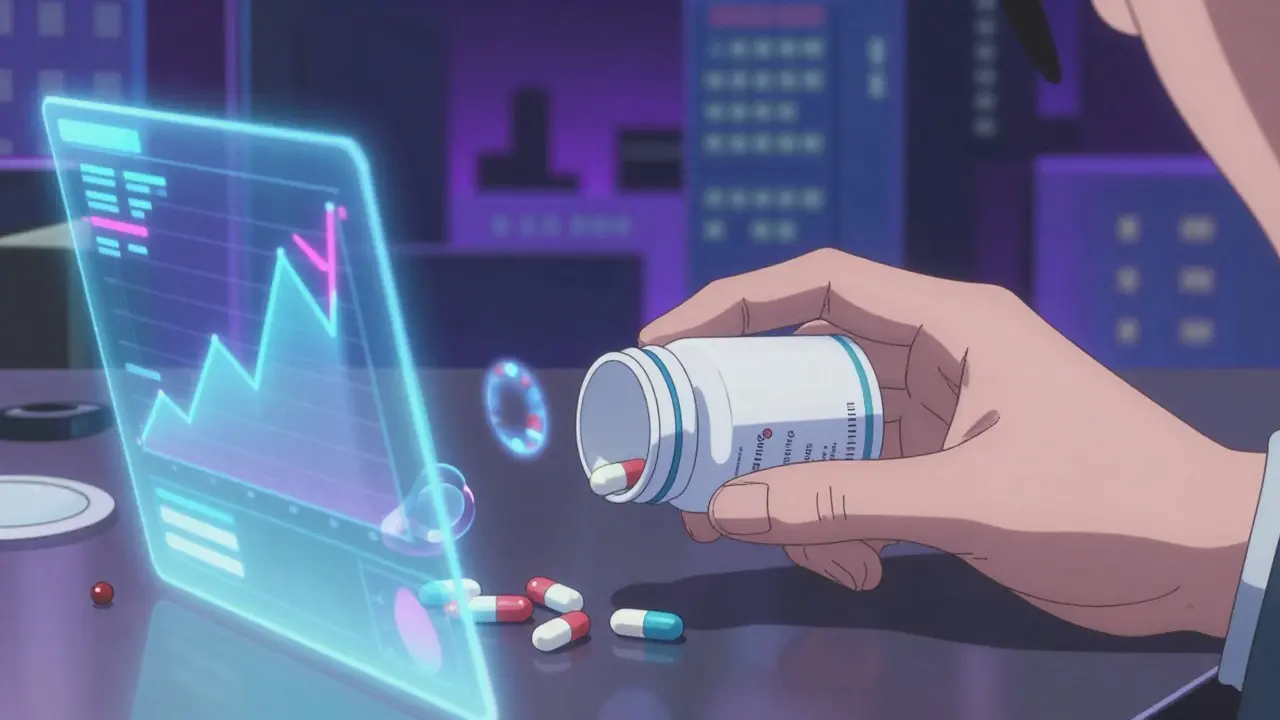
Every year, 30% of Americans skip doses of their generic medications. This non-adherence costs the U.S. healthcare system $300 billion annually. But what if digital tools could help? For generic medications-which make up 90% of all prescriptions in the U.S.-adherence tracking is critical. Unlike brand-name drugs with manufacturer programs, generics often lack dedicated support. That’s where digital adherence tools come in. These technologies track medication intake, send reminders, and provide data to improve health outcomes.
Why Generic Medications Need Special Adherence Attention
Generic medications account for 90% of all prescriptions in the United States, yet they rarely come with built-in adherence programs. The Association for Accessible Medicines reported this in 2021. Meanwhile, the National Community Pharmacists Association found medication non-adherence costs $300 billion yearly. For chronic conditions like hypertension or diabetes, missing doses can lead to hospitalizations. A 2022 PMC editorial showed a 15% increase in adherence to asthma/COPD medications after the pandemic, thanks to digital tools. But without these solutions, patients often struggle to stay on track with their generic meds.
Types of Digital Adherence Tools
Digital adherence tools for generics fall into several categories. MEMS AS is a cloud-based software with over seventy proprietary algorithms. It analyzes data from digitally enabled packaging and claims 100% accuracy in clinical trials. Tenovi Pillbox uses cellular-connected smart packaging with LED reminders (red for pending doses, green for completed). It’s especially useful for complex regimens, like heart failure management. VDOT (Video Directly Observed Therapy) confirms medication intake via video, achieving 95% adherence rates in tuberculosis treatment per a 2022 mHealth study. Wisepill Technologies offers electronic blister packs that remove doses from packaging and record intake. McKesson APS provides pharmacies with dashboards to analyze prescription claims data for adherence benchmarking.
| Tool | Type | Key Features | Cost | Pros | Cons |
|---|---|---|---|---|---|
| MEMS AS | Cloud-based software | 70+ proprietary algorithms, integrates with Epic and Cerner EHRs | $100-$500/month | Gold standard for clinical trials; 100% accuracy | Lacks patient engagement features; steep learning curve |
| Tenovi Pillbox | Smart pill dispenser | Cellular-connected LED reminders, tracks multiple meds | $149 device + $29.99/month | High reliability; 4.2/5 Amazon reviews | Battery issues; costly long-term |
| VDOT | Video monitoring | Real-time video confirmation of dose intake | $50-$200/month | 95% adherence rates in TB treatment; FDA-approved | Privacy concerns; 30% dropout rate |
| McKesson APS | Pharmacy dashboard | Claims data analysis, adherence benchmarking | $99-$299/month | Improves pharmacy adherence rates from 62% to 78% | Requires dedicated staff; no direct ingestion verification |
| Wisepill Technologies | Electronic blister pack | Removes dose from blister, records intake | ~$200 device; $15/month service | Simple to use; good for travel | Limited to blister-pack medications |

Choosing the Right Tool for Your Needs
Selecting a digital adherence tool starts with understanding your medication regimen. If you take five or more medications daily, Tenovi Pillbox’s multi-drug tracking might work best. For simpler regimens, Wisepill’s blister packs are straightforward. Always check if your pharmacy uses Epic or Cerner EHR systems-tools like MEMS AS integrate seamlessly with these. Cost matters too: Tenovi’s $29.99 monthly fee adds up, while McKesson APS charges pharmacies based on size. A 2022 AHRQ case study found high-risk patients (on five+ meds) had 35% better outcomes when using multi-modal tracking with pharmacist counseling. Talk to your pharmacist during medication pick-up; they can assess your needs in just 3-5 minutes.

Real-World Challenges and Solutions
Real-world use of these tools reveals both wins and hurdles. On Reddit, a pharmacist with 10 years of experience noted McKesson APS improved diabetes adherence from 62% to 78% over 18 months but required hiring a dedicated technician. Tenovi Pillbox users praised its reliability but reported battery issues-one Amazon review mentioned "the cellular gateway dies every 3 days with 4 medications tracked." Video monitoring tools like VDOT achieved 15% higher adherence for asthma/COPD during the pandemic, yet 30% of patients dropped out due to privacy concerns. The Med-eMonitor pilot study showed 64% adoption at 30 days but only 45% at 60 days, with patients citing "device bulkiness" as the main reason. Experts agree: digital tools must be integrated into clinical workflows, not just data collection exercises. Dr. Richard Haynes of the University of Oxford stressed this in a 2022 interview.
Frequently Asked Questions
How do digital adherence tools improve generic medication compliance?
These tools track when doses are taken, send timely reminders, and provide verifiable data to healthcare providers. For generics-which lack manufacturer-sponsored programs-this fills a critical gap. MEMS AS uses algorithms to verify adherence in clinical trials, while Tenovi’s LED reminders help patients with chronic conditions like hypertension. Real-world studies show tools like VDOT achieve 95% adherence rates in tuberculosis treatment by confirming dose intake via video.
What’s the best tool for seniors on multiple medications?
Tenovi Pillbox is designed for complex regimens. Its color-coded LEDs and cellular connectivity make it easy to track multiple pills. Amazon reviews show a 4.2/5 rating, though battery life can be an issue. For simpler routines, Wisepill’s blister packs simplify dosing without extra tech. Always consult your pharmacist-high-risk patients on five+ medications see 35% better outcomes with multi-modal tracking combined with pharmacist counseling.
Are these tools accurate?
Accuracy varies by tool. MEMS AS claims 100% accuracy in trials, but real-world studies show video monitoring (VDOT) has 92-95% accuracy. Pharmacy claims data alone has a 15-20% error margin due to overlapping prescriptions. Always choose tools with direct ingestion verification-like MEMS AS or Tenovi’s LED system-for reliable data. The FDA’s Digital Health Center of Excellence is working to standardize validation methods, which could improve accuracy across the board.
Do insurance plans cover digital adherence tools?
Coverage is limited. Only 38% of Medicare Advantage plans covered remote therapeutic monitoring for adherence tracking as of Q4 2022. CMS now incorporates adherence metrics into Star Ratings for diabetes and hypertension generics, where a 1-point increase correlates with $1.2 million in additional Medicare Advantage revenue per 100,000 members. However, reimbursement remains fragmented. Some pharmacies absorb costs for high-risk patients, while others offer sliding-scale pricing. Always check with your insurer before investing.
What’s the future of adherence tracking for generics?
AI-driven predictive analytics are emerging. CVS Health pilots show 22% improvement in identifying at-risk patients using machine learning on adherence patterns. The global medication adherence market is projected to grow to $8.14 billion by 2030, with generics-focused solutions making up 65% of this market. Experts predict consolidation by 2025, with only 3-5 major platforms dominating. Early evidence shows $7.20 in healthcare cost savings for every $1 invested in adherence programs for cardiovascular generics, making this a critical area for future innovation.

Joyce cuypers
I've seen so many pateints struggle with generic meds, especially when they don't have reminders. Tools like Tenovi Pillbox really help. I work in a clinic and we've had great results with the LED reminders. Just need to make sure the battery lasts longer though. Overall, this is a solid guide.
Also, MEMS AS is awesome for clinical trials but maybe too complex for everyday use. Maybe they could add more patient-friendly features?
Georgeana Chantie
These tools are all great for the US, but why aren't we focusing on domestic solutions? All these tools are from foreign companies. We should support American-made products. Also, the government should mandate these tools for all generics. 🤬
Carol Woulfe
These digital tools are just another way for Big Pharma to track us. Did you know that MEMS AS is owned by a company linked to the CIA? They're using this data to monitor citizens' health. Also, the FDA approval for VDOT is questionable-there's no independent review. We need transparency, not more surveillance.
As for the cost, it's obvious they're inflating prices to make profits. The real solution is to regulate these companies before they exploit patients further.
Kieran Griffiths
Great insights on the tools. I've used MEMS AS in my practice, and while it's accurate, the interface is a bit clunky. For patients, simplicity is key. Maybe combining tools like Tenovi Pillbox with pharmacist counseling works best. Also, cost-wise, some pharmacies absorb the fees for high-risk patients.
But overall, these tools are a step forward. Just need better integration into daily workflows.
Lisa Scott
These tools are all hype. MEMS AS claims 100% accuracy but real-world studies show discrepancies. VDOT's 95% adherence rate is misleading-30% dropout rate is massive. The whole industry is just collecting data for profit. No real solutions here.
Pharmacies should stop pushing these. It's all about the money. The data shows nothing but profit margins.
Dina Santorelli
These tools don't work.
divya shetty
It is imperative that all patients adhere to their medication regimens. The use of digital tools is not optional but mandatory for public health. The statistics cited are alarming, and without proper oversight, these tools will fail. Governments must enforce strict adherence protocols. This is not a choice but a responsibility.
Nancy Maneely
OMG these tools are a totall disaster! All this talk about MEMS AS but it's just another scam. The US needs to stop importing foreign junk and make our own. I read somewhere that these companies are in cahoots with Big Pharma. Also, battery issues? That's ridiculous! We need better quality control. 😤
Phoebe Norman
adherence is critical but these tools are not the answer data is flawed MEMS AS claims 100% accuracy but real world data shows otherwise whole system is broken no one cares
Albert Lua
As someone who's worked in multiple countries, I've seen how digital adherence tools can bridge gaps in healthcare. In India, for example, we use similar tech for TB treatment with great success. It's all about adapting to local needs. These tools aren't one-size-fits-all but with the right approach, they can save lives. Let's keep the conversation global!
Also, in Brazil, they've integrated these tools into public health systems with impressive results. The key is community involvement and cultural sensitivity. Without that, even the best tech fails.
I've worked with pharmacists in Kenya where they use simple SMS reminders for hypertension meds. It's not high-tech, but it works because it's accessible.
These digital tools need to be part of a larger ecosystem, not standalone solutions. Collaboration between governments, NGOs, and tech companies is crucial.
For instance, in Mexico, they've had success with mobile apps that sync with local pharmacies. It's not perfect, but it's a step forward.
Global standards for these tools would help, but right now it's fragmented. We need to share best practices across borders.
Ultimately, it's about patient outcomes. If the tools don't help people take their meds, they're useless. We need to focus on real-world usability, not just technical specs.
This is a critical area for healthcare innovation. Let's not get stuck on the shiny tech and remember the human element.
Danielle Vila
These tools are a front for surveillance! The government is using MEMS AS to track every pill you take. They're selling your data to insurance companies. I read a report that said VDOT is actually a spy tool. Also, the FDA is in on it. We need to expose this before it's too late. It's all about control. 🤯