
Decongestant Safety Checker
Is This Decongestant Safe for You?
Answer the questions below to assess if decongestants are safe for you. Based on the American Heart Association guidelines and the article content.
If you have heart disease or high blood pressure, taking a common cold medicine could be riskier than you think. Many people reach for decongestants when they’re stuffed up - they work fast, they’re easy to find, and they’re sold right on the shelf. But for someone with a weak heart or uncontrolled hypertension, these medications can push the body into danger. The same chemical that shrinks swollen nasal passages can also tighten blood vessels everywhere else - including around your heart and brain. That’s not just a side effect. It’s a serious threat.
How Decongestants Work - and Why They’re Dangerous for Your Heart
Decongestants like pseudoephedrine (found in Sudafed) and phenylephrine (common in store-brand cold meds) are alpha-adrenergic agonists. That’s a fancy way of saying they mimic adrenaline. When they hit your nasal tissues, they cause blood vessels to narrow, reducing swelling and letting you breathe easier. Sounds helpful, right? But that effect doesn’t stay in your nose. These drugs enter your bloodstream and act on receptors throughout your body.That means your heart has to work harder. Blood pressure rises. Heart rate increases. For a healthy person, this might feel like a slight buzz - maybe a little jittery, maybe a bit more alert. But for someone with heart disease, this is like pouring gasoline on a smoldering fire. The heart muscle is already strained. Adding extra pressure can trigger arrhythmias, spike blood pressure to dangerous levels, or even cause a heart attack or stroke.
According to the American Heart Association, people with uncontrolled high blood pressure, heart failure, or a history of heart attack or stroke should avoid oral decongestants entirely. Even if your blood pressure is "controlled" with medication, the risk isn’t zero. A 2005 meta-analysis found that pseudoephedrine causes a small but measurable rise in systolic blood pressure - enough to matter when your heart is already compromised.
Oral vs. Nasal: Not All Decongestants Are the Same
Not every decongestant carries the same level of risk. Oral forms - pills and liquids - affect your whole body. Topical nasal sprays like oxymetazoline (Afrin) or naphazoline are meant to act locally. But they’re not safe either.One study of 100 patients using nasal sprays for a week showed a small but noticeable increase in heart rate - from about 81 to 84 beats per minute. That might not sound like much, but for someone with heart failure or an irregular heartbeat, even a few extra beats can destabilize the rhythm. And then there’s the case of the 40-year-old man who developed life-threatening heart failure after using nasal sprays of naphazoline and prednisolone. He wasn’t overdosing. He was just following the label. That’s the first documented case of heart failure directly linked to topical decongestant use. It’s rare, but it’s real.
Topical sprays also carry warnings on their labels - if you look closely. Most people don’t. They think, "It’s just a spray. It can’t hurt my heart." But the medicine doesn’t know the difference between your nose and the rest of your body. Some of it gets absorbed. And in people with pre-existing conditions, that’s enough.
Who’s at the Highest Risk?
Not everyone with heart disease needs to avoid decongestants the same way. But certain groups are in the danger zone:- Uncontrolled high blood pressure - If your numbers are still above 140/90 despite medication, decongestants can push you into hypertensive crisis.
- Heart failure - Your heart is already struggling to pump. Decongestants make it work harder, which can cause fluid to back up into your lungs.
- History of heart attack or stroke - Your arteries are already damaged. Constriction increases the chance of another clot or rupture.
- Arrhythmias - If you have atrial fibrillation or other irregular rhythms, decongestants can trigger dangerous fast heartbeats like ventricular tachycardia.
- Prinzmetal angina - This rare condition causes coronary arteries to spasm. Decongestants can trigger those spasms, cutting off blood flow to the heart.
Dr. Al-Kindi from Houston Methodist Hospital says these five conditions make decongestants a hard no. Even if you feel fine, your heart might not be. And when you’re sick, your body is already under stress. A cold or flu raises your heart rate and causes inflammation. Adding a decongestant on top? That’s a double hit.
What About Other Cold Medicines?
You don’t need decongestants to feel better. Many cold medicines combine decongestants with pain relievers or cough suppressants - and that’s where things get trickier. For example, NSAIDs like ibuprofen (Advil, Motrin) have been shown to increase heart attack risk by more than three times during a respiratory infection, according to a 2017 study of nearly 10,000 heart attack patients.So what’s safe?
- Saline nasal sprays - Saltwater rinses or sprays moisten nasal passages without affecting blood pressure.
- Humidifiers - Adding moisture to the air helps loosen mucus naturally.
- Guaifenesin (Mucinex) - This expectorant helps thin mucus. It doesn’t constrict blood vessels.
- Rest and hydration - Sometimes, the best medicine is time and water.
Even if you’re tempted to grab a multi-symptom cold tablet, check the label. If it says "decongestant" or lists pseudoephedrine, phenylephrine, or ephedrine - put it back. Your heart will thank you.
Why Pharmacists Ask So Many Questions
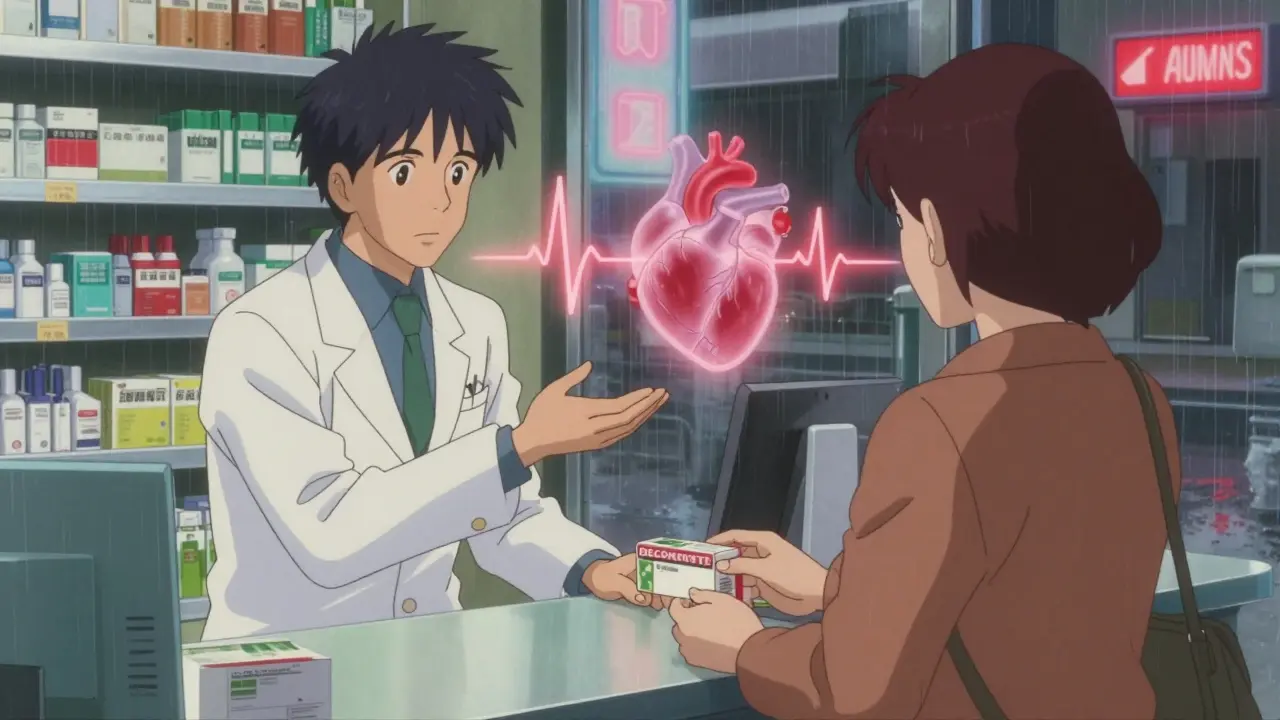
You’ve probably noticed that pseudoephedrine is kept behind the counter. That’s not just bureaucracy. It’s a safety net. After the 2005 Combat Methamphetamine Epidemic Act, pharmacies had to start screening customers for conditions like hypertension, heart disease, and thyroid problems before selling Sudafed.That’s not a coincidence. Pharmacists are trained to spot red flags. They ask: "Do you have high blood pressure?" "Are you on heart medication?" "Have you had a heart attack?" These questions save lives. If you’re uncomfortable answering, remember - they’re not judging you. They’re protecting you.
Even if you think your blood pressure is fine, it’s worth mentioning your heart history. Many people don’t realize they have undiagnosed hypertension. A quick check at the pharmacy could catch something dangerous before it’s too late.
What to Do If You’ve Already Taken a Decongestant
If you have heart disease and you’ve taken a decongestant - even once - watch for these signs:- Headache or dizziness
- Chest pain or pressure
- Fast, fluttering, or irregular heartbeat
- Shortness of breath
- Blurred vision or confusion
If you experience any of these, stop the medication immediately. Call your doctor. If symptoms are severe - like chest pain or trouble breathing - call 911. Don’t wait. Decongestant-induced hypertension can escalate quickly.
Even if you feel fine, it’s worth mentioning to your cardiologist. They may want to check your blood pressure more closely or adjust your heart meds.
Bottom Line: When in Doubt, Skip It
Decongestants give you quick relief - but they don’t cure anything. They just mask symptoms. And for people with heart disease, the cost is too high. The European Journal of General Medicine says it plainly: if your symptoms are mild or moderate, not using decongestants is the wiser choice.Your body is fighting an infection. That’s enough stress. Don’t add more by forcing your heart to work harder. Use saline sprays. Drink water. Rest. Use a humidifier. Talk to your doctor before reaching for anything that says "decongestant" on the label.
There’s no shame in avoiding these meds. It’s not weakness. It’s smart. Your heart doesn’t need a boost. It needs protection.

Joe Bartlett
Decongestants? Nah, I just use saltwater rinse. Works fine. No heart panic.
Steven Lavoie
I’m a nurse in Texas and I’ve seen too many patients come in with arrhythmias after popping Sudafed thinking it’s harmless. It’s not just about blood pressure-it’s about the whole autonomic cascade. Your heart isn’t just pumping harder, it’s being chemically startled. That’s why I always ask: ‘Have you taken anything for your cold?’ before even checking vitals. The answer is almost always yes. And it’s never the right thing.
Pharmacists aren’t being annoying-they’re the last line of defense. If you roll your eyes at them, you’re not being independent. You’re being reckless.
And don’t get me started on those ‘natural’ decongestant teas with ephedra derivatives. Same damn mechanism. Just less regulated. More dangerous.
Saline sprays, humidifiers, hydration-yes. Decongestants? Only if your cardiologist signs off on it. And even then, use the lowest dose for the shortest time. No heroics.
My grandma had heart failure. She took one pseudoephedrine tablet for a stuffy nose and ended up in the ER with a BP of 210/110. She was fine two days before. That’s how fast it can go south.
We treat colds like they’re minor. But for people with cardiac conditions? A cold is a full-blown physiological crisis. Adding stimulants to that? That’s not self-medication. That’s Russian roulette with your ticker.
Naomi Lopez
Ugh I just bought a multi-symptom cold med yesterday and didn’t even check the label. Now I’m paranoid. Thanks for the wake-up call. 🤦♀️
Salome Perez
Thank you for writing this with such clarity and compassion. So many of us are taught to ‘tough it out’ with OTC meds, especially in the U.S., where everything’s marketed as ‘safe’ if it’s on the shelf. But safety is relative. What’s safe for a 30-year-old athlete isn’t safe for a 65-year-old with a stent. This isn’t just medical advice-it’s a public health imperative.
One thing I wish more people understood: decongestants don’t treat the cause of congestion. They suppress the symptom. That’s like turning off a smoke alarm because the kitchen is on fire. The fire’s still there. And your heart? It’s the house.
Saline rinses, steam inhalation, honey-lemon tea, rest-these aren’t ‘alternative’ remedies. They’re foundational care. The fact that we’ve normalized chemical interventions over simple, gentle support says more about our healthcare culture than our biology.
I’ve shared this with my entire book club. Everyone’s going back to check their medicine cabinets. That’s the power of good information.
BETH VON KAUFFMANN
Let’s be real-the AHA’s guidelines are based on meta-analyses with questionable heterogeneity. Pseudoephedrine’s BP effect is statistically significant but clinically marginal in most cases. The real issue is overdiagnosis of hypertension and pharmaceutical fearmongering. People are being scared off safe OTC options because of inflated risk narratives.
Also, nasal sprays? The absorption rate is less than 10%. You’re more likely to get a stroke from a caffeine pill than from Afrin. The data doesn’t support the alarmism.
And let’s not forget: ibuprofen is the real villain here. NSAIDs are far more cardiotoxic than decongestants, yet nobody’s banning Advil. Double standard.
Chris Van Horn
Oh wow. So now I’m not allowed to take Sudafed because I have a pacemaker? What’s next? Are they going to ban breathing? This is pure medical authoritarianism. I’ve been taking decongestants for 20 years. My heart’s fine. The system wants you dependent on their ‘safe’ alternatives-saline sprays? Come on. That’s just a placebo with a price tag.
And why is pseudoephedrine behind the counter? Because Big Pharma doesn’t want you to buy it cheap. They want you to pay for a prescription for a ‘safer’ drug that’s actually just a repackaged version with a higher markup. This isn’t medicine. It’s capitalism.
Also, ‘rest and hydration’? That’s what your grandma did in 1952. We have science now. Stop romanticizing the past.
Pawan Chaudhary
Bro, I’m from India and we don’t even have decongestants in most villages. We use steam with eucalyptus, turmeric milk, and sleep. Works better anyway. No side effects. 🌿💛
Michael Whitaker
It is, of course, profoundly regressive to suggest that individuals with cardiovascular pathology should eschew alpha-adrenergic agonists on the basis of population-level risk data. The individual autonomy principle, as articulated by Kantian ethics, demands that pharmacological agency remain unencumbered by paternalistic public health mandates. One’s right to self-medicate, even at the expense of physiological risk, is a foundational liberty. To restrict access to pseudoephedrine is to institutionalize medical infantilization.
Furthermore, the American Heart Association’s stance reflects a troubling conflation of statistical correlation with causal inevitability. One must question the funding sources of the 2005 meta-analysis-was it influenced by the pharmaceutical lobby promoting beta-blockers as ‘safe’ alternatives? The conflict of interest is glaring.
And let us not forget: the very term ‘heart disease’ is a reductive, monolithic construct. It ignores the heterogeneity of cardiac phenotypes. To blanket-ban decongestants for all ‘heart disease’ patients is akin to forbidding all drivers from using roads because one person had a crash.
Evelyn Vélez Mejía
This isn’t about decongestants. It’s about how we treat our bodies as machines we can hack with chemicals, rather than living systems that need harmony. We’ve turned medicine into a toolbox of quick fixes while abandoning the wisdom of rest, rhythm, and reverence for our own biology.
Decongestants are the symptom of a deeper illness: our addiction to speed, control, and denial of vulnerability. We don’t want to sit still with a cold. We want to be productive. We want to be ‘on.’ But your heart doesn’t care about your deadlines. It only cares about your breath, your rest, your silence.
When you take a decongestant, you’re not treating congestion-you’re demanding your body perform under duress. And your heart? It’s the silent employee who never says no. Until one day, it just… stops.
There’s dignity in slowing down. There’s courage in saying, ‘I need to rest.’ That’s the real medicine here. Not the spray. Not the pill. The pause.
Victoria Rogers
lol so now colds are a conspiracy? I bet the FDA and pharma are in cahoots to make us buy saline sprays so they can charge $12 for a bottle of salt water. Next they’ll say breathing is dangerous if you have lungs. 😂
I took Sudafed with my high BP meds for 3 years. No issues. My doc never said a word. So who’s lying? The science or the fear-mongers?
Also, why is this even a thing? I’m not a lab rat. I’m an American. I get to decide what goes in my body. This is socialism disguised as medicine.
Virginia Seitz
OMG I just threw out my whole medicine cabinet 😱 I’m using a humidifier now and drinking hot tea. My nose feels weird but my heart feels… calm? 🤍
Jonathan Morris
Here’s the real story: decongestants were banned in some countries because they interfere with surveillance drug testing. The ‘heart risk’ narrative was manufactured to replace the real reason. Why? Because the government doesn’t want you using pseudoephedrine to make meth-but they can’t say that outright. So they invented a cardiac scare to control the population. Look up the 2005 Combat Meth Act. It was never about heart disease. It was about controlling the supply chain.
And now they’re using this fear to push you toward ‘safe’ alternatives that are patented, expensive, and monitored. You’re being played.
Don’t trust the ‘experts.’ Check the original legislation. Follow the money. This isn’t medicine. It’s social control.
Steven Lavoie
Jonathan, I get it. You’re angry at the system. I am too. But the data isn’t fabricated. The 2005 meta-analysis was peer-reviewed, replicated, and confirmed by the FDA’s own post-market surveillance. And the case reports? They’re not anecdotes-they’re documented in the FDA Adverse Event Reporting System. That 40-year-old man with heart failure from Afrin? His case was published in the Journal of the American Heart Association.
It’s not about control. It’s about harm reduction. You don’t have to be a lab rat to care about your heart. You just have to be human.
And if you’re on BP meds and still taking Sudafed? Please, just talk to your pharmacist. One question. One minute. Could save your life. That’s not socialism. That’s basic care.