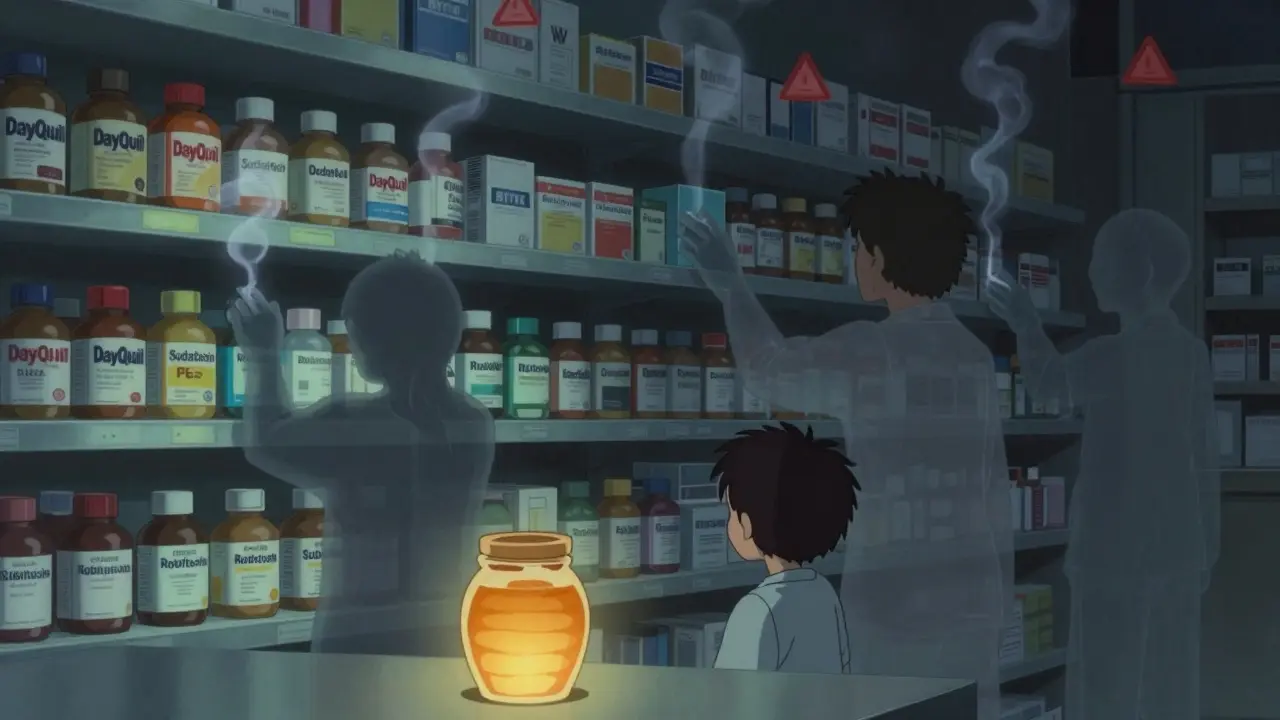
Every winter, millions of Americans reach for the same shelves of OTC cough and cold medicines-DayQuil, Sudafed PE, Robitussin, Vicks-hoping to feel better fast. But what if most of these products don’t actually work? And worse, what if they’re putting your kids or yourself at risk? The truth is, the cold medicine aisle is full of drugs that have been on the market for decades, even though science says they don’t do what they claim. The FDA just confirmed it: oral phenylephrine, the decongestant in nearly every store-brand cold pill, doesn’t relieve congestion at the doses you’re told to take. It’s not dangerous in small amounts-it just doesn’t work.
Why Your Cold Medicine Might Be Wasting Your Money
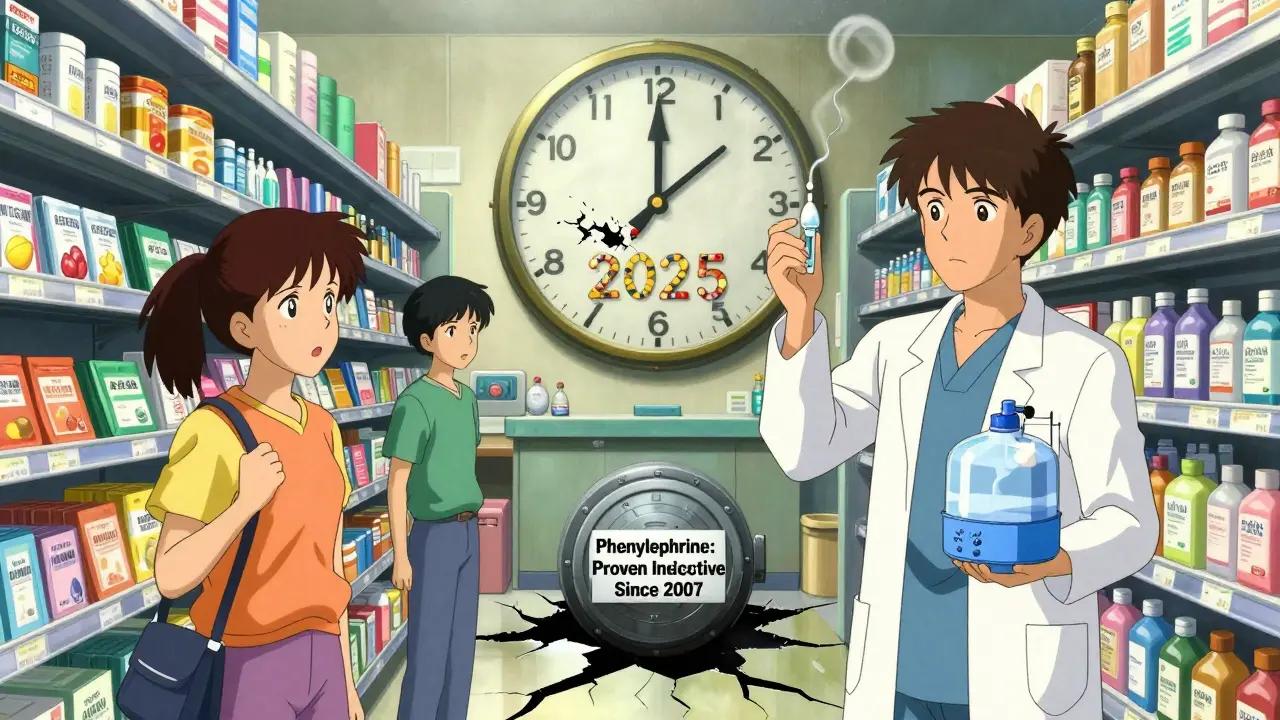
Phenylephrine has been the go-to decongestant in OTC products since the early 2000s, replacing pseudoephedrine, which was moved behind the pharmacy counter because it can be used to make methamphetamine. But here’s the catch: a 2007 meta-analysis found that 10mg of oral phenylephrine-exactly what’s in a single dose of Sudafed PE-has zero effect on nasal congestion compared to a sugar pill. Even at 25mg, the only dose that showed any benefit, the improvement was barely noticeable and didn’t match how people actually felt. That’s why the FDA’s Non-prescription Drug Advisory Committee recommended removing phenylephrine from the list of approved OTC ingredients in September 2023. If the rule goes through, manufacturers will have to reformulate products by late 2025.And it’s not just phenylephrine. Dextromethorphan, the cough suppressant in Robitussin and Coricidin, has mixed evidence. Some studies show it helps slightly in adults, but in kids, it’s no better than a placebo. Guaifenesin, the expectorant meant to loosen mucus, has almost no solid proof it works. A 2014 review of 29 clinical trials found no consistent benefit for any OTC cough medicine in children. And yet, these ingredients are still in almost every box, bottle, and packet on the shelf.
What’s Safe for Kids? (Spoiler: Not What You Think)
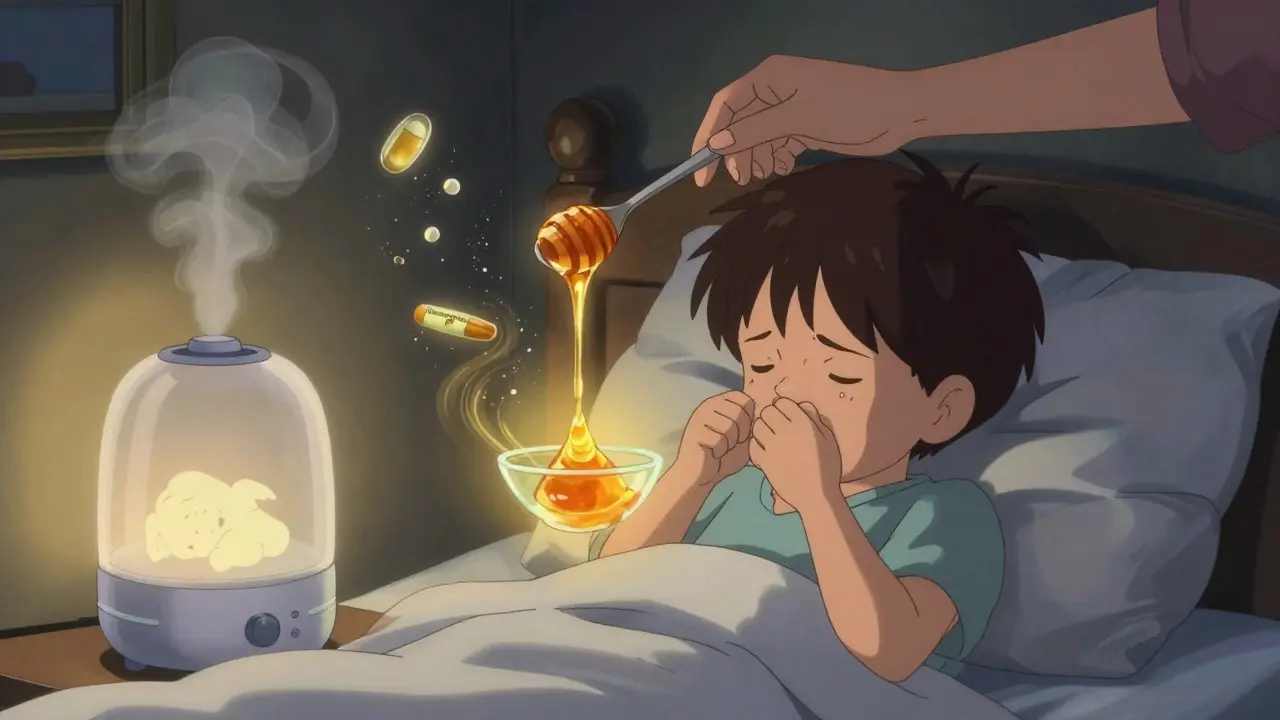
Parents are especially vulnerable to marketing claims. You see a product labeled “pediatric formula” and assume it’s safe. But the American Academy of Pediatrics has warned since 2008 that OTC cough and cold medicines should not be given to children under 2-and most doctors now say avoid them entirely under age 6. Why? Because these medicines don’t shorten illness, and they can cause serious side effects: rapid heart rate, seizures, even death. Between 2000 and 2007, 20 child deaths in the U.S. were linked to accidental overdoses of these products. Thirteen of those kids were under two.So what do you do when your 4-year-old is coughing at night? Skip the medicine. Use honey. Yes, honey. A 2023 study from the American Medical Association found that half a teaspoon of honey before bed was as effective as dextromethorphan at reducing nighttime coughing in kids over 12 months. And it’s safer. No risk of overdose. No hidden ingredients. You probably already have it in your pantry. The Mayo Clinic, UCSF, and the CDC all support honey as a first-line remedy for children’s coughs.
For babies under 12 months, skip honey (risk of botulism) and stick to saline drops, a bulb syringe, and a cool-mist humidifier. These simple tools clear nasal passages without drugs. A 2008 review in the PMC journal found these methods consistently helped with congestion and sleep-without any side effects.
Adults: What Actually Helps (and What Doesn’t)
Adults aren’t off the hook either. Just because you’re older doesn’t mean OTC cough meds are any more effective. Dextromethorphan might offer mild relief for some, but it’s no miracle. Guaifenesin? Probably useless. And phenylephrine? Don’t bother.If you need a decongestant, look for pseudoephedrine-but you’ll have to ask the pharmacist. It’s kept behind the counter because of its link to meth production, but it works. A 30mg dose can open up your sinuses for 4-6 hours. It’s the real deal. If you can’t get it, try a nasal spray with oxymetazoline (like Afrin). It’s local, targeted, and effective-just don’t use it for more than three days in a row. It can cause rebound congestion.
For coughs, try saline gargles, warm tea with lemon, or just drink more water. Staying hydrated thins mucus better than any expectorant. If you’re struggling to sleep because of coughing, try elevating your head with an extra pillow. It’s not glamorous, but it works.
The Hidden Danger: Double Dosing
One of the biggest risks with OTC cold medicines isn’t the ingredients-it’s mixing them. You take DayQuil for your cough and fever. Then you take Tylenol for the fever. Then you take NyQuil because you’re still congested. Suddenly, you’ve tripled your dose of acetaminophen. That’s how liver damage happens. The FDA says over 50% of accidental overdoses from OTC cold meds come from combining products with the same active ingredient.Always read the Drug Facts label. Look for the active ingredients. If two products have the same one-like acetaminophen or dextromethorphan-don’t take them together. Use a single product that targets your main symptoms. If you have a cough and runny nose, pick one with an antihistamine and cough suppressant. Don’t grab three bottles and hope for the best.
What’s Coming Next: A Shift Away from Pills
The market is changing. Sales of OTC cold medicines hit $3.5 billion in 2022, but they’re already slipping. Amazon reviews for phenylephrine products have dropped from 4.1 stars in 2020 to 3.2 stars in 2023. Reddit users in r/Pharmacy are calling out the ineffectiveness of oral phenylephrine daily. People are tired of spending money on pills that don’t work.By 2026, industry analysts predict a 25% drop in traditional cold medicine sales as consumers turn to alternatives. Saline sprays, honey-based syrups, and steam inhalers are growing at 12.7% a year. Companies like Vicks and Johnson & Johnson are already testing new formulas without phenylephrine. The FDA’s move isn’t just about safety-it’s about forcing the industry to stop selling ineffective drugs.
What to Do Today
You don’t need a prescription to feel better. Here’s what works, right now:- For adults: Use pseudoephedrine (behind the counter) for congestion. Skip phenylephrine. Use honey or warm fluids for cough. Drink water. Rest.
- For kids over 12 months: Half a teaspoon of honey at bedtime. Saline drops and suction for stuffy noses. Humidifier in the room.
- For babies under 12 months: Saline drops, bulb syringe, humidifier. No medicine. No exceptions.
- For everyone: Never mix cold meds. Check the Drug Facts label. Stop using any product with phenylephrine-there’s no reason to.
There’s no magic pill for the common cold. Your body fights it off in 7-10 days. OTC meds don’t cure anything-they only try to make you feel a little less awful. And now we know: most of them don’t even do that.
When to See a Doctor
Most colds are harmless. But if you or your child has:- Fever over 102°F lasting more than 3 days
- Difficulty breathing or wheezing
- Cough lasting more than 2 weeks
- Signs of dehydration (dry mouth, no tears, less than 3 wet diapers a day in babies)
- Severe headache, stiff neck, or confusion
These aren’t cold symptoms-they’re warning signs. Call your doctor. Don’t rely on a bottle from the pharmacy.
Is phenylephrine still safe to take?
Phenylephrine at the standard 10mg dose is not dangerous in most people, but it also doesn’t work. The FDA has proposed removing it from OTC monographs because studies show it’s ineffective for nasal congestion. If you’re taking it, you’re not getting any benefit. Switch to a product with pseudoephedrine or try a nasal spray instead.
Can I give my child cough medicine?
No-don’t give OTC cough and cold medicine to children under 6. The FDA and American Academy of Pediatrics agree: these products don’t help kids recover faster and can cause serious side effects like rapid heartbeat, seizures, or even death. For children over 12 months, honey is just as effective as dextromethorphan and much safer. For babies under 12 months, use saline drops, a bulb syringe, and a humidifier.
What’s the best OTC cold medicine right now?
There’s no single "best" product, but avoid anything with phenylephrine. For congestion, choose a product with pseudoephedrine (ask the pharmacist). For cough, look for one with dextromethorphan-but know it may not help much. The best approach is to use the fewest ingredients possible. A single tablet with just what you need is safer than a multi-symptom combo.
Do guaifenesin and dextromethorphan really work?
The evidence is weak. A 2014 review of 29 clinical trials found no consistent benefit for guaifenesin (expectorant) or dextromethorphan (cough suppressant) in treating acute cough. Some adults report feeling better, but that’s likely due to placebo or natural recovery. In children, these ingredients show no benefit over placebo. Don’t expect miracles.
What are safer alternatives to OTC cold medicine?
For congestion: saline nasal spray or rinse, humidifier, steam from a hot shower. For cough: honey (for kids over 12 months), warm tea, extra fluids. For fever or pain: acetaminophen or ibuprofen-used correctly. These methods are backed by science, cost less, and carry no risk of overdose or dangerous interactions.

Christina Widodo
I had no idea phenylephrine was useless-my whole medicine cabinet just became a shrine to placebo magic. Time to throw out half these bottles.
laura manning
It is, indeed, a profound and concerning revelation that the over-the-counter pharmaceutical industry has, for over two decades, persisted in marketing an ingredient-oral phenylephrine-that possesses no clinically significant vasoconstrictive properties at the recommended dosage. The regulatory inaction is, frankly, indefensible.
The FDA’s proposed removal is not merely prudent-it is overdue. The continued availability of this compound, despite robust meta-analytic evidence demonstrating its inefficacy, constitutes a systemic failure of consumer protection.
Moreover, the proliferation of multi-symptom formulations compounds the danger: consumers, unaware of active ingredient overlap, routinely exceed safe thresholds of acetaminophen-resulting in preventable hepatotoxicity.
It is not merely about efficacy-it is about informed consent. Consumers are being sold the illusion of relief, while the industry profits from inertia and brand loyalty.
The shift toward saline irrigation, humidification, and honey-based interventions represents not a regression to folk remedies, but a return to evidence-based, low-risk care.
One must also consider the psychological dimension: the perceived benefit of taking a pill, regardless of pharmacological reality, reinforces placebo-driven compliance.
Pharmaceutical marketing exploits vulnerability during illness-a time when rational decision-making is compromised.
It is no coincidence that sales of phenylephrine-containing products have declined in direct correlation with rising public awareness via platforms such as Reddit and PubMed.
The real tragedy? Parents, desperate to help their children, are administering drugs that offer no benefit and carry measurable risk.
For pediatric cough, honey-when age-appropriate-is not a ‘home remedy’-it is a first-line, evidence-supported intervention, validated by randomized controlled trials.
The medical community must do more than issue guidelines. We must actively dismantle the infrastructure of misinformation.
Until then, we remain complicit.
Check your labels. Question your assumptions. Demand better.
Lawrence Jung
So we’re just supposed to sit there and wait for the cold to run its course like some kind of ancient ritual? Man we’ve come a long way from caves but now we’re back to honey and steam? Progress is a myth
Alice Elanora Shepherd
Thank you for this thoughtful, well-researched post. I’ve been telling my friends for years that those multi-symptom cold pills are mostly sugar and wishful thinking. The fact that phenylephrine is ineffective at standard doses is both shocking and deeply disappointing.
For parents: honey really does work. My daughter was coughing through the night at age three-half a teaspoon before bed, and within two days, she was sleeping through. No side effects, no panic.
Also, please remember: saline drops and suction for babies aren’t ‘old-fashioned’-they’re the gold standard. I’ve seen too many parents rush to the pharmacy out of fear, only to give their child something that could do more harm than good.
Let’s stop treating colds like emergencies. They’re self-limiting. Rest, fluids, and patience are the real medicine.
Prachi Chauhan
So the whole pharma thing is just scamming us with fake decongestants? I mean, I always thought it was placebo but now I got proof. Also why is pseudoephedrine behind the counter? Because they want to make us jump through hoops? That’s not safety that’s control. We need real access not bureaucracy
Katherine Carlock
Wait so you’re telling me I’ve been wasting money on DayQuil for years? I feel so dumb. But honestly I’m glad I’m not alone-my mom used to give me Robitussin for everything and I’m 32 now and still don’t know if it helped or not. I’m switching to honey and steam tonight. Also-why does every cold medicine look the same? Like same colors, same fonts? It’s like they’re trying to trick us into thinking they’re different.
Lelia Battle
The most troubling aspect of this issue is not the ineffectiveness of the drugs, but the normalization of pharmaceutical dependency for self-limiting conditions. We have conditioned ourselves to believe that illness requires intervention, when often, the body’s own mechanisms are sufficient.
There is dignity in rest. There is wisdom in patience. And there is profound harm in mistaking comfort for cure.
The market thrives on fear-fear of discomfort, fear of missing work, fear of being ‘sick’ in a society that equates productivity with worth.
Let us not confuse the alleviation of symptoms with the restoration of health.
Rinky Tandon
OH MY GOD I JUST REALIZED I’VE BEEN GIVING MY KID DAYQUIL SINCE HE WAS 1 AND I’M A TERRIBLE PARENT. I’M GOING TO CRY. I’M SO GUILTY. I THOUGHT I WAS BEING A GOOD MOM. NOW I FEEL LIKE I’M A MONSTER. I’M GOING TO THROW EVERYTHING AWAY AND JUST STARE AT THE HUMIDIFIER NOW. I’M SO SORRY BABY.
Ben Kono
Why are you all so mad? It's just a cold. Take the pill. It makes you feel better. Who cares if it's placebo? If it works for you then it works
Cassie Widders
My grandma used to make us tea with lemon and honey. Didn’t know it was science. Just knew it made the cough go quiet. Funny how the old ways were right all along.
Konika Choudhury
USA is so lazy they need pills for everything. In India we just drink kadha and sleep. No pharma scam needed. Why are you paying for nonsense?
Darryl Perry
Stop pretending you’re a doctor. The FDA hasn’t banned phenylephrine yet. Until then, it’s legal. If you don’t like it, don’t buy it. Don’t lecture everyone else.
Windie Wilson
So let me get this straight: the entire American cold industry is built on a lie… and we’re all just supposed to sip honey like we’re in a Pinterest dream? I mean, I get it. But I still want to take something that looks like a rocket ship on the bottle and makes me feel like I’m fighting the cold with a superhero cape. Give me my DayQuil. I need the illusion.