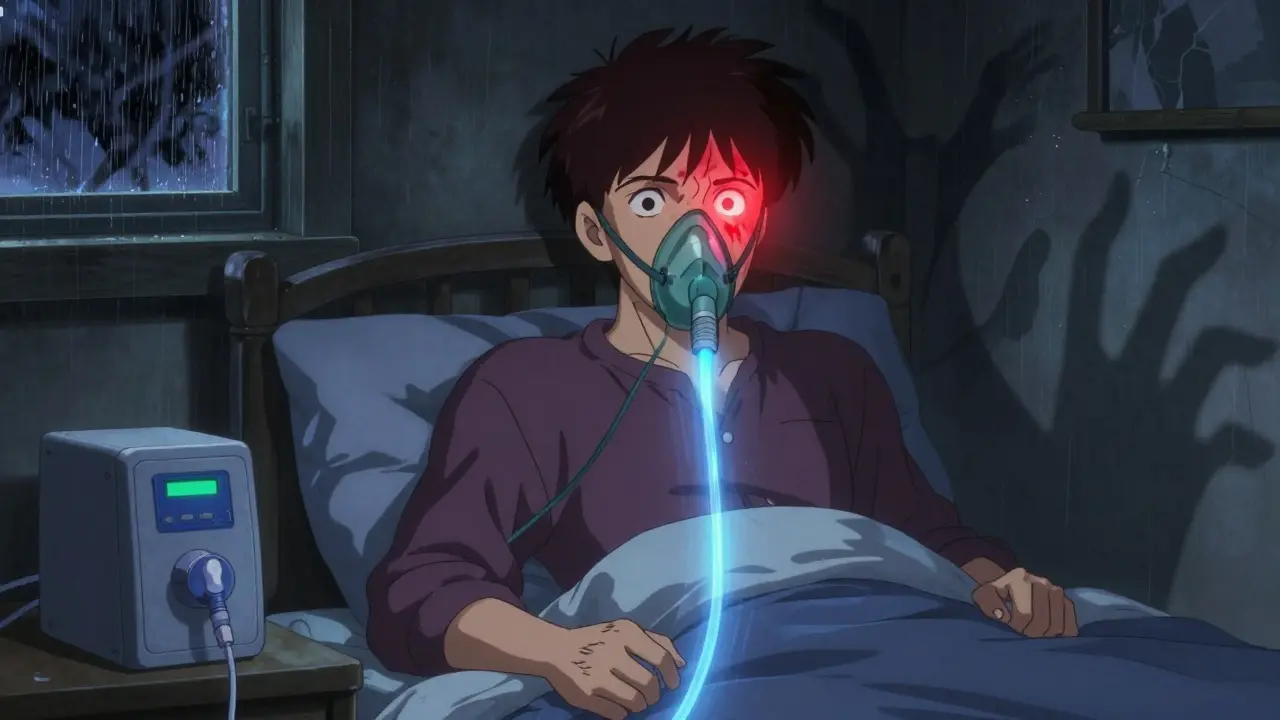
Imagine waking up in the middle of the night with a pain so intense it feels like a hot poker being shoved behind your eye. No warning. No trigger you can point to. Just pure, unrelenting agony that hits like a hammer and lasts for 15 to 90 minutes - sometimes multiple times a day. This isn’t a migraine. This is a cluster headache.
Cluster headaches are among the most painful conditions known to medicine. People who live with them often describe the pain as worse than childbirth or kidney stones. It’s not just bad - it’s debilitating. And unlike migraines, which can last for hours or days, cluster attacks come in short, brutal bursts, often at the same time every day or night. They follow a pattern: weeks or months of daily attacks, then a break - sometimes for years.
What makes cluster headaches even harder to manage is how little most people know about them. Even some doctors overlook them. But there’s one treatment that stands out above all others: oxygen therapy. It’s fast, safe, and works for most people when used correctly.
What Exactly Are Cluster Headaches?
Cluster headaches are a type of primary headache disorder. That means they aren’t caused by another illness like a tumor or infection. They’re a neurological condition, linked to overactivity in the hypothalamus - the part of the brain that controls your body clock. That’s why attacks often happen at the same time each day. Many people get them between 1 and 3 a.m., waking them up in agony.
The pain is always on one side of the head - usually around the eye, temple, or forehead. It’s sharp, burning, or stabbing. Along with the pain, you’ll often see other symptoms on the same side: a watery eye, a runny or stuffy nose, a drooping eyelid, or even a flushed or sweaty face. Some people pace, rock back and forth, or scream because the pain is so unbearable. That’s why it’s sometimes called the “suicide headache.”
It affects about 1 in 1,000 people. Men are three times more likely to get them than women, though that gap is narrowing as diagnosis improves. Most people get their first attack between ages 20 and 50. Smoking and alcohol can trigger attacks, but they don’t cause the condition itself.
Why Oxygen Therapy Works
In the 1950s, Dr. Harold Wolff noticed something strange. When patients with cluster headaches breathed pure oxygen, their pain often vanished. At first, it was dismissed as coincidence. But decades of research have proven it works - and not just a little. Oxygen therapy is the gold standard for stopping an attack in its tracks.
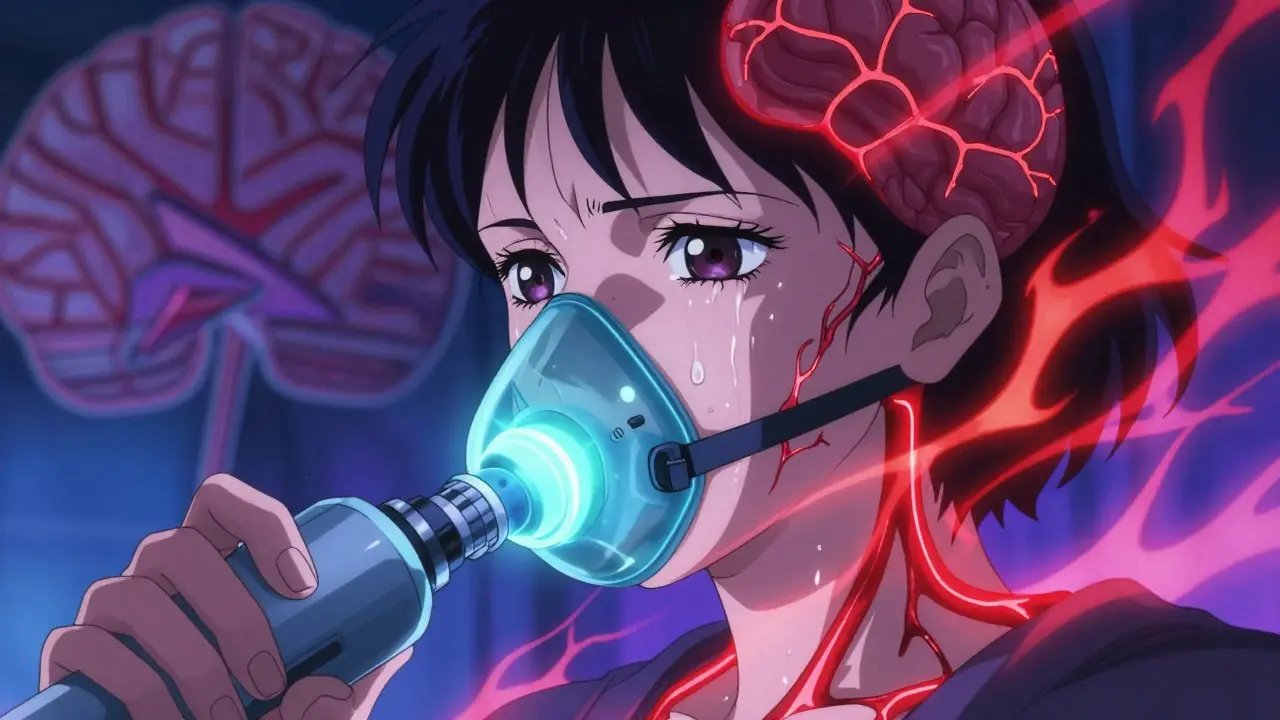
Here’s how it works: breathing 100% oxygen at high flow rates (between 12 and 15 liters per minute) through a non-rebreather mask floods your bloodstream with oxygen. This seems to calm the overactive nerves in your brain that are firing during the attack. The effect is fast. For 78% of people, pain drops significantly within 15 minutes. Some feel relief in as little as 5 minutes.
What makes oxygen therapy so valuable is what it doesn’t do. Unlike triptans (a common migraine drug), oxygen has no cardiovascular risks. People with heart disease, high blood pressure, or a history of stroke can use it safely. There are no side effects like dizziness, chest tightness, or nausea - which are common with medications.
One 2019 Cochrane Review compared oxygen to subcutaneous sumatriptan (an injection). Both worked about the same - 78% vs. 74% pain-free at 15 minutes. But oxygen had 0% side effects. Sumatriptan? 34% of users had bad reactions. That’s why headache specialists overwhelmingly recommend oxygen first.
How to Use Oxygen Therapy Correctly
Using oxygen therapy wrong is like using a fire extinguisher on a candle - it might help a little, but it won’t stop the fire. To get full benefit, you need the right setup.
- Flow rate: 12 to 15 liters per minute. Lower flow (like 6 L/min) doesn’t work as well. Studies show 12 L/min gives 78% pain-free results - compared to only 20% with placebo.
- Mask: A non-rebreather mask with a reservoir bag. This ensures you’re breathing almost pure oxygen, not air mixed in. Regular nasal cannulas won’t cut it.
- Duration: 15 to 30 minutes. Don’t stop early. Even if you feel better after 10 minutes, keep going for the full 15 to prevent the attack from coming back.
- Position: Sit upright. Leaning back or lying down reduces oxygen flow to your brain.
- Timing: Start oxygen as soon as you feel the first twinge. Waiting more than 10 minutes after onset cuts your chances of success in half.
Many people make the mistake of using oxygen too late - or using a low-flow device. That’s why some think it doesn’t work. It’s not the treatment - it’s how it’s used.
Who Doesn’t Respond to Oxygen?
Oxygen therapy works for 60-82% of people. That’s impressive. But it doesn’t help everyone. If you’ve tried it and it didn’t work, here’s why:
- You don’t have a history of smoking. Oddly, non-smokers are less likely to respond.
- You have constant, low-level pain between attacks (called persistent interictal headache).
- Your attacks last longer than 180 minutes. Cluster headaches usually don’t - if they do, they may be something else.
Also, if your oxygen device can’t deliver 12 L/min continuously, it won’t work. Many cheap concentrators max out at 5 or 6 L/min. You need a medical-grade unit designed for high flow.
Equipment You Need
You can’t just grab a portable oxygen tank from the hardware store. This is medical-grade treatment. You need:
- An oxygen concentrator: A machine that pulls oxygen from the air and delivers it at high flow. Look for models like the Invacare Perfecto2 or Inogen One G5. The G5 weighs just 4.8 pounds and is portable - great for carrying to work or while traveling.
- A non-rebreather mask: Must have a reservoir bag and one-way valves. These cost $5-$10 each. Buy extras - they wear out.
- Tubing: Standard medical oxygen tubing. Make sure it’s long enough to let you move around.
Costs vary. A new concentrator runs $1,200-$2,500. Rental is $150-$300/month. Insurance often covers it - but only if you have a prescription and meet strict criteria.
Insurance and Access Issues
This is where things get messy. Even though oxygen therapy is recommended by the American Academy of Neurology and the European Headache Federation, getting it covered is a battle.
Medicare only approves oxygen for cluster headaches if:
- You’ve tried and failed two triptans,
- Your attacks happen at least once a week,
- You have a confirmed diagnosis.
In 2022, 41% of Medicare claims were denied. Private insurers are inconsistent. UnitedHealthcare approves 68% of claims. Aetna approves just 42%. Rural patients have far less access than urban ones - only 28% vs. 63%.
Some patients end up paying out of pocket. Others wait months for approval. That delay can mean more pain, more missed work, and more despair.
Advocacy groups like Clusterbusters have pushed for state laws. Since 2020, 22 states have passed laws requiring insurers to cover oxygen therapy for cluster headaches. But many others still don’t.

Real Stories: What Patients Say
On Reddit’s r/ClusterHeadaches community - with over 14,500 members - users share daily experiences. One person wrote: “12 L/min with a non-rebreather mask gets me pain-free in 8-10 minutes. If I catch it early, it’s a miracle.” Another said: “I went from 8 attacks a day to 2 after starting oxygen. My life changed.”
But not all stories are positive. One user on Patient.info wrote: “My insurance denied my oxygen machine three times. I had to buy it myself. It cost $2,100.” Another said: “The mask kept slipping. I lost 10 minutes every time I had to reseat it. That’s 10 minutes of hell.”
Those who succeed are the ones who prep: keep the mask on the nightstand. Charge the portable unit. Have backup tubing. Practice putting it on before an attack hits.
What’s New in 2026?
Things are improving. In May 2023, the FDA cleared the O2VERA - a portable oxygen concentrator designed specifically for cluster headaches. It delivers 15 L/min and weighs only 5.2 pounds. In Europe, a new nasal delivery system showed 89% effectiveness in trials. That could mean easier use - no mask needed.
Researchers are also testing demand-valve masks - they only release oxygen when you inhale. Early results show they cut treatment time by over 4 minutes. That’s huge when you’re in pain.
Long-term, neuromodulation devices like gammaCore (which stimulates nerves in the neck) are helping people who don’t respond to oxygen. But for now, oxygen remains the most effective, safest, and fastest tool we have.
What to Do Next
If you think you have cluster headaches:
- See a neurologist who specializes in headaches. General doctors often miss this.
- Ask for the ICD-10 code G44.0 - it’s critical for insurance.
- Request a prescription for high-flow oxygen therapy.
- Get a non-rebreather mask and a concentrator that delivers at least 12 L/min.
- Practice using it. Set up your equipment in your bedroom, living room, and office.
- Join a support group. Clusterbusters.org has free guides, videos, and a community that gets it.
Don’t wait for the next attack to figure it out. Learn how to use oxygen before you need it. Time matters. Minutes matter. And with the right setup, you can stop the pain before it takes over.

Freddy King
Let me break this down like a neurologist at a conference: the hypothalamic hyperactivity in cluster headaches is a circadian-driven phenomenon, not just ‘bad luck.’ The oxygen mechanism? It’s not just about vasodilation-it’s suppressing trigeminal-autonomic reflexes via hyperbaric-like effects on NO and CGRP. If you’re not hitting 12 L/min with a non-rebreather, you’re doing placebo-level therapy. And yeah, I’ve seen 40% non-responders in clinic-usually non-smokers with persistent interictal pain. The data doesn’t lie.
Also, anyone using a portable concentrator under 15 L/min max? You’re wasting oxygen. Period.
Jayanta Boruah
It is imperative to acknowledge, with the utmost scientific rigor, that oxygen therapy, while efficacious in the majority of cases, remains an intervention predicated upon physiological modulation rather than etiological resolution. The underlying neurochemical cascade involving calcitonin gene-related peptide (CGRP) and nitric oxide (NO) is not eradicated by hyperoxic inhalation; it is transiently suppressed. Therefore, one must not conflate palliation with cure. Furthermore, the socioeconomic disparity in access-particularly in rural communities where oxygen concentrators are neither subsidized nor available-constitutes a systemic failure of healthcare equity. This is not merely a clinical issue; it is a moral one.
James Roberts
Oh wow, so oxygen is the ‘magic gas’ now? 😏 Let’s be real-this whole post reads like an ad for Invacare. I get that it works for some, but 78%? That’s not a miracle, that’s ‘better than a placebo but still leaves a third of people screaming into a pillow.’
And why is no one talking about the fact that half the people who swear by it are ex-smokers? Coincidence? Or is there a damn nicotine receptor thing going on? I’ve got a buddy who uses oxygen and still gets 5 attacks a day. He’s got the whole setup: mask, tank, yoga mat, incense… nothing works. So yeah, ‘gold standard’ sounds nice, but it’s not a cure-all. Don’t sell people a dream.
Danielle Gerrish
I just want to say-I’ve been living with this for 12 years. I used to think I was crazy. I’d wake up at 2 a.m., sobbing, clawing at my face, convinced I was dying. No one believed me. My husband thought I was faking for attention. I lost my job. I stopped dating. I thought I’d die alone in pain.
Then I got my oxygen. Not because insurance paid. Because I sold my car. Because I cried on the phone to Clusterbusters for 45 minutes. Because I refused to let it win.
Now I can sleep. I can work. I can hug my kid without screaming. I’m not ‘cured.’ But I’m alive. And if you’re reading this and you’re scared? Get the mask. Get the tank. Don’t wait for permission. You deserve to stop hurting.
Liam Crean
I’ve been using oxygen for 3 years. It works, but the mask is the real enemy. It slips. It chafes. I can’t move. I can’t drink water. I can’t check the time. I end up losing 8 minutes every time I have to reseat it. I wish there was a nasal option. Or a helmet. Or something that didn’t feel like being held down by a plastic squid.
Also, the 12 L/min requirement is brutal on battery life. My portable unit dies in 18 minutes. I have to charge it before bed. It’s a whole ritual. I’m not mad. Just… tired.
madison winter
Interesting. So the ‘suicide headache’ label is still in use? That’s… not helpful. And why are we still talking about oxygen like it’s the only option? What about verapamil? Lithium? Occipital nerve blocks? The post reads like a one-song playlist. Oxygen isn’t the cure-it’s one tool. And it’s not even accessible to most people. Why is this being presented as gospel? I’m tired of medical content that ignores systemic failure and just tells you to ‘buy the machine.’
Ellen Spiers
The assertion that oxygen therapy is the ‘gold standard’ is empirically accurate, yet semantically imprecise. While the Cochrane Review (2019) demonstrates comparable efficacy to subcutaneous sumatriptan, the methodological limitations of self-reported pain scales in acute cluster headache cohorts must be acknowledged. Furthermore, the claim that ‘oxygen has no side effects’ is demonstrably false: barotrauma, dry mucous membranes, and oxygen toxicity (at prolonged exposure) are documented. The omission of these risks constitutes a form of medical misrepresentation. The non-rebreather mask requirement, while physiologically sound, is impractical for patients with facial deformities or claustrophobia. This is not a panacea; it is a conditional intervention.
Marie Crick
People who don’t use oxygen are just lazy. If you’re in pain, you get the mask. You don’t whine about insurance. You don’t wait for a ‘better option.’ You do the work. I’ve seen people with $300,000 in debt because they didn’t want to buy a $1,500 machine. That’s not a healthcare problem-that’s a character problem. Get your head right. Then get your oxygen.
John Cena
Just wanted to say thanks to Danielle for sharing her story. That hit hard. I’ve been in the same boat-lost my job, lost friends. Didn’t know anyone else got this. The mask thing? Yeah, it’s annoying. But I keep a second one in my glovebox. I keep the charger plugged in at work. It’s a pain. But it’s not as bad as the headache. I’m not ‘fixed.’ But I’m not broken anymore. You’re not alone.
Tommy Chapman
Ugh, another ‘oxygen is magic’ post. What about the fact that 70% of these patients are white, male, and from the U.S.? What about the fact that in countries with universal healthcare, they just give you sumatriptan and call it a day? This whole thing feels like American medical capitalism in a nutshell: ‘Here’s a $2,000 device. Good luck.’ Meanwhile, in Canada, they get it covered. In the UK, they get neurostimulators. We’re glorifying a Band-Aid because the system won’t fix the wound.
Scott Dunne
While oxygen therapy may offer transient relief, its long-term efficacy remains unproven. The anecdotal triumphs cited in this article are compelling, yet they constitute a selection bias. The true measure of success lies not in the 15-minute window of relief, but in the reduction of attack frequency over a 12-month period. No such longitudinal data is presented. Until then, this remains a palliative measure, not a therapeutic breakthrough. Furthermore, the emphasis on equipment purchase ignores the fact that many sufferers are unemployed, underinsured, or geographically isolated. A system that demands personal investment to alleviate suffering is not a system-it is a trap.