
Cerebral aneurysm is a weakened area in a brain artery that bulges outward like a balloon on a tire. Most people with this condition never know they have it. About 3.2% of the global population carries an unruptured intracranial aneurysm (UIA). For most, it stays quiet. But if it bursts, the result is a subarachnoid hemorrhage-a type of stroke that kills 30-40% of patients within the first 24 hours.
You might be wondering why some aneurysms stay stable for decades while others rupture suddenly. The answer lies in a mix of your genetics, lifestyle habits, and the specific shape and location of the aneurysm itself. Understanding these factors helps you decide whether to watch and wait or take action through surgery or minimally invasive procedures.
Who Is at Risk? Non-Modifiable Factors
Some risks are out of your control. You can’t change your age, gender, or family history, but knowing how they affect your odds is crucial for early detection.
- Age: People over 65 face a 2.7-fold higher rupture risk compared to younger patients. As arteries stiffen with age, they become less able to handle blood pressure fluctuations.
- Gender: Women are 1.6 times more likely to develop cerebral aneurysms than men. Hormonal changes, particularly after menopause, may weaken arterial walls.
- Genetics: If two or more first-degree relatives have had an aneurysm, your risk jumps fourfold. This suggests a strong hereditary component involving collagen structure and inflammatory pathways.
These factors don’t guarantee a rupture, but they do mean you should be more vigilant about screening if you fit these profiles.
Lifestyle Choices That Change Your Odds
Unlike age or genetics, you have power over modifiable risk factors. Making changes here can significantly lower your chances of a rupture.
| Risk Factor | Specific Threshold | Risk Increase |
|---|---|---|
| Hypertension | Systolic BP >140 mmHg | 2.3-fold higher risk |
| Tobacco Use | Current smoker (10+ cigarettes/day) | 3.1-fold higher risk; +47% per pack |
| Alcohol Consumption | >14 drinks per week | 32% higher risk |
Smoking is arguably the biggest threat. It damages the inner lining of blood vessels and promotes inflammation. Quitting smoking reduces rupture risk by 54% within just two years. Similarly, keeping blood pressure below 130/80 mmHg takes constant mechanical stress off the aneurysm wall. Heavy alcohol use also weakens vessel integrity, so moderation is key.
Anatomy Matters: Size, Shape, and Location
Not all aneurysms are created equal. Doctors look closely at three physical traits to predict rupture likelihood: size, shape, and location.
Size is a major predictor. Aneurysms measuring 7 mm or larger have a hazard ratio of 3.1 for rupture compared to smaller ones. However, size isn’t everything. A small aneurysm in a high-stress area can be more dangerous than a large one in a low-flow zone.
Shape plays a surprising role. Irregular shapes, especially those with "daughter sacs" (small bumps on the main sac), carry a 2.9 times higher rupture risk. Spherical, smooth aneurysms tend to be more stable. The presence of daughter sacs increases risk by 68% because these protrusions experience uneven blood flow forces.
Location determines hemodynamic stress. Aneurysms in the anterior communicating artery (AComm) have a 2.4 times higher rupture risk than those elsewhere. Middle cerebral artery aneurysms also show elevated risk (HR 3.6). In contrast, posterior circulation aneurysms under 5 mm have a very low 5-year rupture risk (0.7%), often supporting a "watchful waiting" approach.

Predicting the Future: Risk Scoring Systems
Doctors don’t guess-they calculate. Several validated scoring systems help estimate your personal rupture probability over time.
The PHASES score is the gold standard. It evaluates Population, Hypertension, Age, Size, Earlier SAH (subarachnoid hemorrhage), and Site. Scores range from 0 to 10+ points:
- 0-3 points: ~3% 5-year rupture risk
- 9-10 points: ~45% 5-year rupture risk
Other tools include the ELAPSS score (for 1-year risk) and the Triple-S model (Size, Site, Shape), which predicts short-term risks with good accuracy (C-index 0.72). These models incorporate biological markers too-like elevated IL-6 and CRP levels, which signal active inflammation in the vessel wall.
Treatment Options: Clipping vs. Coiling vs. Flow Diversion
If your doctor recommends intervention, you’ll choose between three main approaches. Each has pros, cons, and ideal candidates.
Microsurgical Clipping
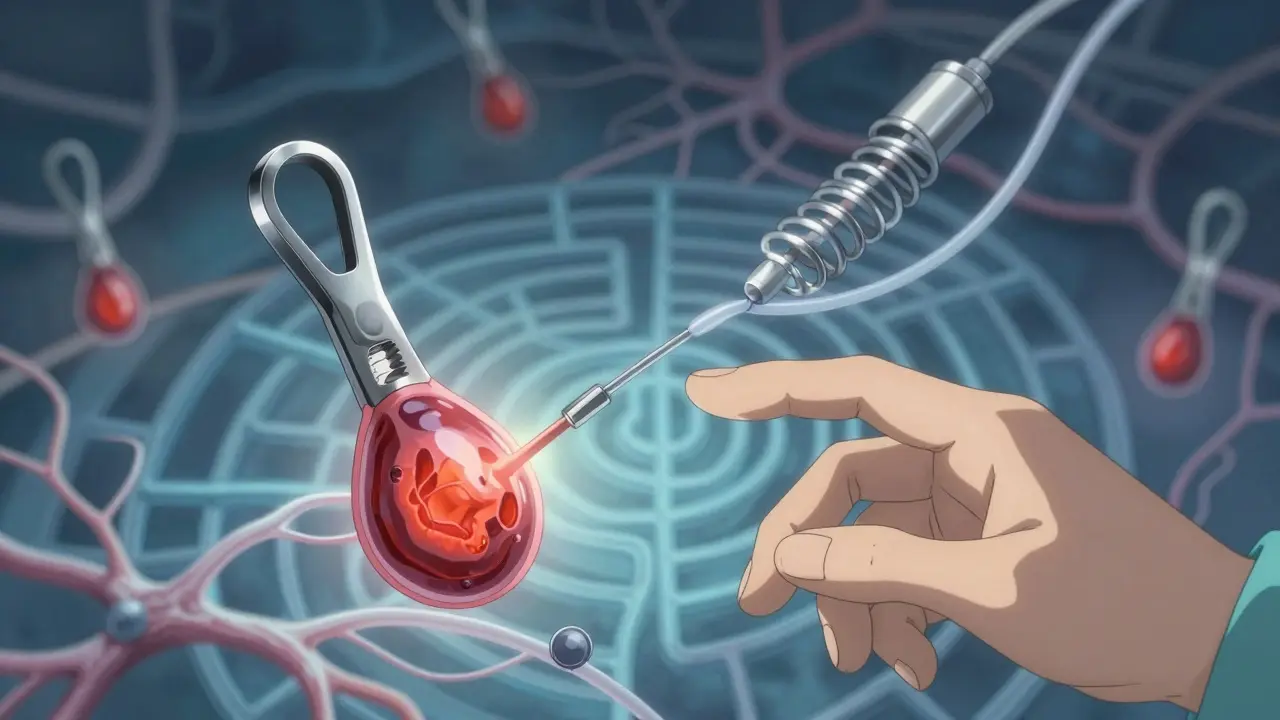
This traditional method involves opening the skull (craniotomy) and placing a titanium clip across the aneurysm’s neck to stop blood flow into the sac. It offers a permanent cure in 88-92% of cases. However, it’s invasive, with a 4.7% permanent morbidity rate and 1.5% mortality risk. Recovery takes weeks.
Endovascular Coiling
First introduced in 1991, this minimally invasive technique threads a catheter through the groin artery up to the brain. Platinum coils are packed into the aneurysm to induce clotting. Success rates reach 78-85% complete occlusion at 6 months. It’s less risky upfront (3.9% morbidity, 1.1% mortality) but has higher retreatment rates (15.7% at 12 years) as coils compact over time.
Flow Diversion
For large or wide-necked aneurysms, flow diverters like the Pipeline Embolization Device act as mesh stents that redirect blood flow away from the aneurysm. They achieve 76.4% complete occlusion at 6 months for giant aneurysms. Morbidity is 5.2%, mortality 0.8%. This option requires lifelong antiplatelet medication to prevent clots in the stent.
| Treatment | Invasiveness | Success Rate (Occlusion) | Morbidity/Mortality | Retreatment Need |
|---|---|---|---|---|
| Surgical Clipping | High (Craniotomy) | 95% immediate | 4.7% / 1.5% | Low (6.2%) |
| Endovascular Coiling | Low (Catheter-based) | 78-85% at 6 mo | 3.9% / 1.1% | High (15.7%) |
| Flow Diversion | Low (Stent-based) | 76.4% at 6 mo | 5.2% / 0.8% | Medium |
The International Subarachnoid Aneurysm Trial (ISAT) showed coiling reduced 1-year mortality by 22.6% compared to clipping. But long-term, clipping may offer better durability. Your neurosurgeon will weigh your age, aneurysm location, and overall health to pick the best path.
When to Watch and Wait
Not every aneurysm needs fixing. Small (<5 mm), regular-shaped aneurysms in low-risk locations often pose minimal danger. The UCAS Japan study found a 0.2% 5-year rupture risk for anterior circulation aneurysms under 5 mm. In these cases, annual MRA imaging and strict blood pressure control are safer than surgery.
Conservative management includes:
- Target blood pressure <130/80 mmHg
- Complete smoking cessation
- Limiting alcohol to <14 drinks/week
- Annual MRI/MRA scans to monitor growth
New Frontiers in Care
Medicine is evolving. The WEB (Woven EndoBridge) device, FDA-approved in 2019, offers a new option for bifurcation aneurysms, achieving 71.4% occlusion at 1 year. Meanwhile, researchers are using machine learning to analyze 42 morphological parameters for better rupture prediction. Genetic studies have identified 17 loci linked to aneurysm formation, paving the way for personalized risk assessments.
For now, the best defense is awareness. Know your family history, manage your blood pressure, quit smoking, and follow up on any incidental findings. With modern diagnostics and treatments, most people with cerebral aneurysms live full, healthy lives.
What is the average lifespan with an unruptured cerebral aneurysm?
Most people with small, unruptured aneurysms have a normal life expectancy. The annual rupture risk is generally less than 1% for small aneurysms. Successful treatment reduces long-term mortality significantly, bringing survival rates close to the general population.
Can a cerebral aneurysm heal on its own?
No, cerebral aneurysms do not heal spontaneously. They may remain stable for years, but the weakened vessel wall does not repair itself. Without intervention, the risk of rupture persists and may increase if the aneurysm grows.
Is endovascular coiling better than surgical clipping?
It depends on the case. Coiling is less invasive with faster recovery and lower short-term mortality, making it preferred for many patients. However, clipping offers a more permanent solution with lower retreatment rates. Wide-necked or complex aneurysms may require clipping or flow diversion instead.
How often should I get scanned if I have an unruptured aneurysm?
Typically, doctors recommend annual MRA or CTA scans for the first few years to check for growth. If the aneurysm remains stable, intervals may extend to every 2-3 years. Any rapid growth or symptom onset requires immediate imaging.
Does stress cause an aneurysm to rupture?
Acute severe stress can spike blood pressure, potentially triggering rupture in vulnerable aneurysms. While chronic stress isn't a direct cause, managing hypertension and avoiding extreme physical or emotional strain is part of risk reduction strategies.
