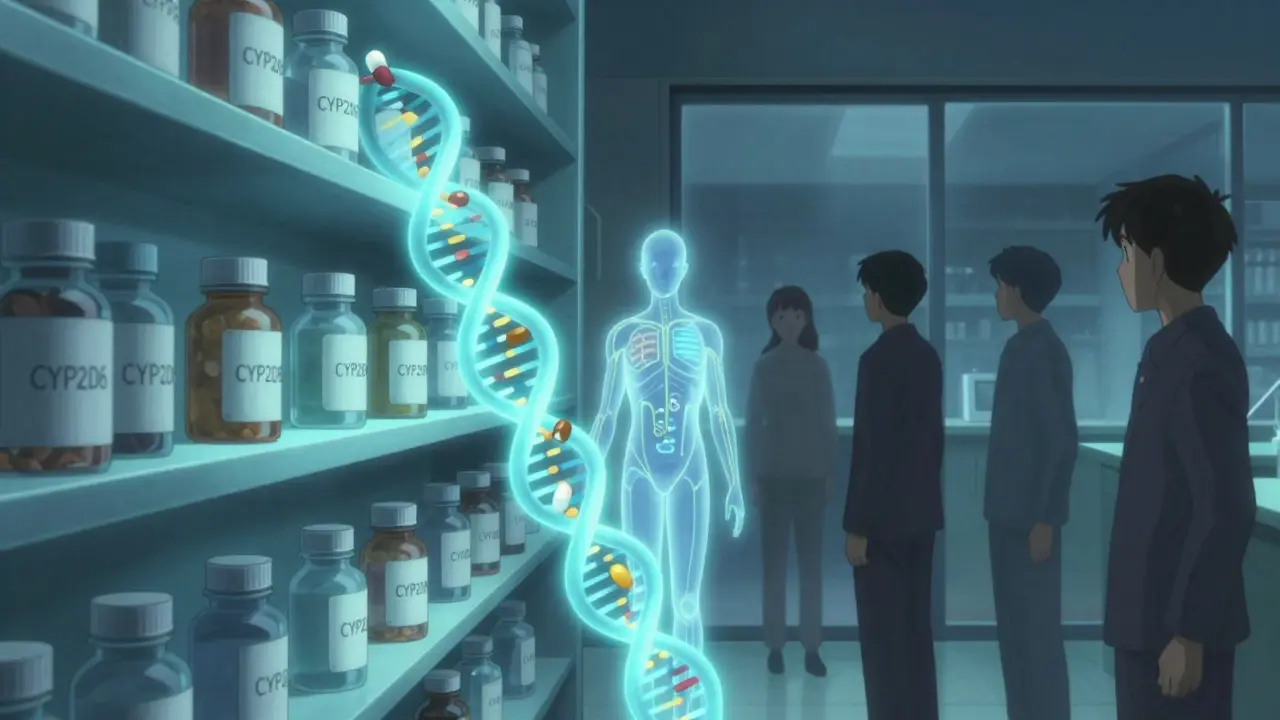
When you pick up a prescription at an online pharmacy, you expect the right drug at the right dose. But what if that pill could be tailored to your genes? That’s not science fiction-it’s happening now. AI and pharmacogenomics are quietly transforming how medications are chosen, especially for online pharmacies serving patients who need precise, safe, and personalized treatment. This isn’t about guessing what works. It’s about using your DNA to predict how your body will react to a drug before you even take it.
What Is Pharmacogenomics, Really?
Pharmacogenomics (PGx) sounds complicated, but it’s simple in practice: your genes affect how your body processes medicine. Two people can take the same pill, and one might feel great while the other gets sick. Why? Because of tiny differences in their DNA. For example, some people have a variant in the CYP2D6 gene that makes them ultra-rapid metabolizers of codeine. That means their body turns codeine into morphine way too fast-risking breathing problems. Others are slow metabolizers, so the drug doesn’t work at all. These aren’t rare cases. About 20% of Americans have at least one gene variant that changes how they respond to common drugs like warfarin, clopidogrel, or SSRIs.Traditionally, doctors relied on trial and error. Now, AI is stepping in to make sense of genetic data faster and more accurately than any human can. A 2024 study in JAMIA showed an AI system using GPT-4 interpreted PGx results with 89.7% accuracy-better than human experts. It didn’t just spit out a report. It explained in plain language why a patient shouldn’t take a certain antidepressant based on their CYP2C19 status. That kind of clarity is a game-changer for online pharmacies where patients aren’t sitting across from a pharmacist.
How AI Makes Personalized Recommendations Work
AI doesn’t work alone. It’s built on a foundation of decades of research, especially from the Clinical Pharmacogenetics Implementation Consortium (CPIC). These guidelines tell us exactly which gene variants matter for which drugs. The AI takes that data, adds your genetic test results, and cross-references it with your current medications, allergies, and medical history.Most systems use a technique called retrieval-augmented generation (RAG). Think of it like a super-savvy librarian who pulls the right rule from a massive library (CPIC guidelines), then writes a custom answer for you. For example, if you’re prescribed tamoxifen for breast cancer and your test shows you’re a poor CYP2D6 metabolizer, the AI doesn’t just say “avoid tamoxifen.” It says: “Tamoxifen may not work for you. Consider letrozole instead. Here’s why, and here’s what your doctor should know.”
These systems integrate directly into online pharmacy platforms. When you upload your PGx report (from companies like 23andMe Health, Myriad, or OneOme), the AI scans it in seconds. It checks for drug-gene interactions, drug-drug conflicts, and even gene-gene interactions. A 2023 study from InterSystems showed this reduced decision time from 15 minutes per patient to under 90 seconds. For an online pharmacy handling hundreds of daily prescriptions, that’s massive.

Why This Matters for Online Pharmacies
Online pharmacies are under pressure. Patients expect convenience, speed, and safety. But without a doctor in the room, how do you prevent dangerous reactions? That’s where AI-PGx becomes essential.Consider a patient who orders a refill of fluoxetine. They’ve been on it for years. But this time, they added a new supplement-St. John’s Wort. The AI flags a dangerous interaction: both drugs affect serotonin levels. Without AI, the pharmacist might miss it. With AI, the system sends an alert: “Combining fluoxetine and St. John’s Wort increases risk of serotonin syndrome. Consider discontinuing supplement or switching to sertraline.”
Another example: an elderly patient on multiple medications. Their genetic profile shows they’re a slow metabolizer of metoprolol. The AI recommends halving the dose. Without this, they could develop dangerously low heart rate or dizziness. The AI doesn’t just prevent harm-it improves outcomes. Mayo Clinic reported a 22% drop in adverse drug events after implementing AI-PGx in cardiac patients.
For online pharmacies, this isn’t just a feature-it’s a competitive edge. Patients are more likely to trust and return to a service that doesn’t just ship pills, but ensures they’re the right ones for their body.
Limitations and Risks
It’s not perfect. AI can hallucinate. The same JAMIA study found 3.2% of AI responses contained clinically significant errors. One case missed a rare CYP2D6 ultrarapid metabolizer status for codeine in a child-a potentially fatal oversight. That’s why human oversight is still required. No system should auto-fill prescriptions without a pharmacist review.Another issue: data bias. Over 78% of PGx research is based on people of European descent. That means the AI might give inaccurate advice to Black, Latino, Asian, or Indigenous patients. A 2023 study in Cell Genomics showed non-European patients were 3 times more likely to get misleading recommendations. This isn’t just a technical flaw-it’s a justice issue.
Also, AI can’t read raw DNA yet. You still need a lab to process your sample and send a clean report. If your genetic data is messy or incomplete, the AI will struggle. And if your online pharmacy doesn’t integrate with your EHR (electronic health record), it won’t know about your kidney function, liver disease, or other conditions that affect drug metabolism.

What You Need to Get Started
If you’re a patient wondering if this applies to you: you don’t need to wait for your doctor. Several direct-to-consumer PGx tests are FDA-cleared, including GeneSight Psychotropic (for mental health meds) and Pillcheck (for general meds). You can order them online, send a saliva sample, and get your results in 2-3 weeks.Once you have your report, upload it to your online pharmacy’s portal (if they support it). Look for pharmacies that mention “genetic-based dosing,” “PGx integration,” or “personalized medication review.” Not all do yet-but the ones that do are ahead of the curve.
For pharmacies: start by partnering with a PGx provider like OneOme or Pharmazell. Integrate via FHIR APIs (the modern standard for health data sharing). Train your pharmacists on basic PGx concepts-CYP450 enzymes, poor vs. ultra-rapid metabolizers, common high-risk drugs. You don’t need a PhD. Just a 12-hour training module. University of Pittsburgh found pharmacists reached full proficiency 30% faster than doctors.
The Future Is Here-But It’s Not Everywhere
The NIH just launched a $125 million initiative to build fairer, more transparent AI for pharmacogenomics. DeepMind is working on AlphaPGx, set to launch in 2025, which will model drug-enzyme interactions at the atomic level. By 2027, 45% of academic medical centers plan to combine PGx with polygenic risk scores for full medication personalization.But adoption is slow. Only 22% of U.S. healthcare systems with over 500 beds use AI in PGx. Online pharmacies? Even fewer. Most still rely on paper-based alerts or outdated clinical decision tools that miss half the risks.
The truth? We’re at a turning point. AI-PGx won’t replace pharmacists. It will empower them. It won’t replace your doctor. It will give them superpowers. And for online pharmacies? It’s no longer optional. If you’re shipping meds without checking genes, you’re gambling with patient safety. The best online pharmacies won’t just deliver pills. They’ll deliver the right pill-for your DNA.
Can AI really predict how I’ll react to a drug based on my genes?
Yes, for many common drugs. AI tools trained on CPIC guidelines can accurately predict how you’ll respond to medications like warfarin, clopidogrel, statins, SSRIs, and opioids based on your genetic variants. Accuracy rates in recent studies reach nearly 90%. But it doesn’t work for every drug-especially rare ones or those with complex interactions. It’s a powerful tool, not a crystal ball.
Do I need to get a genetic test to use this service?
Yes. AI-PGx systems need your genetic data to make recommendations. You can get tested through services like 23andMe Health, Myriad, OneOme, or Pillcheck. Some online pharmacies partner with labs to offer discounted testing. Once you have your report, you can upload it to your pharmacy profile. You only need to test once-your genes don’t change.
Is this only for people with chronic conditions?
No. While it’s most useful for people on multiple medications, mental health drugs, or blood thinners, even healthy people can benefit. If you’ve ever had a bad reaction to a common painkiller or antibiotic, your genes might explain why. PGx can help avoid future issues-even if you’re not currently sick.
Are AI recommendations safer than what my doctor does now?
In many cases, yes. Human doctors often miss gene-drug interactions because they don’t have time to memorize them all. AI checks thousands of combinations in seconds. Studies show AI reduces medication errors by up to 30%. But it’s not a replacement. The best outcome comes when AI supports a pharmacist or clinician-not replaces them.
What if my genetic data is wrong or outdated?
If your test was done by a reputable lab, the data is reliable. But if you got tested years ago with an older method, some variants might be missed. Always check that your report includes key genes like CYP2D6, CYP2C19, CYP3A4, and SLCO1B1. If you’re unsure, ask your pharmacist or order a new test. AI can only be as good as the data it’s given.

Jeff Card
Been using this tech for my dad's heart meds and honestly? It saved his life. He was on metoprolol for years, dose never changed. Then he got his PGx report back-turns out he's a slow metabolizer. Pharmacist caught it before the refill. Dose halved. No more dizziness, no more falls. AI didn't replace the pharmacist. It just gave them the missing puzzle piece.
Also, glad they mentioned CYP2D6. Most people don't know codeine turns to morphine in your body. My cousin's kid nearly died because of it. This isn't futuristic-it's overdue.
Biggest win? No more trial-and-error with antidepressants. I was on three different SSRIs before one actually worked. PGx told me right away: avoid fluoxetine. Saved me six months of feeling like a zombie.
Wish every pharmacy did this. Even if it's just for high-risk meds. Why gamble when the data's right there?
Tobias Mösl
AI reading your DNA like it's a fortune cookie? Yeah right. This is just Big Pharma's new way to lock you into their ecosystem. You think they care about your genes? They care about your data. Every time you upload a report, you're feeding a corporate monster that sells your genome to insurers, employers, advertisers.
And don't get me started on the bias. 78% of the data is from white people. So if you're Black? Your genes get ignored. The AI says 'safe' but you're actually at risk. They call it precision medicine. I call it genetic redlining.
They say 'no human oversight needed'-yeah right. Last time I checked, GPT-4 hallucinated a drug interaction that didn't exist. Some guy almost got his liver fried because an algorithm thought he was a 'fast metabolizer' when he wasn't.
This isn't progress. It's a surveillance trap wrapped in a lab coat.
Chris Beckman
So AI can read your genes and tell you what meds to take cool but have you considered that most people dont even know what CYP2D6 is let alone how to interpret a report
And dont even get me started on the labs that send you a 40 page pdf with no explanation
Im not saying the tech is bad its just that the average person cant use it without a PhD in biochemistry
Also why are we trusting AI trained on mostly european data to make decisions for everyone
Its like using a map of europe to navigate to tokyo
Richard Elric5111
The epistemological foundation upon which this technological intervention rests is both compelling and perilous. We are, in essence, outsourcing clinical judgment to algorithmic systems trained on fragmented, historically biased datasets. While the efficiency gains are nontrivial, we must interrogate whether the reduction of human variability to genetic determinism constitutes a form of biological essentialism.
Moreover, the conflation of statistical probability with prescriptive certainty-particularly in the context of polypharmacy-risks the erosion of therapeutic autonomy. One cannot reduce the phenomenology of drug response to a binary output of 'safe' or 'unsafe.'
And yet, the empirical data, as cited, remains persuasive. The 89.7% accuracy rate in JAMIA is not trivial. It suggests that, despite its ontological shortcomings, the system may serve as a necessary prosthetic for an overburdened healthcare infrastructure.
Perhaps, then, the real question is not whether AI should be deployed-but whether our institutions are ethically equipped to govern its deployment.
Betsy Silverman
I love how this is quietly changing lives without making headlines. My mom’s been on warfarin for 12 years. They finally tested her genes last year. Turns out she’s a super slow metabolizer. Her dose was triple what it should’ve been. No one ever caught it. Now she’s stable, no more bruising, no more ER visits.
And yes, the bias is real. My cousin’s Asian and got flagged for a drug that’s actually safe for her group-because the algorithm was trained on white data. That’s messed up.
But the fact that this even exists? Huge. We just need to fix the data. And make sure pharmacists get trained, not just the tech.
Ivan Viktor
So you're telling me we're now using AI to tell us what pills to take because we can't be bothered to read the label?
Next thing you know, the algorithm will be telling us when to breathe.
Just give me a pill. I'll take my chances.
Zacharia Reda
Love that this is happening but seriously-why isn't this standard everywhere? I work in retail pharmacy and we still use paper charts from 2008. The AI could be saving lives daily.
Also, huge props to the point about St. John’s Wort + fluoxetine. That combo catches so many people off guard. I’ve seen it twice. Both times, the patient had zero idea it was risky.
Maybe we need a public campaign: 'Your genes don’t lie. Your pharmacist might.'
Also, anyone know if CVS or Walgreens are doing this? I’d switch in a heartbeat.
Gretchen Rivas
Got my Pillcheck report last year. Turned out I can't process ibuprofen well. Switched to naproxen. No more stomach issues. Took me 15 years to figure that out. This tech is simple, life-changing, and cheap. Do it.
Mike Dubes
Just got my PGx report back and honestly? Mind blown. I’ve been on sertraline for 5 years, thought it was working fine. Turns out I’m a CYP2C19 poor metabolizer. My dose was way too high. My doc didn’t even know. We cut it in half. I feel clearer than I have in years.
Also, I didn’t know St. John’s Wort and SSRIs could be deadly. My cousin takes it for anxiety. Gonna send her this article ASAP.
Biggest thing? You only test once. That’s wild. It’s like a lifetime pass to smarter meds. Why isn’t this part of every checkup?
Helen Brown
I dont trust this. They are using your DNA to control you. They will use it to deny you insurance or jobs. They are already tracking you online. Now they want your genes. This is how they decide who gets sick and who doesnt. They are playing god. I know people who got denied meds because of their genes. This is not science. This is control.
John Cyrus
Most people don't understand that AI can't replace clinical judgment and yet here we are letting algorithms decide who gets what pill
Also the data is garbage 78 percent european and you think this works for everyone
And dont even get me started on how many people upload incomplete reports
Its a disaster waiting to happen and no one cares because its tech and tech is cool
John Smith
Let me get this straight-we’re letting a machine with a 3% error rate decide whether I live or die because it’s faster than a human?
And the data’s biased? So if you’re not white, you’re basically a guinea pig for someone else’s algorithm?
Meanwhile, my local pharmacist who’s been around since 1998? He remembers my grandma’s allergy to penicillin. He remembers I hate nausea. He knows I take my meds with coffee. That’s not replaceable.
AI? Cool tool. But don’t you dare call it a doctor. This isn’t innovation. It’s arrogance wrapped in a white coat.