Absolute vs Relative Risk Calculator
Calculate Real Risk Reduction
Enter the baseline risk and relative risk reduction to see the actual absolute risk change.
How to Use This Tool
When you see drug ads claiming "reduces risk by X%" (relative risk), use this calculator to find out the real impact:
- Step 1: Find the baseline risk (e.g., "2% risk of heart attack")
- Step 2: Enter it in the "Baseline Risk" field
- Step 3: Enter the relative risk reduction (e.g., "50% reduction")
- Step 4: Click Calculate to see the real absolute risk change
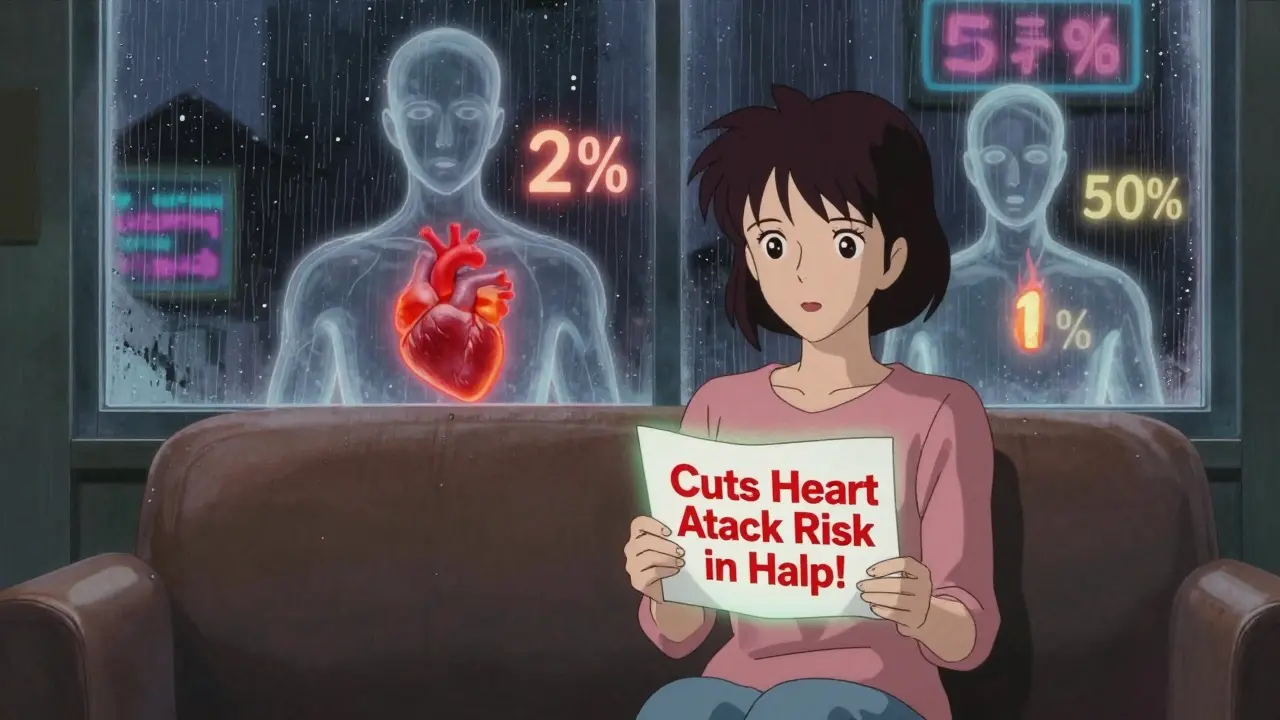
When you hear a drug ad say it "cuts your risk of heart attack in half," it sounds powerful. But what does that really mean? If your risk was 2% to begin with, cutting it in half means it drops to 1%. That’s a real benefit - but it’s not the dramatic change it sounds like. This is the gap between absolute risk and relative risk, and understanding the difference can change how you think about medications - and whether you take them.
What Absolute Risk Really Tells You
Absolute risk is the actual chance something will happen. If 1 in 100 people get a certain side effect, that’s a 1% absolute risk. Simple. Direct. No math needed. For example, if 10 out of 1,000 people on a drug develop liver problems, the absolute risk is 1%. This number doesn’t change based on comparisons - it’s just the real-world likelihood.
Doctors use absolute risk to make decisions because it shows what actually happens to people. If a drug lowers the chance of a stroke from 4% to 3%, that’s a 1 percentage point drop. That’s the absolute risk reduction. It’s small, but meaningful if you’re one of those people. For someone with high blood pressure and a history of smoking, a 1% reduction might be worth it. For someone with no risk factors, it might not be.
Think of it this way: absolute risk answers, "How likely am I to get this side effect or benefit?" It’s grounded in your own body and your own life.
What Relative Risk Makes You Believe
Relative risk compares two groups: people on the drug versus people not on it. It’s a ratio. If the risk of a side effect is 2% in the control group and 4% in the drug group, the relative risk is 2 (4% ÷ 2% = 2). That means you’re twice as likely to have the side effect. But here’s the trap: a 100% increase sounds huge - even if the actual difference is tiny.
Take sexual dysfunction from an antidepressant. One study found 20% of people on venlafaxine had this side effect, compared to 8.3% on placebo. The relative risk is 2.41 - meaning you’re 2.41 times more likely to experience it. Sounds scary, right? But the absolute difference is just 11.7 percentage points. That’s 12 out of 100 people - still a real concern, but not the overwhelming majority the relative number suggests.
Pharmaceutical companies love relative risk because it makes benefits look bigger. A drug that reduces heart attack risk from 2% to 1% has a 50% relative risk reduction. That’s the number you’ll see on TV. But the absolute reduction? Just 1%. That’s not nothing - but it’s not a miracle cure either.
Why Both Numbers Matter - And Why One Isn’t Enough
Using only relative risk is like saying, "I doubled my savings!" - without telling you I went from $5 to $10. The percentage sounds impressive. The reality? Not life-changing.
Here’s another example: a drug reduces cancer risk from 0.75% to 1.25% after radiation exposure. The relative risk increase is 67% - a scary headline. But the absolute increase? Just 0.5 percentage points. That’s 5 extra cases per 1,000 people. For most, the benefit of radiation outweighs this tiny added risk. But without the absolute number, you’d panic.
Experts like Dr. Steve Woloshin and Dr. Lisa Schwartz from Dartmouth say: always start with absolute numbers. Then add relative risk for context. The FDA now requires both in clinical trial summaries - though enforcement is uneven. The European Medicines Agency is stricter. In the U.S., many ads still hide the absolute numbers.
What About Number Needed to Treat (NNT)?
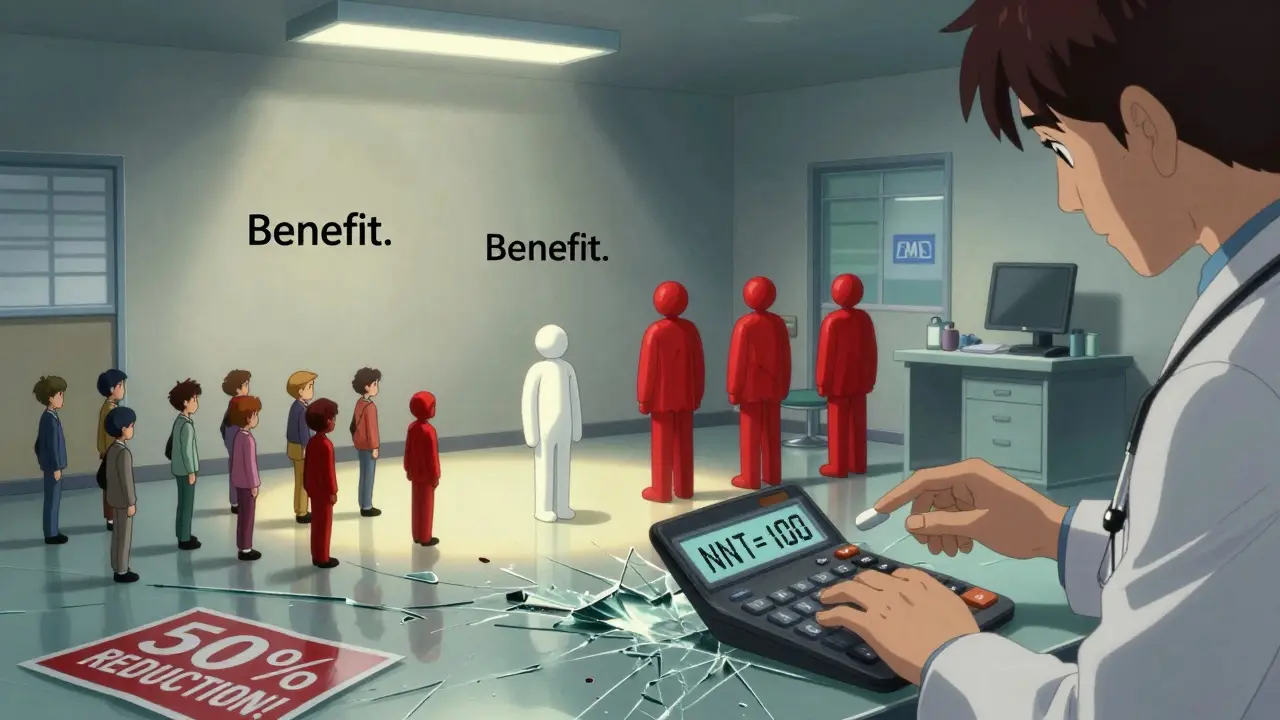
Here’s a practical tool: Number Needed to Treat (NNT). It tells you how many people need to take a drug for one person to benefit.
If a drug reduces heart attacks from 4% to 3%, the absolute risk reduction is 1% (0.01). The NNT is 1 ÷ 0.01 = 100. That means 100 people need to take the drug for one person to avoid a heart attack. The other 99? They get no benefit - but might still face side effects.
Compare that to a drug with an NNT of 5. That’s powerful. You’re helping 1 in 5 people. That’s worth taking. But if the NNT is 50 or 100? You’re trading a small chance of benefit for a real chance of side effects. That’s a decision you should make with full information.
How Ads Trick You - And How to Spot It
A 2021 study found 78% of direct-to-consumer drug ads in the U.S. highlighted relative risk reduction without showing absolute numbers. They’ll say: "Reduces risk of stroke by 40%!" - but never say: "From 1.5% to 0.9%."
Here’s how to check:
- If they say "reduces risk by X%" - ask: "Reduced from what?"
- If they say "cut your risk in half" - calculate: what was your starting risk?
- Look for phrases like "relative to placebo" - if they’re missing, they’re hiding the baseline.
One Reddit user shared: "I refused statins because I read it "cuts heart attack risk in half." Then I learned my risk was 2% - so it went to 1%. I still took them, but now I know why. I didn’t want to take a pill for a 1% change."
That’s the real story. Not fear. Not hype. Just numbers.
How Patients Get It Right
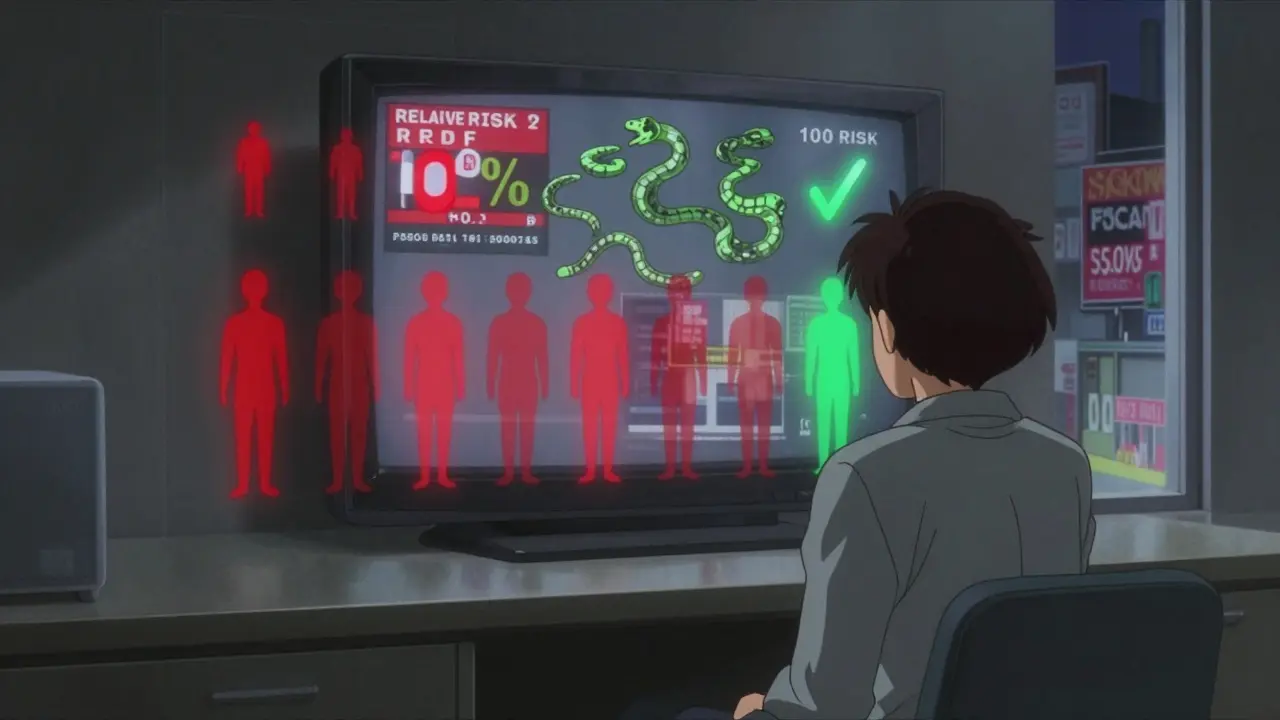
Some clinics now use visual tools. Picture 100 people. Color in how many get the side effect or benefit. One study showed that with pictograms, 62% of patients understood their risk - compared to only 8% who understood relative risk alone.
A patient named Mrs. Smith was told a drug reduced her risk of blood clots by 50%. She was ready to say no. Then her doctor showed her: "Out of 100 people like you, 4 get clots without the drug. With it, 3 do. So one person out of 100 benefits." She agreed to take it.
That’s communication that works.
What You Should Do Next
When your doctor talks about a drug’s benefits or risks:
- Ask: "What’s my absolute risk of this problem without the drug?"
- Ask: "How much does the drug lower that risk?"
- Ask: "What’s the chance I’ll get a side effect?"
- Ask: "How many people need to take this for one to benefit?" (NNT)
If they can’t answer, ask for a written fact sheet. Most drug manufacturers are required to include both absolute and relative risks in the patient information leaflet - even if the ad doesn’t.
And if you’re researching online? Always look for the baseline. If they only say "50% reduction," dig deeper. Find the original study. Check the control group numbers. You’re not being paranoid - you’re being smart.
Why This Matters Beyond Pills
This isn’t just about drugs. It’s about how we understand risk in general. Cancer screenings, vaccines, surgery - all use these same numbers. Misunderstanding them leads to unnecessary fear or false confidence.
After the Fukushima nuclear accident, headlines screamed: "Cancer risk increases by 70%!" But the actual risk went from 0.75% to 1.25%. That’s not a crisis - it’s a small, measurable change. Without the absolute number, people made panicked decisions.
The same applies to medications. You deserve to know what the numbers really mean - not what the ad wants you to believe.
What’s the difference between absolute risk and relative risk?
Absolute risk is the actual chance of something happening - like a 2% chance of having a heart attack. Relative risk compares two groups - for example, "this drug cuts your risk in half," meaning your risk went from 2% to 1%. Absolute risk tells you what’s real. Relative risk tells you how much better or worse something is compared to something else.
Why do drug ads only talk about relative risk?
Because relative risk numbers are bigger and sound more impressive. A 50% reduction sounds better than a 1% reduction - even though they’re the same thing. It’s not deception - it’s marketing. But it’s misleading if you don’t know the baseline.
How do I find the absolute risk for a drug?
Check the patient information leaflet that comes with the drug. It’s required by law in most countries. You can also search for the drug’s clinical trial data on the FDA or EMA websites. Look for phrases like "control group" and "experimental group" - the difference between those numbers is the absolute risk reduction.
What is Number Needed to Treat (NNT), and why should I care?
NNT tells you how many people need to take a drug for one person to benefit. If the NNT is 10, 10 people take it and one benefits. If it’s 100, 99 people take it for no benefit - but still risk side effects. A low NNT means the drug helps many people. A high NNT means it helps very few. It’s a quick way to judge if the trade-off is worth it.
Can I trust my doctor if they only give me relative risk?
Some doctors do - often because they’re rushed or never learned to interpret these numbers themselves. A 2019 study found 60% of physicians couldn’t convert relative risk to absolute. If your doctor can’t explain the absolute numbers, ask for a written summary or seek a second opinion. You’re not being difficult - you’re being informed.
If you’re deciding whether to take a new medication, don’t rely on ads or headlines. Ask for the real numbers. Write them down. Compare them. Your health isn’t a statistic - but understanding the stats can save you from unnecessary fear - or unnecessary risk.

Christina VanOsdol
I just read a drug ad that said this medication cuts stroke risk in half!!! 🤯 I was about to sign up until I looked up the numbers... turns out my baseline risk was 0.8% so now it's 0.4%. Like... cool? I guess? Still took it but now I side-eye every pharmaceutical commercial. 😅
Brooke Exley
This is the kind of clarity we NEED more of. Seriously. I used to panic over every side effect until I learned about absolute risk. Now I ask my doctor: 'What's my number?' Not 'Is this scary?' But 'How many out of 100 people like me actually benefit?' That shift changed everything. You're not just a patient-you're a decision-maker. And that's powerful. 💪
Matthew Brooker
The NNT concept is the real game changer. I work in primary care and I started using it with patients. One guy said 'So 100 people take this and only one benefits?' I said 'Yep. But that one is you if you're the one who avoids the heart attack.' He took it. No hype. Just math. That's how you build trust.
Joseph Cantu
They’re all lying. Every single one. Big Pharma knows you won’t dig deeper. They hide the 1% absolute risk and scream 50% reduction. It’s manipulation. I stopped taking all meds after learning this. Vaccines too. Why? Because if they can twist numbers like this for statins, what are they hiding on the flu shot? The system is rigged. You’re being sold snake oil wrapped in science.
Jacob Carthy
This is why we need to stop trusting these fancy science articles. You want real numbers? Look at the VA data. They don't sugarcoat it. Most of these drugs help less than 5% of people. Meanwhile the side effects? Real. I'm not taking a pill for a 1% chance when I can just eat better and walk more. America's too lazy to live right so they push pills. Wake up.
Bhaskar Anand
In India, we don't have the luxury of choosing based on 1% risk reduction. We take what works. If a drug lowers heart attack risk even slightly, and it costs $2 a month, we take it. You Americans overthink everything. Your problem isn't the numbers-it's your privilege. Most of the world would kill for a 0.5% reduction in mortality. Stop whining and take the pill.
David McKie
I’ve been a clinical researcher for 18 years. Let me tell you-the FDA’s requirements are a joke. Companies bury absolute risk in footnotes. I’ve seen trials where the relative risk reduction was 40%... but the absolute difference was 0.3%. That’s not medicine. That’s a marketing campaign disguised as science. And they wonder why people don’t trust doctors? It’s because we’re complicit.
Southern Indiana Paleontology Institute
I read this and thought wow this is so important but then i remembered my cousin took a drug that cut his risk of something in half and he had a heart attack anyway so maybe the numbers dont matter? like what if you just dont get lucky? i mean like if you're the one in 100 who gets the side effect or the one in 100 who still has the event... then the stats dont help you at all. so why even bother? just live your life and dont stress.
Anil bhardwaj
I used to think this was just math nonsense. Then my mom got prescribed a blood thinner. Doctor said it "reduces risk by 60%." She said no. I pulled up the numbers. Baseline risk: 1.2%. After drug: 0.48%. NNT: 125. We didn't take it. She's fine. No clot. No bleed. Sometimes the best treatment is knowing when not to treat.
lela izzani
I work in patient education. We use pictograms now. 100 squares. Color the ones who benefit. Color the ones who get side effects. Suddenly, it clicks. One woman said, "So I'm one of the 97 who gets nothing?" I said, "Yes. But you also didn't get the side effect. That's a win too." It's not about fear. It's about knowing your own story. That's the power of absolute numbers.